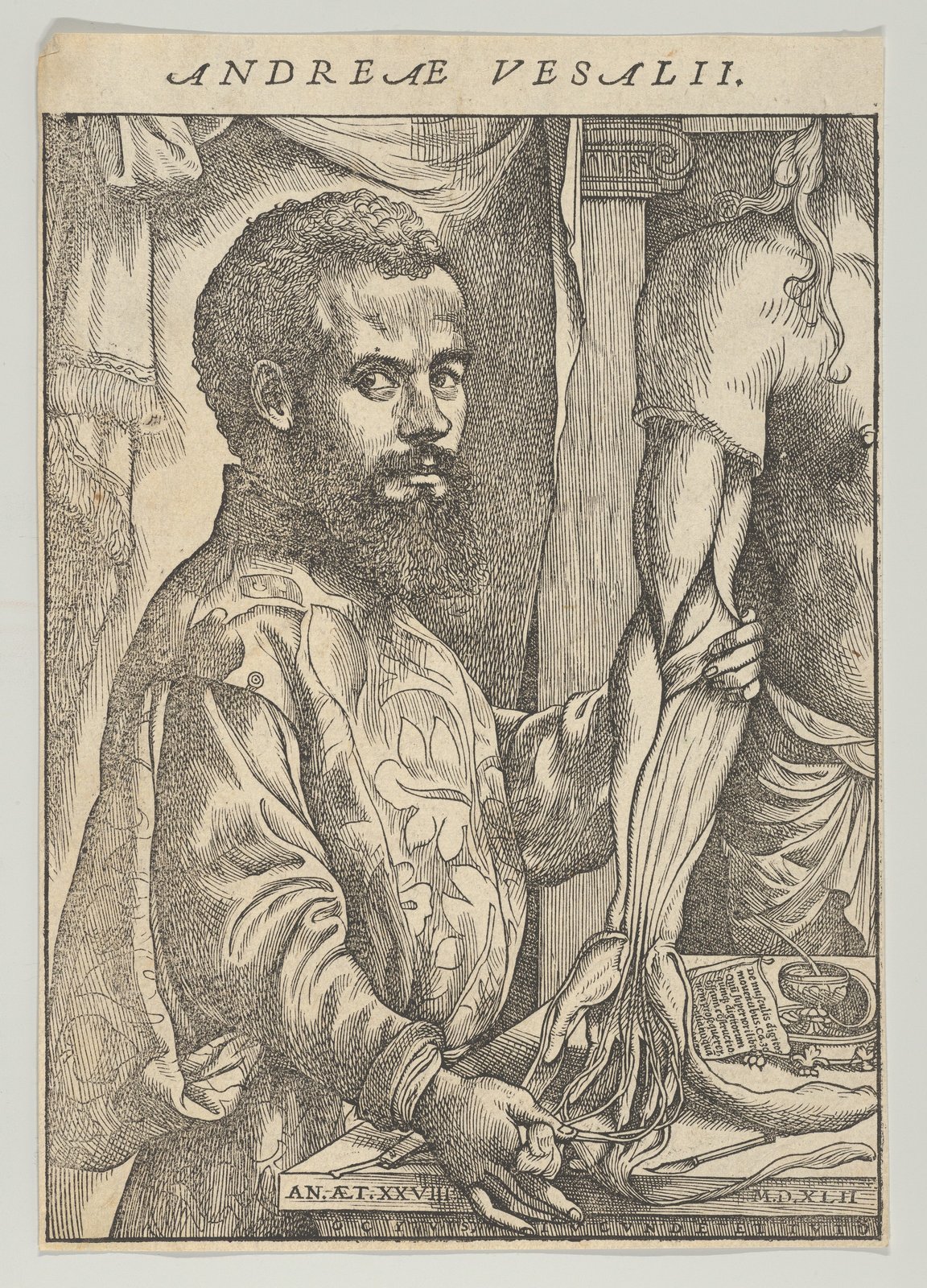

Portrait of Andreas Vesalius, woodcut dated 1542 (inscribed 'AN. AET. XXVIII', age 28), attributed to John (Jan Stephan) of Calcar; Metropolitan Museum of Art, Gift of Richard Day, 1980 (1980.1001) · The Metropolitan Museum of Art, New York, Drawings and Prints, accession 1980.1001 (Gift of Richard Day, 1980), impression of the portrait leaf of De humani corporis fabrica (Basel, 1543), Open Access image DP853465, downsized from 2658 x 3693 px Classified as a historical depiction: a woodcut by an unknown cutter after Calcar, and no source states it was drawn from life. · Public domain / Met Open Access (CC0); sixteenth-century woodcut, Met Open Access API reports isPublicDomain true and no rightsAndReproduction notice
해부학자 · 근세
안드레아스 베살리우스
1514–1564
주요 업적 분야
아직 성격 매칭에 포함되지 않았습니다 — 기록된 근거가 성격 모델 전체를 다루기에는 충분하지 않습니다. 이 페이지의 다른 모든 내용은 자유롭게 확인하실 수 있습니다.
핵심 특성
주요 업적
베살리우스는 1543년 바젤에서 『인체의 구조에 관하여(De humani corporis fabrica)』를 펴냈다. 요하네스 오포리누스(Johannes Oporinus)가 인쇄했고 카를 5세에게 헌정되었다. 이 책은 일곱 권으로, 뼈와 연골, 인대와 근육, 정맥과 동맥, 신경, 영양·생식 기관, 심장과 폐, 뇌와 감각기관을 다루며, 본문 옆에 큰 목판 삽화를 배치했다. 같은 해 학생용 요약본 『에피토메(Epitome)』도 나왔다. 삽화는 전통적으로 티치아노 문하의 얀 스테판 판 칼카르(Jan Stephan van Calcar)의 작품으로 알려져 있다.
베살리우스는 해부를 근거로 갈레노스가 사람이 아니라 원숭이의 몸을 기술했다고 주장했다. 『파브리카』에서 그는 흉골이 일곱 조각이 아니라 세 부분으로 이루어져 있고, 아래턱뼈는 하나이며, 사람에게는 기이한 그물(rete mirabile)이 없고, 신경은 속이 비어 있지 않다는 점 등을 바로잡았다. 1543년판은 심장 중격의 보이지 않는 구멍으로 피가 통한다고 여전히 말했지만, 1555년 제2판에서는 감각으로 알 수 있는 한 중격을 통과하는 피는 없다고 썼다.
베살리우스는 1537년 12월 파도바 대학에서 외과학과 해부학을 가르치게 되었다. 당시 해부학은 교수가 책을 읽는 동안 이발외과의가 시신을 자르는 방식이 보통이었지만, 그는 직접 해부하며 강의했다. 1538년에는 학생용으로 큰 판형의 인쇄 도판 여섯 장 『해부학 도판 여섯 장(Tabulae anatomicae sex)』을 냈고 그림은 칼카르의 이름으로 기록되어 있다. 1540년에는 볼로냐에서 해부 시연을 했으며, 학생 발다자르 헤젤러(Baldasar Heseler)가 이를 노트에 기록했다.
삶의 장면들
1530년대 파리에서는 교수가 갈레노스를 읽는 동안 이발외과의가 시신을 자르는 방식으로 해부학을 가르쳤다. 베살리우스가 직접 밝힌 이야기를 전기 작가 제임스 볼(James Ball)이 전하는 바에 따르면, 그는 직접 칼을 잡고 복부 장기와 팔 근육을 체계적으로 해부했다. 파리의 교수 요하네스 귄터(Joannes Guinterius)는 1539년 베살리우스를 해부학에 '남다른 열의'를 가진 청년이라 쓰며, 함께 근육과 정맥, 동맥, 신경을 조사했다고 적었다.
교수들이 하지 않던 일을 기회가 오기를 기다리지 않고 스스로 맡은 것은 주도적 행동성과 부합한다. 주된 서술은 베살리우스 자신의 이야기를 옛 전기 작가가 전한 것이며, 귄터의 1539년 언급이 독립적으로 이를 뒷받침하는 유일한 증거다. 선제적 행동력
1561년 가브리엘레 팔로피오(Gabriele Falloppio)는 베살리우스를 높이 평가하면서도 그의 오류를 바로잡는 『해부학 관찰(Observationes anatomicae)』을 냈다. 베살리우스는 마드리드에서 이에 답하는 글을 썼고, 이 글은 1564년 베네치아에서 출간되었다. 비비언 넛턴(Vivian Nutton)에 따르면 어조는 정중했다. 베살리우스는 피의 흐름을 조절하는 정맥 섬유가 있다는 자신의 믿음에 대한 팔로피오의 비판을 받아들였고, 치아에 관한 설명을 매우 반겼으며, 눈꺼풀을 올리는 근육과 세 번째 귀속뼈를 다른 사람들이 발견했음을 인정하고 귀속뼈는 직접 해부로 확인했다고 덧붙였다.
젊은 해부학자의 정정을 받아들이고 다른 사람들의 발견을 인정한 것은 믿음 갱신과 부합한다. 넛턴은 이를 1555년 주석에서 우선권 문제를 조용히 처리한 방식과 대비하므로, 이것이 그의 일관된 행동 방식이었다고 할 수는 없다. 입장 수정 성향
전환점
이탈리아를 떠나 궁정으로 향할 때, 베살리우스는 궁정 의사들이 자신의 책을 혹독하게 평가한 뒤 갈레노스에 관한 자신의 주석, 강의에 쓰던 갈레노스 책, 라지(Rhazes)의 『알만소르』를 더 충실히 풀어 쓴 글, 약 처방 자료를 불태웠다. 1546년의 편지에서 그는 '글쓰기를 어느 정도 자제하려는 뜻으로' 그렇게 했고 자주 후회했으며 친구들이 말렸다고 썼다. 넛턴은 팔로피오에게 보낸 답을 그가 1555년 이후 낸 유일한 출판물로 기록한다.
적대적 평가를 받은 뒤 자신의 주석을 불태운 일은 공개 논쟁에 머무는 한계가 있었음과 부합하지만, 같은 편지에서 그는 실비우스에 맞서 자신의 연구를 변호한다. 이 서술은 본인의 것이며 사건으로부터 2~3년 뒤에 쓰였다. 갈등 감내
비슷한 인물
전체적인 프로필이 이 사람과 닮은 사람들이에요.
출처
- Andreas Vesalius (Q170267) -- verified live via wbgetentities (2026-10-08): en label 'Andreas Vesalius', description 'Flemish anatomist, physician and author (1514-1564)', died 16 Oct 1564, instance of human, ko label '안드레아스 베살리우스', P18 'Vesalius Fabrica portrait.jpg'. Orientation only; not used as support for any row.
- Vivian Nutton (historian of medicine, UCL), 'Vesalius Revised. His Annotations to the 1555 Fabrica', Medical History 56(4), 2012, open-access full text on PubMed Central -- INDEPENDENT scholarly study of Vesalius's own heavily annotated copy of the 1555 edition, prepared for a never-published third edition; admiring of his precision but openly critical of how he handled credit to contemporaries and of the 'brash young man in a hurry' of 1543. Read in full (text, footnotes not read).
- A. H. Compier (Leiden), 'Rhazes in the Renaissance of Andreas Vesalius', Medical History 56(1), 2012, open-access full text on PubMed Central -- INDEPENDENT scholarly article that reads Vesalius's early Paraphrasis of Rhazes (1537), his 1539 bloodletting letter, the Fabrica preface and his 1546 letter on the China root (long passages translated, including his own account of burning his notes). Read the introduction, the sections on the 1537 Paraphrasis, the 1538-1546 development and the discussion of the 1546 letter; the closing speculation about Rhazes's possible influence on his criticism of Galen was skimmed only.
- F. Zampieri, M. ElMaghawry, A. Zanatta and G. Thiene (University of Padua), 'Andreas Vesalius: Celebrating 500 years of dissecting nature', Global Cardiology Science and Practice 2015, open-access full text on PubMed Central -- ADMIRING Padua-based review for the 500th anniversary, quoting the Fabrica preface and the 1543 and 1555 passages on the heart septum; relies on O'Malley (1964) and Cushing (1962). Read in full (figure captions skimmed).
- James Moores Ball, 'Andreas Vesalius, the Reformer of Anatomy' (St. Louis, 1910), Internet Archive scan -- OLD POPULAR biography by an American physician, admiring and partly romantic (it repeats the pilgrimage legend and some embellished anecdotes, which are not used here); useful for the structure of the Padua courses, the contents of the Fabrica book by book, the Tabulae of 1538, and the quarrels with Sylvius and Colombo. Read chapters 4-15 (early life to death); the opening chapters on ancient and medieval anatomy were skimmed.
- Moritz Roth, 'Andreas Vesalius Bruxellensis' (Berlin, 1892), Internet Archive scan (German, poor OCR) -- standard archival biography of the 19th century. Read only the passages on Vesalius's departure from Italy and the burning of his notes (pp. 189-191, with the Latin of his 1546 letter in the footnote) and on Jacobus Sylvius's attacks on Vesalius (pp. 227-230); the remaining ~500 pages were not read.
- Gabriele Falloppio (Italian anatomist and Vesalius's junior contemporary, who taught at Pisa and Padua), 'Observationes anatomicae' (Venice, 1561/1562), digitised Wellcome copy at the Internet Archive (Latin) -- CONTEMPORARY respectful critic of Vesalius; read the author's preface and opening pages (his statement of how he came to side with Vesalius and where he thought Vesalius went wrong) and located the many later passages that name Vesalius; the anatomical body of the book was not read.
- M. H. Spielmann, 'The Iconography of Andreas Vesalius' (London: Wellcome Historical Medical Museum, 1925), Internet Archive scan -- scholarly iconography with forewords by Arthur Keith and others; read the foreword and the chapter on the Fabrica woodcut portrait (authorship by Calcar's drawing, Vesalius's reuse of the block in several works); the catalogue of painted portraits was skimmed.
- P. Krishnan and S. Nag, 'Historical Vignette: Andreas Vesalius and Head Injuries in Royalty', Asian Journal of Neurosurgery 2021, open-access full text on PubMed Central -- short secondary vignette of Vesalius's involvement in the 1559 Henri II and 1562 Don Carlos head-injury cases; rests on Norwich, Kean and others. Read in full.
- J. Xiang and S. Venkatesan (Imperial College London), 'The role of Vesalius and his contemporaries in the transfiguration of human anatomical science', Journal of Anatomy 2023, open-access full text on PubMed Central -- student-level secondary review; some details are loose (e.g. the places where Falloppio held his posts) and are not relied on. Used only for its quotations of the 1540 Bologna student notes of Baldasar Heseler and of Sylvius's 1551 pamphlet. Read in full.
- The Metropolitan Museum of Art, object 1980.1001 (Gift of Richard Day, 1980): woodcut 'Portrait of Andreas Vesalius, half-length ... frontispiece to De humani corporis fabrica libri septem', John of Calcar, dated 1542, Open Access (public domain flag true in the Met Open Access API, no rights notice) -- institutional record of the portrait leaf; used only for the portrait chain, not for any row.