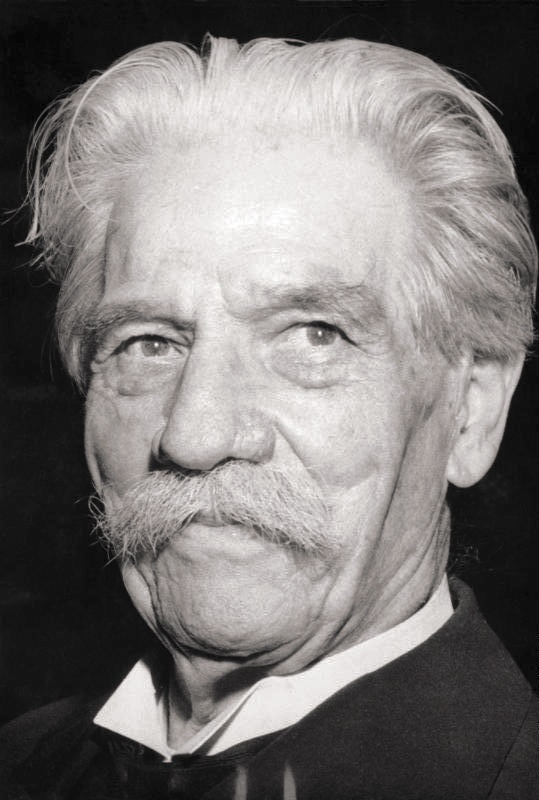

Bundesarchiv, Bild 183-D0116-0041-019 / CC-BY-SA 3.0 · Wikimedia Commons 'Bundesarchiv Bild 183-D0116-0041-019, Albert Schweitzer.jpg': Zentralbild press photograph, photographer unknown, 1955, supplied to Commons by the German Federal Archive (Bundesarchiv) under CC BY-SA 3.0 DE. Saved at the original 539 x 800 pixels with no resizing or upscaling. · CC BY-SA 3.0 DE
의사 · 20세기
알베르트 슈바이처
1875–1965
주요 업적 분야
아직 성격 매칭에 포함되지 않았습니다 — 기록된 근거가 성격 모델 전체를 다루기에는 충분하지 않습니다. 이 페이지의 다른 모든 내용은 자유롭게 확인하실 수 있습니다.
핵심 특성
주요 업적
의학 학위를 받은 뒤 1913년 가봉 랑바레네에 병원을 세워 평생 대부분을 그곳에서 보내며 약 70동 규모로 키웠다. 노벨재단에 따르면 그는 노벨 평화상 상금으로 그곳에 나병 요양 시설을 세웠다.
1906년 『역사적 예수의 탐구』(The Quest of the Historical Jesus)에서 기존의 예수 전기들이 저자들의 자유주의적 이상을 투영했다고 논증해 성서 비평의 대표 저작을 남겼고, 이후 '생명에 대한 경외' 윤리를 정립했다.
국제적으로 알려진 오르가니스트이자 바흐 연구자로서 바흐 전기(1905)와 오르간 제작·연주에 관한 책(1906)을 썼고 바흐 오르간 작품 전 8권 편집에 착수했다. 연주 활동은 의학 공부와 병원 운영 자금에 보탬이 되었다.
삶의 장면들
독일 국적자로 억류되었다가 1924년 랑바레네로 돌아온 슈바이처는 병원이 낡고 일부가 밀림에 잠식된 것을 보고 상류에 새로 지었다.
이는 차질을 겪고도 사업을 이어 가려는 꾸준한 노력과 일치한다. 끈기
1964년 서평에서 코너 크루즈 오브라이언은 교육받은 아프리카인들이 슈바이처에게서 변화에 대한 저항을 보았다고 전했고, 제럴드 맥나이트의 설명을 빌려 그가 '소박한 사람들'이 현대적 병원에 오지 않으리라 믿어 랑바레네를 현대화하지 않았다고 소개했다.
이는 그가 방식을 바꾸는 데 더뎠다는 비판과 일치하지만, 날짜가 특정된 사건이 아니라 비판적 논평이다. 입장 수정 성향
전환점
1905년 이미 신학 교사·설교자·오르가니스트였던 슈바이처는 아프리카에서 봉사하기 위해 스트라스부르에서 의학 공부를 시작했고, 연주회와 강연으로 학비를 마련했다.
이는 봉사를 향한 의도적인 진로 전환과 일치한다. 영향 창출 동기
비슷한 인물
전체적인 프로필이 이 사람과 닮은 사람들이에요.
출처
- Albert Schweitzer (Q49325) -- verified live via the Wikidata API (2026-10-24): English label 'Albert Schweitzer', description 'French-German physician, theologian, musician, and philosopher (1875-1965)', born 1875-01-14, died 1965-09-04, nationalities Germany and France, Korean label '알베르트 슈바이처'. Orientation only; not used as support for any row.
- Nobel Foundation, 'Albert Schweitzer - Biographical' (nobelprize.org, written at the time of the 1952 Peace Prize award), read in full: Alsatian family of ministers, teachers and organists; doctorate in philosophy 1899 (Kant) and theology licentiate 1900 at Strasbourg; The Quest of the Historical Jesus (1906) on which 'much of his fame as a theological scholar rests'; internationally recognised concert organist who funded his medical schooling and hospital with his engagements; a Bach biography (1905, rewritten in German 1908) and a book on organ building (1906); MD 1913 and founding of the Lambaréné hospital; internment 1917-18; return in 1924, hospital expanded to seventy buildings and over 500 patients; the prize money (withheld in 1952, presented December 1953) used to start a leprosarium. CANONICAL SIGNIFICANCE SOURCE. Award-body biography, admiring and contemporary.
- Encyclopedia.com, 'Schweitzer, Albert (1875-1965)' (reference entry on philosopher, theologian, musicologist and humanitarian physician, with a companion entry on his ethics), read in full: ability to excel in philosophy, theology and music before choosing medicine; his Quest of the Historical Jesus 'devastated the reputation of many predecessors' by arguing that earlier lives of Jesus projected their own liberal ideals, and found a permanent place in biblical criticism; the reverence-for-life idea that came to him on the Ogooué river in 1915; the hospital administration described as 'often arbitrary, patriarchal, and paternalistic' and his attitude toward Africans as condescending to the point of being called racist by critics, yet he gained and held credentials by serving the suffering; points to the Marshall and Poling and Brabazon biographies, which were NOT opened. Independent reference writing, mixed in tone.
- Albert Schweitzer Centre (Maison Albert Schweitzer, Günsbach), 'The organist' timeline page (schweitzer.org, text by Benoit Wirrmann, Les Saisons d'Alsace, February 2013), read in full: teachers Eugene and Ernest Munch, Charles-Marie Widor and Marie Jaell; the 450-page 1905 Bach book 'J.S. Bach, le musicien-poete' and the almost twice-as-long 1908 German rewrite; the annual 28 July Bach memorial concert at St Thomas Strasbourg from 1909; the eight-volume Schirmer edition of Bach's organ works begun in 1912 and finished fifty years later with Edouard Nies-Berger; his 1906 organ-building treatise and role in the 1909 Vienna organ congress; the Silbermann organ campaign and advice that was often ignored; taking a pedal piano to Gabon to practise for fund-raising concerts; and the note that he is criticised today for slow organ tempi (Nabokov's Volkswagen-to-Porsche remark). Institution run by his admirers, but it records criticism.
- Dictionary of African Christian Biography, 'Schweitzer, Albert' (dacb.org; reproduced from An African Biographical Dictionary, ed. Norbert C. Brockman, 1994), read in full: Strasbourg doctorates, the 1905 Bach book and 1906 Quest; the 1905 turn to medicine; the 1913 departure to Gabon under the Paris Mission; 1917-18 internment; return in 1924 to a hospital 'decayed and partially reclaimed by the jungle' and its rebuilding upstream; a simple hospital in which families lived with patients, which he saw as early appropriate technology; staff of 30-40 doctors supported partly from his Bach recordings and recitals; his approach described as autocratic and paternalistic with a low expectation of Africans' intellectual capability, yet respectful to patients and workers; reverence for life 'not absolute' and his 1950s nuclear-testing opposition framed by effects on plant and animal life. Reference work on African Christianity; the most direct treatment of his mission-field conduct among the sources read.
- Conor Cruise O'Brien, 'The Schweitzer Legend' (The New York Review of Books, 20 August 1964; review of Gerald McKnight's 'Verdict on Schweitzer'), read in full: reports that educated Africans and Afro-Americans, with few exceptions, saw in Schweitzer paternalism, condescension and resistance to change; Dr Davidson Nicol (Principal of Fourah Bay College) criticising Schweitzer's writings on Africa in Ghana; claims that he kept Lambaréné unmodernised because he believed 'simple people' would not come to a modern hospital, a view O'Brien says was disproved by other African hospitals; also sharply criticises McKnight's own hostile method and innuendo about his private life, which was not used. Contemporary critical review; counter-voice, with the reviewer's own bias stated in the text.
- Ruth Harris (New College, Oxford), 'Schweitzer and Africa' (The Historical Journal 59(4), 2016), abstract and footnotes read; the article body was behind the publisher's reader and was NOT opened. Abstract: Schweitzer was 'strangely indifferent' to African culture and never learned native languages; his service was grounded in a Nietzschean rejection of European conventionalities and a desire to develop his 'ethical personality'; his village-hospital, where the sick came with their families, treated people effectively but after the First World War became more hierarchical and de-personalised; the experiment was 'radical and conformist, daring and self-protectively conservative'; he stands out less for therapeutic innovations than for his later reverence-for-life ethics. Footnotes cite staff accounts of the authoritarian running of the hospital. Scholarly critical historian; abstract-level only.
- University of Bern, Institute for the History of Medicine, 'Lambarene Hospital 1913-1965' research project page and project summary (Swiss National Science Foundation project 2013-2019; investigators Hubert Steinke and Hines Mabika), read in full: a first thorough historical study based on thousands of patient records, correspondence, notebooks and photographs; questions the 'alleged stagnation of medical and hygienic standards' and the role of religion and authority; examines Schweitzer's promotional strategy; aims to be a counterweight to the popular perception of him as a humanitarian giant or a paternalistic racist; lists Tizian Zumthurm's 2020 Brill volume (NOT opened: the open-access PDF was blocked by a bot check). Academic project description rather than findings.
- Howard Markel (University of Michigan Center for the History of Medicine), 'Dr. Albert Schweitzer, a renowned medical missionary with a complicated history' (PBS NewsHour, 14 January 2016), read in full: summary of his life and hospital growth (more than 2,000 patients in nine months, 70 buildings by his death); his 1950s joint appeals with Einstein, Hahn, Russell and others against nuclear weapons; quoted remarks such as 'The African is indeed my brother, but my junior brother' that the author calls paternalistic and a contradiction of his reverence for life, while noting that remarks like these were common in the colonial era and that he devoted more than half a century to patients few colleagues would serve. Some dates differ from the Nobel biography, so the column is used only for the critical framing and quotations. Journalism by a medical historian.
- Singapore Medical Journal (PubMed Central), 'Albert Schweitzer (1875-1965): A reverence for life' biographical article, read in full: his turn to medicine after reading a Paris Mission article about the need for physicians in Gabon, financing his medical studies with concerts and lectures, the mission society's initial rejection and his agreement to raise his own two years of funds, internment in 1917, return in 1924; the account of his temper and demand for obedience among staff; detractors' criticism of autocratic management, outdated methods, unsanitary conditions and the free-roaming animals; Norman Cousins' admiring assessment. Medical-journal biography, largely admiring but records criticisms.
- Wikimedia Commons file page and API record 'Bundesarchiv Bild 183-D0116-0041-019, Albert Schweitzer.jpg' (wikitext and image info), checked for the portrait's licence: Bundesarchiv (German Federal Archive) Zentralbild photograph, photographer unknown, 1955, supplied by the Bundesarchiv under the CC BY-SA 3.0 DE licence with the attribution line 'Bundesarchiv, Bild 183-D0116-0041-019 / CC-BY-SA 3.0'; original size 539 x 800. Not used for any scoring.