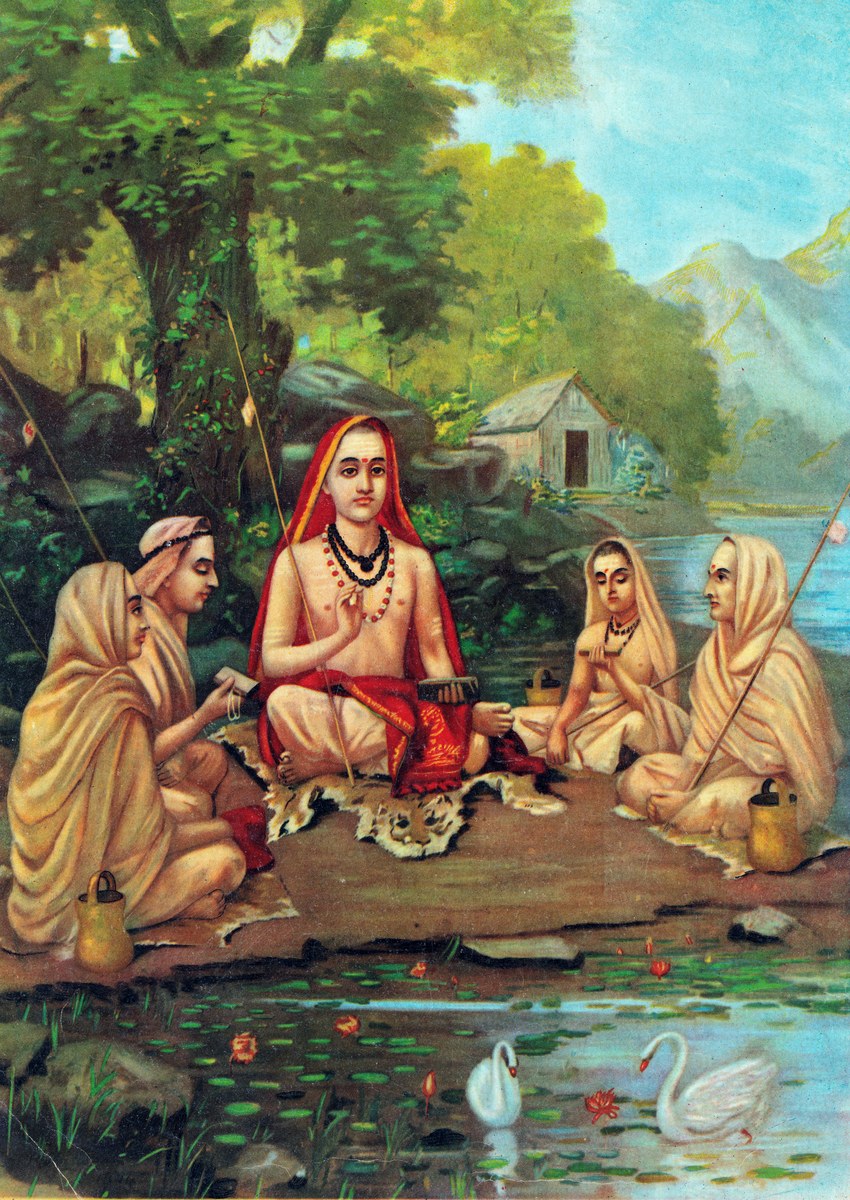
Raja Ravi Varma and Ravi Varma Press, Adi Shankaracharya, circa 1904, collection of The Ganesh Shivaswamy Foundation, Bengaluru, via Google Arts & Culture and Wikimedia Commons. · Colour oleograph print 'Adi Shankaracharya', Raja Ravi Varma and the Ravi Varma Press, circa 1904, 50 x 35 cm, showing him with four disciples, in the collection of The Ganesh Shivaswamy Foundation, Bengaluru (Google Arts & Culture item record) and reproduced on Wikimedia Commons from a 5146 x 7262 pixel scan. A later imagined devotional image made about eleven centuries after the sitter's traditional dates, so it is a depiction and not a likeness. The museum record states the print came from the Ravi Varma Press and was derived from a painting of Ravi Varma, and a Google Arts story cited in the research notes cautions that many Ravi Varma Press prints are not from Ravi Varma's own paintings; the creator is therefore credited to both. Public domain by age: the artist died in 1906 and a print published about 1904 in India is long out of copyright. Downscaled with no cropping to 850 x 1200; not upscaled. · Public domain (published c. 1904; artist died 1906)
철학자 · 중세
샹카라
788–820
주요 업적 분야
아직 성격 매칭에 포함되지 않았습니다 — 기록된 근거가 성격 모델 전체를 다루기에는 충분하지 않습니다. 이 페이지의 다른 모든 내용은 자유롭게 확인하실 수 있습니다.
주요 업적
브라흐마 수트라, 바가바드 기타, 주요 우파니샤드에 대해 현존하는 가장 이른 완결된 주석을 썼고, 이를 통해 불이일원론 브라만의 철학인 아드바이타 베단타를 체계화했다.
독립 저작인 『우파데샤사하스리(천 가지 가르침)』는 그의 작품으로 꼽히지만, 그의 이름으로 전해지는 수백 편의 다른 문헌에 대해서는 학자들이 저자 여부를 의심한다.
스탠퍼드 철학백과는 그를 아드바이타 베단타의 가장 권위 있는 철학자로 부르며, 전통은 그가 네다섯 곳의 수도원을 세웠다고 전하나 학자들은 이를 검증되지 않은 것으로 본다.
삶의 장면들
브라흐마 수트라 주석에서 그는 요가차라 관념론과, 그가 마디아마카의 입장이라 본 '본질적 근거는 없다'는 견해에 맞서 자신의 불이 존재론을 옹호했다.
이는 경전을 풀이하는 데 그치지 않고 다른 학파에 맞서 논증을 세운 사상가의 면모와 부합한다. 분석적 엄밀성
전환점
학자들은 그의 활동을 8세기로 보지만 그의 저술 외에 신뢰할 만한 생애 기록은 없으며, 『샹카라비자야』 전기들은 그가 죽고 수 세기 뒤에 쓰였다.
이는 생애의 기록된 사건보다 주로 저술에 의해 역사적 정체성이 정해지는 인물의 모습과 부합한다. 시스템적 사고
비슷한 인물
전체적인 프로필이 이 사람과 닮은 사람들이에요.
출처
- Ādi Shankara (Q180967) -- verified live via Wikidata (2026-10-30): English label 'Ādi Shankara', description 'An Indian philosopher and theologian who consolidated the doctrine of Advaita Vedanta and revitalized Sanskrit scholasticism', Korean label '샹카라', birth 788 and death 820 (traditional dates, year only), no citizenship value, P18 image 'Raja Ravi Varma - Sankaracharya.jpg'. Orientation only; not used as support for any row.
- Neil Dalal, 'Śaṅkara' (Stanford Encyclopedia of Philosophy, first published 4 October 2021), read in full for the life, works and method sections. CANONICAL SIGNIFICANCE SOURCE: it calls him one of the most widely known and influential Indian philosophers of the classical period and the most authoritative philosopher of Advaita Vedanta, says dates are disputed (788-820 CE by early scholars, 700-750 CE per Nakamura, late seventh to early eighth century per Potter), that there are no dependable historical records of his life beyond his works, that the Śaṅkaravijaya hagiographies were composed several centuries after his death, that he was a systematizer and not a founder, that his earliest complete extant commentaries cover the Brahma Sutras, the Bhagavad Gita and ten principal Upanishads plus the independent Upadeśasāhasrī, that hundreds of other attributed texts are of questionable authorship, and that he 'purportedly' established monastic orders and four or five monasteries. Scholarly university encyclopedia entry; the monastery and travel traditions are treated as unverified.
- Sangeetha Menon, 'Advaita Vedanta' (Internet Encyclopedia of Philosophy), history section read in full: that the Advaita tradition predates Śaṅkara and that he acknowledges it in his commentaries, that only Gauḍapāda and Govinda Bhagavadpāda have some historical certainty as earlier teachers, that scholars believe he lived in the eighth century, that his life 'as we understand from the digvijaya texts' is of almost superhuman quality, that his authorship of many attributed texts is established only for some, and that Mandana Miśra's version of Advaita differed from his. Peer-reviewed philosophy encyclopedia written by a professional philosopher; independent of the Stanford entry.
- INDOLOGY mailing list thread 'Works attributed to Śaṅkarācārya' (August 2018), messages by David Reigle, Johannes Bronkhorst and Michael Witzel, read in full: that S. K. Belvalkar considered 408 works attributed to Śaṅkarācārya and concluded that 24 were genuine, that Paul Hacker proposed criteria for authenticity, that Sengaku Mayeda tested the Kena Upanishad and Bhagavad Gita commentaries, that Gussner's stylometric study rejected fifteen of seventeen hymns, and that Ray and Sastri disagreed about the Dakṣiṇāmūrti hymn. Informal expert discussion among Sanskritists, used only to show that the authorship question is debated and with the named studies relayed second-hand; the original articles were not opened.
- Google Arts & Culture, 'Adi Shankaracharya' (Raja Ravi Varma and Ravi Varma Press, circa 1904), collection of The Ganesh Shivaswamy Foundation, Bengaluru, with the Wikimedia Commons file page for the same print, checked for the portrait only.