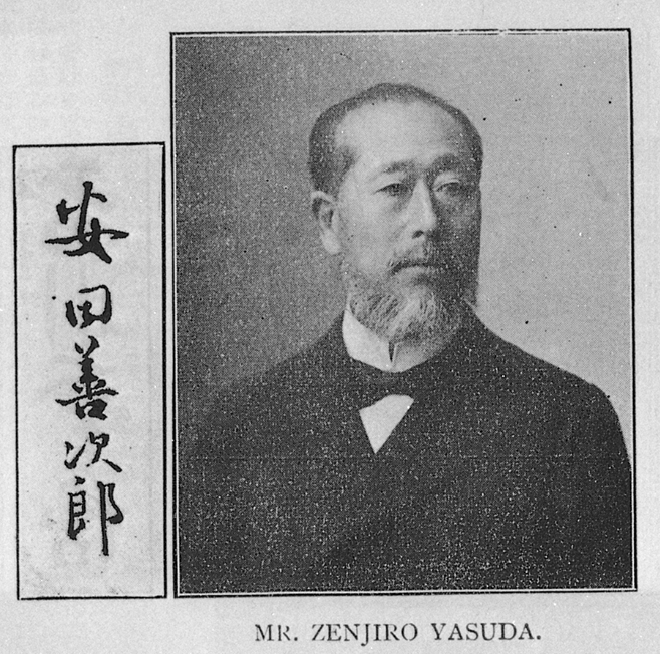

Photographer not named; image from the National Diet Library, Japan, Portraits of Modern Japanese Historical Figures · Studio portrait photograph of Yasuda Zenjiro with the printed caption 'MR. ZENJIRO YASUDA.' and his name in Japanese, shown in the National Diet Library's digital exhibition 'Portraits of Modern Japanese Historical Figures' (image 0343_2); matched to the bilingual biographical dictionary Dai Nihon Teikoku Kinsei Jinmei Jii (Tokyo: Horitsu Keizai Shinposha, 1910) by its caption and the page's source list. Original file 660 x 654 pixels, used without resizing. · Public domain: the National Diet Library states that all images in this digital exhibition are in the public domain and free to reuse; the likely source book was published in Japan in 1910 (before 1931)
Trait Constellation
Key Achievements
He turned a Tokyo money-changing shop, Yasuda-ya (opened in 1864), into the Yasuda Bank (1880), the core of the finance-centred Yasuda zaibatsu and a forerunner of Fuji Bank, now part of Mizuho.
He helped found the Third National Bank (1876), became a director of the Bank of Japan at its founding in 1882, built a bank network by taking over weaker banks, and expanded into life and property insurance.
He gave large sums to public institutions: the University of Tokyo's auditorium, completed in 1925 and now called Yasuda Auditorium, and the funds for Tokyo's Municipal Hall and Hibiya Public Hall, which his heir completed in 1929 after his death in 1921.
Moments That Reveal Them
In 1904, after the Russo-Japanese War, he rescued the Dai-130 Bank, and the company history says that when asked to help a troubled bank he proposed a 6 million yen government loan.
This is consistent with finding a workable financial remedy for a failing institution. Resourcefulness
He supported Tokyo's new municipal research body and the University of Tokyo auditorium with large gifts, and a Japanese encyclopedia says he disliked publicising his donations and was misunderstood as a result.
This is consistent with directing money to public institutions without seeking publicity. Impact Motivation
Turning Points
Between 1876 and 1880 he moved from running a money-changing shop to founding banks: he joined founding the Third National Bank in 1876 and opened the Yasuda Bank in 1880, the base for his later insurers and group.
This is consistent with deliberately building a larger institutional structure out of a small money-changing business. Planning Orientation
Similar People
People whose overall profiles resemble theirs.

Leo Tolstoy

Nelson Mandela

Confucius

Yi Sun-sin

Marie Curie
Opposite Profile
Not a rival — a different profile shape worth a look.
Elizabeth I of England
Sources
- Yasuda Zenjiro (Q3571972), verified live via the Wikidata API (2026-11-05): description 'Japanese businessman (1838-1921)', Korean label 야스다 젠지로, birth 25 November 1838, death 28 September 1921. Orientation only; not used as support for any row.
- National Diet Library, Japan, 'Portraits of Modern Japanese Historical Figures: YASUDA Zenjiro I' (English and Japanese biographical note written by NDL staff; read in full). CANONICAL SIGNIFICANCE SOURCE (with the encyclopedia entries below): founder of the Yasuda zaibatsu; apprenticed in Edo at 17; opened the money-changing shop Yasuda-ya in 1864; made money dealing in dajokan-satsu (government notes), government bonds and government deposits; helped found the Third National Bank in 1876; opened the Yasuda Bank in 1880; became a director of the Bank of Japan founded in 1882; expanded into life and property insurance; in later years donated the Yasuda Hall of the University of Tokyo and the Hibiya Public Hall. Institutional reference; neutral in tone but compressed.
- National Diet Library, Japan, 'Zaibatsu financial conglomerates and their leaders in the Meiji era' (digital exhibition feature page, read). Places Yasuda among founders who built their fortunes in one generation in the Meiji era, in contrast to Edo-period houses such as Mitsui and Sumitomo, and describes his zaibatsu as finance-based, with the Yasuda Bank that became Mizuho Bank.
- Kotobank (Japanese reference aggregator), entry 'Yasuda Zenjiro' collecting the Nihon Daihyakka Zensho (Nipponica), Sekai Daihyakka, Britannica Concise, Yamakawa Japanese History Dictionary, Nihon Jinmei Daijiten and other dictionary texts (all read in Japanese). Documents the 1864-1866 money-changing shop, profits from old coins and dajokan notes, the 1876 Third National Bank, the 1880 Yasuda Bank, the 1882 Bank of Japan board seat, the takeover and rescue of weak banks (Dai-130 Bank in 1904), the 1912 holding company Hozensha, the life and non-life insurers, and the note that he disliked publicising his donations and was misunderstood for it. Independent Japanese reference works; retrospective, not adversarial.
- Encyclopedia.com, 'Fuji Bank Ltd' (company history in the International Directory of Company Histories series; read). Gives the 1856 move to Tokyo, the 1866 exchange shop, the 1874 appointment as fiscal agent for the Ministry of Justice, the 1876 Third National Bank, the January 1880 charter for his own bank, the 1893 and 1900 changes of legal form and the 1912 reincorporation with 10 million yen capital, and his murder at Oiso in 1921. English-language business reference; its dates differ slightly from the Japanese sources (1856 vs 1858 arrival, 1866 vs 1864 shop).
- International Directory of Company Histories (St. James Press), 'The Yasuda Mutual Life Insurance Company History' (Funding Universe copy; the founder passages read). COUNTER-VOICE: describes Yasuda as an upstart with 'almost reckless ambition and imagination', notes he concentrated on banking and finance and backed small and medium-sized traders and industrialists, says the young Tokyo Fire Insurance Company could not survive without his aid (1893), that he proposed a 6 million yen government loan when asked to help a troubled bank after the Russo-Japanese War, that he was accused of profiteering after that war and that he was not a respected figure at his death.
- University of Tokyo, 'Traveling through time with UTokyo buildings' and 'Hongo campus history' pages (read). Say that the University Auditorium, now called Yasuda Auditorium, was built with a generous donation from Zenjiro Yasuda and was completed in 1925, and that the university lacked a 'binden' (a resting place for the Emperor) which Yasuda's donation was meant to supply.
- Sumitomo Mitsui Trust Real Estate, 'Konomachi Archives: Hibiya Park' local-history page (Japanese, read). Records that when the Tokyo Institute for Municipal Research was set up in 1922, Yasuda supported it and offered a large donation but was killed before it was realised; his heir the second Zenjiro paid for the Municipal Hall and the attached Hibiya Public Hall, completed in 1929. Corporate local-history page; independent of the biographies.
- Rakuten Securities 'Toushiru' media, Emi Hashimoto (financial planner), article on Yasuda's saving habits (Japanese, first page only read; page 2 not opened). Says he kept a modest lifestyle into old age, set aside 20 percent of income first and lived on 80 percent, and gave large sums to education and society, citing the University of Tokyo Auditorium; the habits rest on an unnamed book of his own. Modern popular finance article; weak and partly self-report.
- Japanese Wikipedia, 'Yasuda Zenjiro' (read for orientation and for its reference list: Yano Ryukei's 1925 authorised biography, Yui Tsunehiko 2010, Kita Yasutoshi 2010, Nakajima Takeshi 2009 on the assassin). Not counted as support for any row.