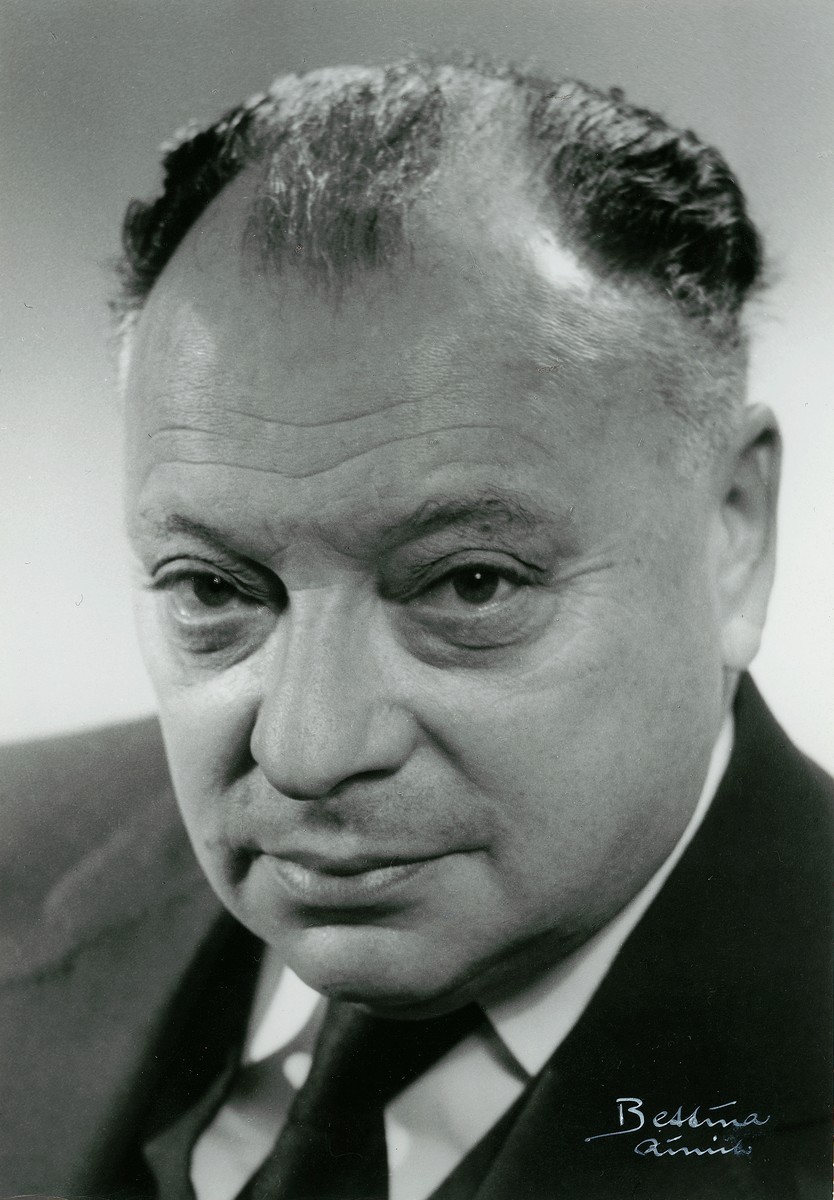
Photo: Bettina Katzenstein, circa 1946, ETH-Bibliothek Zürich, Bildarchiv, Portr_01042, CC BY-SA 4.0 (cropped and downscaled; changes passed on under the same licence) · ETH-Bibliothek Zürich, Bildarchiv, Portr_01042 (E-Pics Bildarchiv, DOI 10.3932/ethz-a-000045505): portrait photograph of Wolfgang Pauli by Bettina Katzenstein, circa 1946, silver gelatin print 12.5 x 18 cm, as published by the ETH-Bibliothek itself on Wikimedia Commons ('ETH-BIB-Pauli, Wolfgang (1900-1958)-Portr 01042.tif', uploaded 22 February 2021 by the account ETH-Bibliothek, 2556 x 3643 pixels, the largest file available; it is also the source of Wikidata's image for him). Rights: the file carries CC BY-SA 4.0 as released by the ETH-Bibliothek, and the ETH-Bibliothek's image-archive terms of use say that images under CC BY-SA 4.0 are those whose usage rights lie entirely with the ETH-Bibliothek, may be used for all purposes with credit, and must be passed on under the same terms if changed. The image's own E-Pics record could not be read (a JavaScript application), so no conflicting notice there could be checked; none appears on the terms page or the Commons page. The print's white border was removed by cropping (2470 x 3555 pixels from the original) and the result downscaled once to 834 x 1200 (never upscaled); the photographer's signature on the print remains visible at lower right. It shows him in a dark suit and tie with a direct, serious gaze. · CC BY-SA 4.0
physicist · 20th Century
Wolfgang Pauli
1900–1958
Known For
Not yet included in personality matching — the documented evidence doesn't yet cover enough of the personality model. Everything else on this page is fully available.
Trait Constellation
Key Achievements
In 1925 Pauli formulated the exclusion principle: no two electrons in an atom can have identical sets of quantum numbers, a rule that needed a new, two-valued quantum number and explains the shell structure of atoms. The Nobel Foundation awarded him the 1945 Nobel Prize in Physics 'for the discovery of the Exclusion Principle', and an Oxford physicist calls the rule crucial to understanding both the periodic table and the stability of matter, although Pauli himself admitted he could not say why it holds.
In December 1930, in an open letter 'Dear Radioactive Ladies and Gentlemen' to physicists meeting in Tübingen, Pauli proposed a 'desperate remedy' for the continuous energy spectrum of beta decay: an electrically neutral particle of spin 1/2 emitted along with the electron, which would save the conservation of energy. The Nobel Foundation's biography calls him the first to recognise the neutrino, as the particle came to be called; he held back a published account for about three years, and neutrinos were detected in 1956 by Cowan and Reines.
Pauli gave the mathematical description of electron spin in the Pauli matrices, which one reviewer says every physics undergraduate knows, and proved the relation between spin and statistics, which consolidated quantum field theory. As a student he wrote an exposition of relativity that Einstein praised in a review, and from 1928 he built at ETH Zürich one of the leading centres of theoretical physics in the world.
Moments That Reveal Them
In December 1930 Pauli put forward the neutrino idea not in a journal but in a letter to the experimentalists meeting in Tübingen. He wrote that so far he did not dare to publish anything about it, admitted that his remedy 'may seem almost improbable', and asked them to 'scrutinize and judge'. About three years passed before the speculation appeared in print.
This is consistent with a theorist who held an unfinished idea back until others had tested it, though the letter is Pauli's own account and the three-year delay is a reviewer's reading. Perfectionism
On 17 January 1957 Pauli wrote that he did not believe 'God is a weak left-hander' and was prepared to bet a high amount that the beta-decay experiment would show a symmetric angular distribution of the electrons. Then John Blatt wrote him of the 'sudden death of parity'; on 19 January Pauli wrote to Chien-Shiung Wu that the asymmetry was 'empirically so well established', and on 27-28 January he told Victor Weisskopf that he was shocked and was already speculating on how symmetry might be restored.
This is consistent with a theorist who held a firm expectation but accepted the experimental result within days, though he went on looking for a way to restore the symmetry, and the account rests on one scholar's reading of his letters. Belief Updating
Turning Points
Before accepting the ETH Zürich chair, which he took up at the end of April 1928, Pauli insisted on an assistant and wrote to Ralph Kronig that the task would be 'Every time I say something, to contradict me with detailed arguments' and to animate the scientific activity with modern ideas. At Zürich he built one of the world's leading centres of theoretical physics, and a graduate student of the early 1950s remembered witnessing his strong objections at a colloquium.
This is consistent with a physicist who built disagreement into his working environment, though he was also known for sharp objections that some listeners found daunting. Conflict Tolerance
Similar People
People whose overall profiles resemble theirs.

Wole Soyinka

Sequoyah

Niels Bohr

Franz Kafka

James Joyce
Opposite Profile
Not a rival — a different profile shape worth a look.
Theodore Roosevelt
Sources
- Wolfgang Pauli (Q65989) -- verified live via the Wikidata API (2026-10-16): English label 'Wolfgang Pauli', description 'physicist, Nobel prize winner (1900-1958)', Korean label present, instance of human, born 25 April 1900 (Vienna), died 15 December 1958, citizenship United States, Switzerland and Austria. Orientation only; not used as support for any row.
- Nobel Foundation (NobelPrize.org), 'Wolfgang Pauli - Facts' and 'Wolfgang Pauli - Biographical', Nobel Prize in Physics 1945 (the biographical text is from Nobel Lectures, Physics 1942-1962, Elsevier, 1964) -- CANONICAL SIGNIFICANCE SOURCE: the prize motivation 'for the discovery of the Exclusion Principle, also called the Pauli Principle'; the Foundation's summary that in 1925 he introduced two new quantum numbers and formulated the principle that no two electrons in an atom can have identical sets of quantum numbers (later found to apply to the particles of the nucleus too); and its biography, which names his student-age exposition of relativity, the exclusion principle, his being 'the first to recognize the existence of the neutrino', his part in the foundations of quantum field theory, his proof of the relation between spin and statistics, his Handbuch der Physik articles and his Zürich chair. Award-body prose, admiring by genre and silent on conduct. Read in full.
- Karl von Meyenn, 'Pauli, Wolfgang Ernst Friedrich', Neue Deutsche Biographie 20 (2001), pp. 118-121 (online at Deutsche Biographie) -- a scholarly biographical-dictionary entry, in German, by the editor of Pauli's collected correspondence: his early prominence (a relativity paper in 1918 and a widely praised survey in 1921), his posts under Born, Lenz and Bohr, the exclusion principle, his deliberate renunciation of model pictures that experience could not test, his matrix-mechanical calculation of the hydrogen atom and the Pauli matrices, the neutrino postulate and its detection by Cowan and Reines in 1956, his ETH Zürich chair from 1928 where he built one of the world's most important centres of theoretical physics, his students, and the remark that he communicated many results only orally or by letter. Independent scholarly biography; its sentences on his marriage and on Jung were not used. Read the whole biographical text.
- Domenico Giulini (Max Planck Institute for Gravitational Physics, Albert Einstein Institute), 'Concepts of Symmetry in the Work of Wolfgang Pauli', arXiv:0802.4341, 29 February 2008 (a talk at the conference 'Wolfgang Pauli's Philosophical Ideas and Contemporary Science', Monte Verita, May 2007) -- a physicist-historian's survey of Pauli's work through the idea of symmetry, quoting his letters from the published correspondence and the editors of his collected papers (Kronig and Weisskopf: his works are distinguished by mathematical rigour and 'a thorough and honest appraisal of the validity of assumptions and conclusions', he tried 'by example and sharp criticism' to keep a high standard in others' work and was often called the living conscience of theoretical physicists); the January-February 1957 episodes in which he offered to bet that parity would be conserved, learned of the Wu experiment and reacted in letters to Wu and Weisskopf; and his sharply mocking reply to Markus Fierz, which he essentially conceded within about a week. Independent scholarly secondary source with Pauli's own letters as quoted self evidence; the paper's passages giving Pauli's own psychological explanation of that quarrel were not used, and its mathematical sections were searched by keyword only. Read the introduction, the parity passages and the Fierz exchange in full.
- Valentine Telegdi, review of Charles P. Enz, 'No Time to Be Brief: A Scientific Biography of Wolfgang Pauli' (Oxford University Press, 2002), Physics Today, November 2003, p. 67 -- a review by a physicist who knew Pauli (Pauli was the external examiner of Telegdi's Zürich thesis and they stayed in close touch): Pauli as child prodigy, 'acerbic but much sought critic by age 20' and signer of letters as 'the scourge of God'; his roughly 2,600 published letters; the exclusion principle, the path from 'neutron' to neutrino and his ultimate rejection of a non-abelian gauge theory; the breadth shown by his last paper. Independent peer witness reviewing a biography by Pauli's last assistant. The review's passages on his mother, his marriages, depression and analysis by Jung, and on ETH's wartime handling of his appointment and naturalisation, were not used (private life, psychology and administrative politics, all unscored). Read in full.
- Ian Aitchison (Professor of Physics, University of Oxford), 'Foolish child won greatest praise' (review of Enz's 'No Time to Be Brief'), Times Higher Education, 30 May 2003 -- a physicist's review: the genesis of the exclusion principle (the 'two-valuedness', Stoner's shell numbers, Pauli's admission that he could not give a reason for the rule and his Nobel-lecture regret over 'the shadow of some incompleteness'), Einstein's nomination, the 'sharpness' of his critical judgements of nearly all his distinguished contemporaries ('the conscience and criterion of truth' and 'God's scourge'), his brushing aside of Kronig's spin idea in 1925 and his provision of the Pauli matrices two years later, the December 1930 letter and the three years before the neutrino appeared in print, and its detection in 1956. Independent scholarly review; its passages on his marriage, his mother, analysis by Jung and a remark about 'the crisis of my life' were not used. Read in full.
- Horst Meyer (Duke University), 'Reminiscence of Wolfgang Pauli', letter to Physics Today, 1 June 2004 -- a physicist's eyewitness memory of Zürich in 1949-53, when he was a graduate student: Pauli usually sat in the first row at the ETH physics colloquia, Meyer 'witnessed his strong objections' during a colloquium by Ralph Kronig and Pauli's approving nods during one by Victor Weisskopf, and was relieved that Pauli did not shake his head, criticise him or walk out during his own two colloquia. A short first-hand recollection (about 250 words), with an admiring-and-wary tone; its remarks about Pauli's father were not used. Read in full.
- CERN Archives (archives.web.cern.ch), page on Pauli's appointment in Zürich, with a photograph of Ralph Kronig (from the holdings of the Wolfgang Pauli Archive at CERN) -- states that Pauli took up his ETH chair at the end of April 1928, that before accepting it he insisted on the appointment of an assistant, and quotes his letter of 22 November to Kronig: the task would be 'Every time I say something, to contradict me with detailed arguments' and 'To animate somewhat the scientific activity with modern ideas'; it adds Kronig's later remark that the Zürich years were among the most instructive and exhilarating of his life. A short archive entry quoting Pauli's own letter (self evidence) and a colleague's recollection; the year of the letter is not stated on the page (it precedes April 1928). Read in full (two short paragraphs); the aside about ice cream was not used.
- Wolfgang Pauli, open letter 'Dear Radioactive Ladies and Gentlemen' to the radioactive group at the Tübingen meeting, Zürich, 4 December 1930 -- English translation by Kurt Riesselmann (Fermilab) of a machine-typed copy (the original is in the CERN Pauli Archive), as a PDF hosted by the mathematics department of the University of Utah: a 'desperate remedy' for the 'wrong' statistics of the N-14 and Li-6 nuclei and the continuous beta spectrum, namely an electrically neutral spin-1/2 particle that obeys the exclusion principle and is emitted with the electron so that the sum of their energies is constant; Pauli writes that so far he does not dare to publish anything about the idea, asks the experimentalists how likely it would be to find such a particle, admits his remedy 'may seem almost improbable' but says 'nothing ventured, nothing gained', and asks them to 'scrutinize and judge'. Primary document in his own words (self evidence, used only alongside the independent accounts above); the hosting page is a convenience copy, not the archive of record. Read in full.
- ETH-Bibliothek Zürich, 'Nutzungsbedingungen des Bildarchivs der ETH-Bibliothek' (terms of use of its E-Pics image archive) -- checked for the portrait's rights: images are either public domain (copyright expired, marked with the Public Domain Mark), licensed under Creative Commons BY-SA 4.0 where the usage rights lie entirely with the ETH-Bibliothek (all uses allowed with credit, share-alike for changes), or of restricted use (not downloadable); the credit must give at least 'ETH-Bibliothek Zürich, Bildarchiv'. The image's own E-Pics record (DOI 10.3932/ethz-a-000045505) is a JavaScript application whose text could not be retrieved. Not used for any scoring.
- Wikimedia Commons file page 'ETH-BIB-Pauli, Wolfgang (1900-1958)-Portr 01042.tif' -- checked through the Commons API for the portrait's file and licence: uploaded on 22 February 2021 by the account ETH-Bibliothek as part of its cooperation with Wikimedia CH; photographer Bettina Katzenstein; date circa 1946; silver gelatin print, 12.5 x 18 cm; accession number ETH-Bibliothek_Portr_01042; source the E-Pics DOI above; 2556 x 3643 pixels; licence CC BY-SA 4.0. It is the photograph from which the image Wikidata uses for Pauli is extracted. Not used for any scoring.