Marie Curie
89% Profile Match
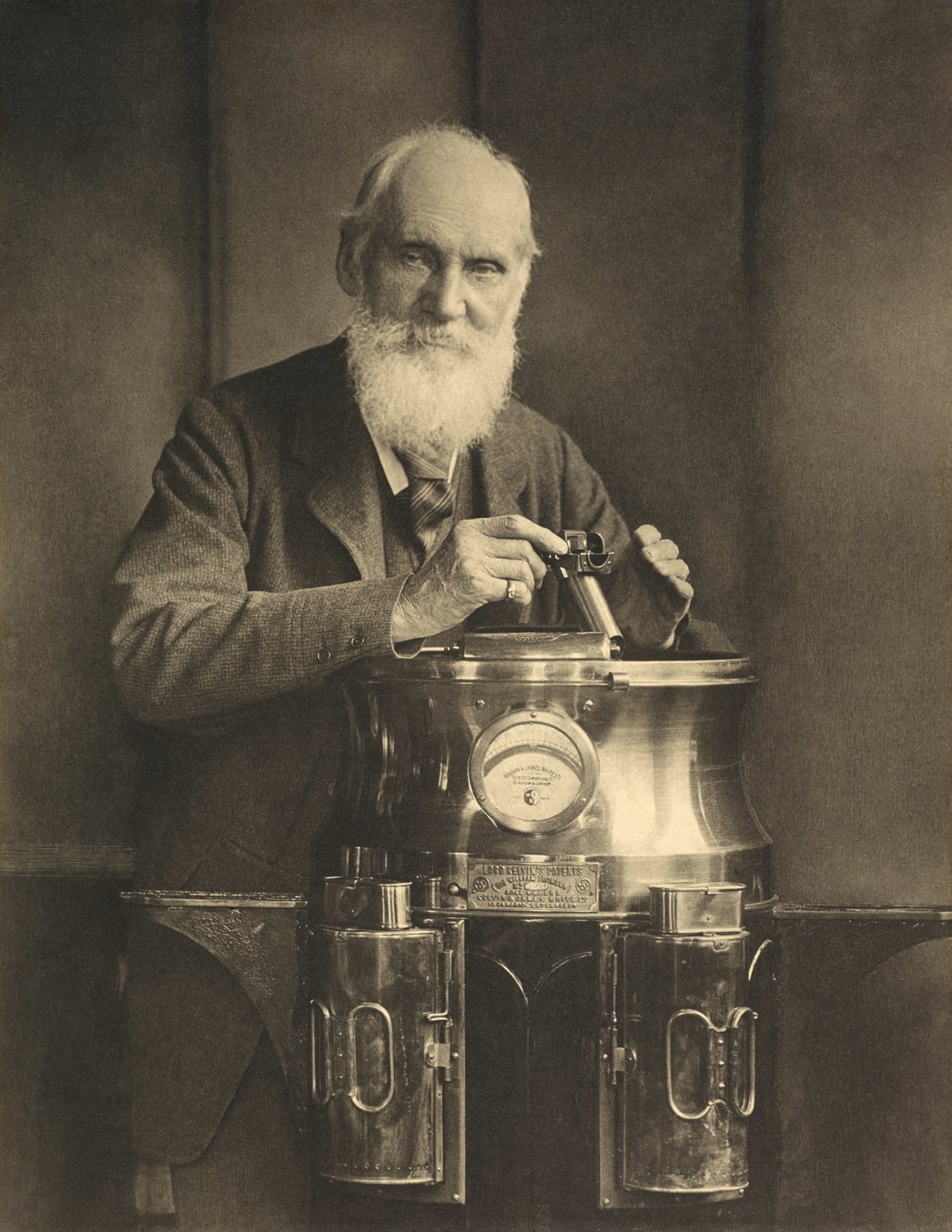
T. & R. Annan & Sons (Glasgow), carbon print of Lord Kelvin with his compass and azimuth mirror, c. 1900; National Galleries of Scotland PGP 230.1; restored scan by Adam Cuerden on Wikimedia Commons · National Galleries of Scotland, accession PGP 230.1 ('Sir William Thomson, Baron Kelvin, 1824 - 1907. Scientist, resting on a binnacle and holding a marine azimuth mirror', carbon print, 19.00 x 14.70 cm), via the Wikimedia Commons file 'Sir William Thomson, Baron Kelvin by T. & R. Annan & Sons.jpg' (restoration by Adam Cuerden of the scan; the unrestored scan is 'Sir William Thomson, Baron Kelvin by T. & R. Annan & Sons - Original.jpg') · Public domain
physicist · 19th Century
1824–1907
Not yet included in personality matching — the documented evidence doesn't yet cover enough of the personality model. Everything else on this page is fully available.
In 1848 Thomson proposed an absolute scale of temperature built on Carnot's theory of heat engines, so that a degree no longer depended on the thermometric substance, and tabulated it from Regnault's measurements. His 1851 paper 'On the Dynamical Theory of Heat' reconciled Carnot's theory with Joule's equivalence of heat and work, and in 1852 he published the principle of a universal tendency to the dissipation of mechanical energy. He credited Clausius with the law of transformation while giving his own demonstration from a different axiom. The Kelvin scale and the SI unit, the kelvin, are named for him.
Thomson worked out the mathematics of signalling through long submarine cables, showing that retardation grew with the square of the cable's length and arguing for a thicker copper conductor. He took part in the Atlantic cable expeditions of 1857 and 1858 and, after the 1858 cable failed within weeks, in those of 1865 and 1866. In 1858 he patented the mirror galvanometer, which made the faint signals readable, and he later devised the siphon recorder. He was knighted in 1866 for his part in the cable.
From the 1870s Thomson redesigned the mariner's compass for iron ships, with a very light card carrying eight thin needles hung on silk threads and adjustable correcting magnets, and developed a sounding machine for taking deep-sea soundings from a moving ship. The German and Russian navies ordered them before the Royal Navy, which made his compass the standard in November 1889. They were made by the Glasgow instrument firm of James White, later Kelvin and James White Ltd.
Thomson held the Glasgow chair of natural philosophy from 1846 until he withdrew from it in 1899. About 1850 he took over a disused wine cellar as a laboratory where students made measurements, which his biographer Thompson calls the first physical laboratory put at students' disposal in any university. With P. G. Tait he wrote the Treatise on Natural Philosophy, whose first volume appeared in 1867, a textbook written from the standpoint of energy.
In August 1858, after the cable was laid, the company's electrician Whitehouse could not get clear signals from Newfoundland on his own relays. According to Thompson, who quotes the directors' letters, the board took the cable out of Whitehouse's hands on 17 August and authorised Thomson to take charge at Valentia. Thomson found his own mirror galvanometer already installed, got the Newfoundland operators to switch to it, and communication was restored; he then asked the board to reconsider Whitehouse's dismissal, and they refused in unsparing terms. Whitehouse's later pamphlet records signals received on Thomson's galvanometer as well as his own apparatus.
Putting a working instrument of his own into service when the main apparatus failed is consistent with resourcefulness; the sequence of events rests on Thompson's account of the directors' documents, and Whitehouse's side is available only through his 1858 pamphlet. Resourcefulness
On 19 February 1869 T. H. Huxley, as president of the Geological Society of London, answered Thomson's argument that the earth's heat and the sun's limited fuel allowed only about 100 million years, likening mathematics to a mill that returns only what is put into it. On 5 April 1869 Thomson replied in Glasgow with 'Of Geological Dynamics', charging that many geologists treated the principles of physics as foreign to their work. In 1871 Darwin wrote to Wallace that Thomson came 'like an odious spectre' when he thought of pre-Silurian time. Thompson notes that the later discovery of radioactive heating undermined the temperature-gradient argument.
Holding a position against what he called perhaps a majority of British geologists, and answering the leading advocate directly, is consistent with independent thinking; the position later proved to rest on incomplete physics, so the same stance carried a cost. Independent Thinking
In 1847 Thomson heard James Joule's paper at the British Association in Oxford and, by his own later account, felt it must be wrong, but waited and spoke to Joule privately. For about three years he held to Carnot's theory while telling others that Joule's work mattered. In 1850 he wrote to Joule that a conclusion about steam could be reconciled with known facts only through Joule's discovery, and his 1851 paper rebuilt the theory on both.
Taking about three years to move from doubt to adoption, while publicly insisting the evidence mattered, is consistent with belief updating that is slow but ends in acceptance; the account comes mainly from his admiring biographer and his own recollection. Belief Updating
People whose overall profiles resemble theirs.



Not a rival — a different profile shape worth a look.