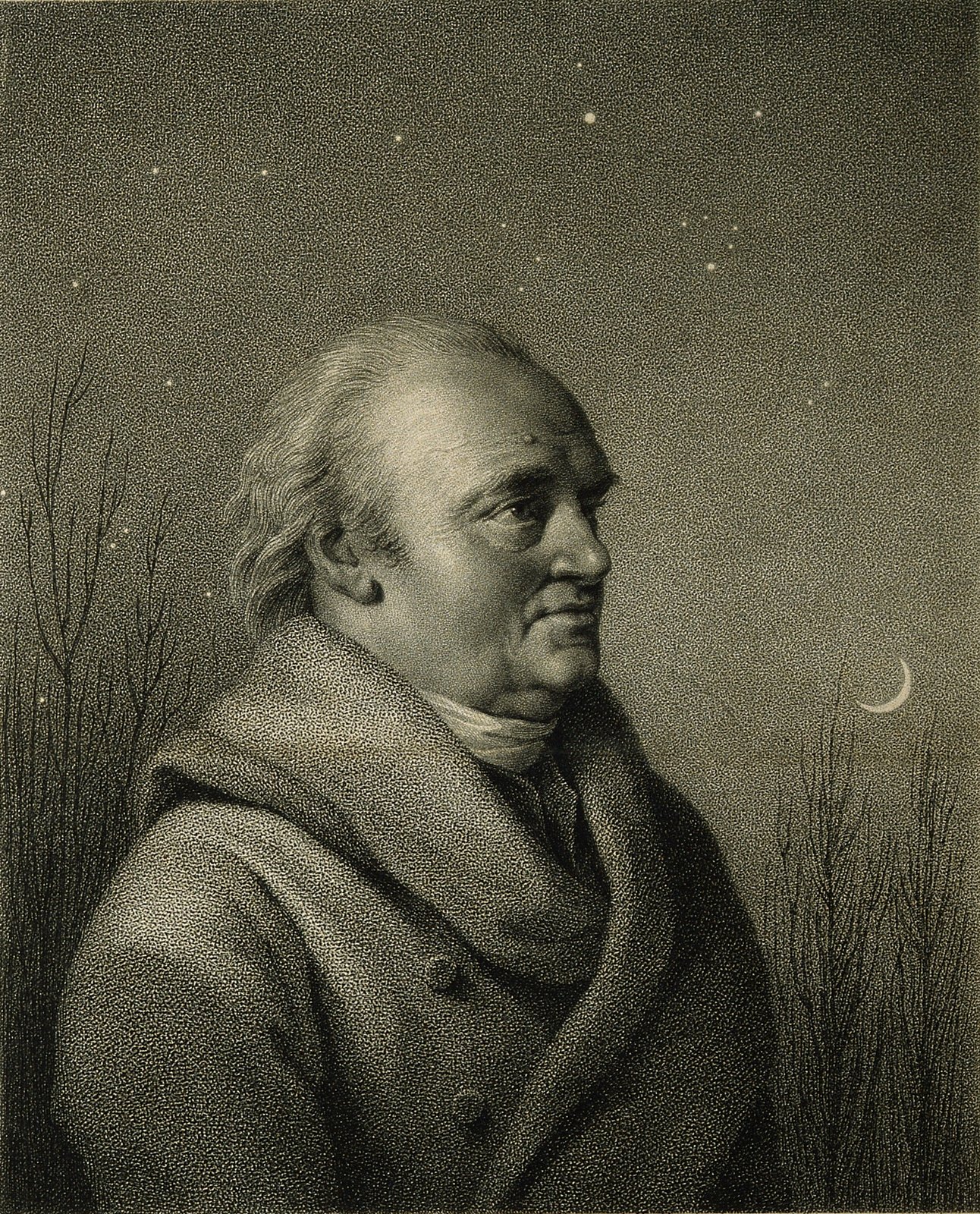

James Godby, stipple engraving after Friedrich Rehberg, 'Dr. Herschel', published London 1 Nov 1814 (inscribed 'Fr. Rehberg del. ad viv. Windsor 1814'); Wellcome Collection V0002727 (Wellcome page: Public Domain Mark; Commons tags the scan CC BY 4.0); cropped to the plate and downscaled · Wellcome Collection, London (portrait print V0002727) via Wikimedia Commons · CC BY 4.0
Trait Constellation
Key Achievements
From September 1773, while working as a music teacher and concert director in Bath, Herschel began making his own reflecting telescopes. His memoranda, as edited by Dreyer, record that he hired a two-foot reflector, bought a Bath amateur's mirror-making tools on 22 September, and worked from Smith's Optics and Emerson's Mechanics; Dreyer counts 2,160 recorded operations on mirrors in the four folio volumes of his record, which runs to December 1818.
On 28 October 1783 Herschel began 'sweeping' the sky with a new 20-foot reflector at Datchet. After 41 sweeps made alone, Dreyer says, he judged the method too tiring and of little value; a workman then raised and lowered the telescope while his sister Caroline wrote down the observations, and from Sweep 46 on 18 December 1783 the series continued to Sweep 1112 on 30 September 1802.
In a paper read to the Royal Society on 27 March 1800, Herschel wrote that trials of coloured darkening glasses for viewing the sun had made him doubt that every colour of sunlight heats equally. He set thermometers beside a prism's spectrum, moving one into a chosen colour while two stayed in the shade as standards, and repeated the runs.
Moments That Reveal Them
On 13 March 1781, during a systematic review of the sky at Bath, Herschel noted in his journal 'a curious either nebulous star or perhaps a comet'; on 17 March he recorded that it had changed its place. His paper to the Royal Society was titled 'An Account of a Comet', and Dreyer reports that the version first presented contained a paragraph arguing for a measurable parallax, which was not printed after more accurate observations elsewhere disproved it.
The difference between the presented and printed versions is consistent with a willingness to drop an argument that later measurements did not support. It is one episode, and other passages in the record show him restating positions when criticised. Belief Updating
In December 1781 William Watson wrote to Herschel that people in London doubted the high magnifying powers he had used, and that Maskelyne and Aubert said they had never seen fixed stars round and well defined. On 7 January 1782 Herschel replied that 'seeing is in some respect an art which must be learnt' and that he had 'many a night' practised it, and he later urged Aubert to raise his powers by degrees; in his own memorandum, his telescope was then tried at Greenwich in May and June 1782 and judged by those who used it to exceed other instruments.
His letters treat good observing as a skill built by repeated practice, which is consistent with a mastery orientation. The evidence is largely his own words and his own memorandum, so it is illustrative rather than conclusive. Mastery Orientation
Turning Points
Dreyer places the turning point of Herschel's life in the winter of 1772-73, when reading Smith's Optics made him want to see the heavens for himself. His memoranda show a quadrant bought on 19 April 1773, an object glass on 24 May, and mirror-making tools on 22 September, while he still attended 46 private pupils in the week of 15 November 1773.
Building instruments from books and a Bath amateur's cast-off tools while carrying a full teaching load is consistent with resourcefulness. The account rests on his own memoranda and his sister's later recollection. Resourcefulness
Similar People
People whose overall profiles resemble theirs.

Marie Curie

Leonardo da Vinci

Yayoi Kusama

Thomas Edison

Alan Turing
Opposite Profile
Not a rival — a different profile shape worth a look.
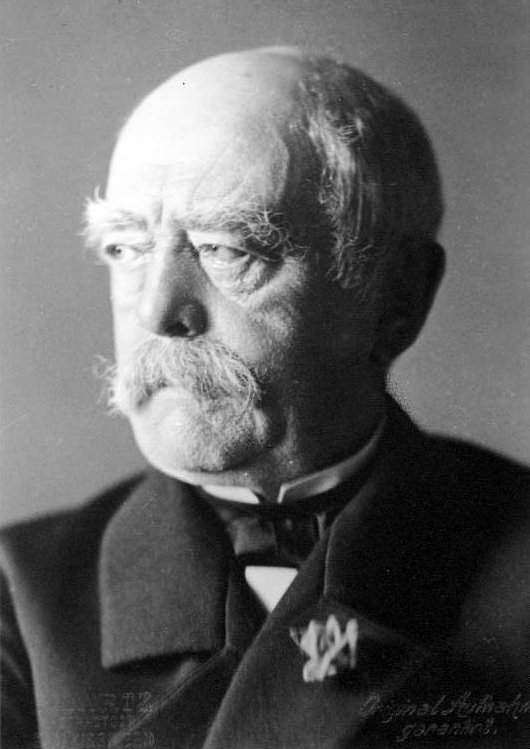
Otto von Bismarck
Sources
- William Herschel (English Wikipedia; lead extract fetched via the MediaWiki API) -- orientation only (dates 15 Nov 1738 - 25 Aug 1822, Hanover-born, emigrated to Britain, astronomer and composer); not used as support for any scored row.
- 윌리엄 허셜 (Korean Wikipedia; lead extract fetched via the MediaWiki API) -- confirms the conventional Korean rendering of the name and the person's identity (German-born astronomer, mathematician and composer, 1738-1822). Orientation only.
- William Herschel (Q14277) -- identity verified live through the Wikidata API (wbsearchentities, then wbgetentities on labels, descriptions and claims): en label 'William Herschel', en description 'German-born British astronomer and composer (1738-1822)', ko label '윌리엄 허셜', P569 1738-11-15, P27 = Electorate of Hanover / Great Britain / United Kingdom of Great Britain and Ireland, P3373 siblings include Caroline Herschel (Q76948), P18 'William Herschel01.jpg'. Orientation only.
- J. L. E. Dreyer, 'A Short Account of Sir William Herschel's Life and Work, chiefly from unpublished sources' (biographical introduction, pp. xiii-xlix and following, to The Scientific Papers of Sir William Herschel, vol. 1, Royal Society and Royal Astronomical Society, London, 1912), Internet Archive OCR text (scientificpapers032804mbp) -- an independent scholar-editor's account built on Herschel's unpublished memoranda, polishing record, journals, sweep-books and letter-book, and quoting letters written TO him (William Watson jun., Maskelyne, Hornsby, Michell, Edwards, Priestley, Aubert, Walsh) and Auwers's later check of his nebula positions. Read in sequence from the opening of the introduction through the 40-foot telescope, machine polishing and the list of telescopes made to order (Sections I-IV, roughly pp. xiii-l); Section V and the unpublished-papers section were not read. Herschel's own memoranda quoted in it are the self perspective; Dreyer's commentary and the incoming letters are non-self. Not family-authored, but Dreyer worked from the family's manuscripts and used Caroline Herschel's Memoir for some particulars.
- The Scientific Papers of Sir William Herschel, vol. 1 (1912), same Internet Archive text as above -- Herschel's OWN papers (self perspective). Read at: 'On Nebulous Stars, properly so called' (Phil. Trans. 81, 1791, read 10 Feb 1791; edition pp. 415-425) -- the opening, the section weighing the former grounds against the new object, and the conclusion (the middle pages, about pp. 419-424, were not read). The rest of the volume (the Bath papers, the double-star and nebula catalogues, the sweep observations) was only searched by keyword, not read.
- The Scientific Papers of Sir William Herschel, vol. 2 (1912), Internet Archive OCR text (scientificpapers02hersuoft) -- Herschel's OWN papers (self perspective; the same self perspective as the other Herschel-authored records). Read at: the opening and first experiments of 'Investigation of the Powers of the prismatic Colours to heat and illuminate Objects' (Phil. Trans. 1800, read 27 Mar 1800); the wheat-price passage of 'Observations tending to investigate the Nature of the Sun' (1801) and his 1805-06 letter to Bode answering the translator Ideler's footnote. The rest of the volume was not read.
- Memoir and Correspondence of Caroline Herschel (by Mrs. John Herschel, London/New York, 1876), Internet Archive OCR text (memoircorrespond00hers) -- Caroline Herschel's firsthand recollections, recorded decades later, compiled by her nephew's wife: an INSIDER, family-compiled source (one perspective). Read at the Bath chapter (pp. 35-42: the purchase of a Bath amateur's mirror-making tools, the workshop years, the casting failure, the visitors of 1781-82); the volume as a whole was not read.
- Agnes M. Clerke, The Herschels and Modern Astronomy (Century Science Series, Cassell, 1895), Internet Archive OCR text (herschelsmoderna00clerrich) -- a Victorian historian of astronomy's synthesis (draws heavily on Caroline Herschel's Memoir, so only partly independent of it; also reports the Schroter exchange and Brougham's Edinburgh Review attack). Read at Chapter I (pp. 21-29), the Venus and sun-spot passages (pp. 88-89) and the passage on heat rays (pp. 95-96); the book as a whole was not read.