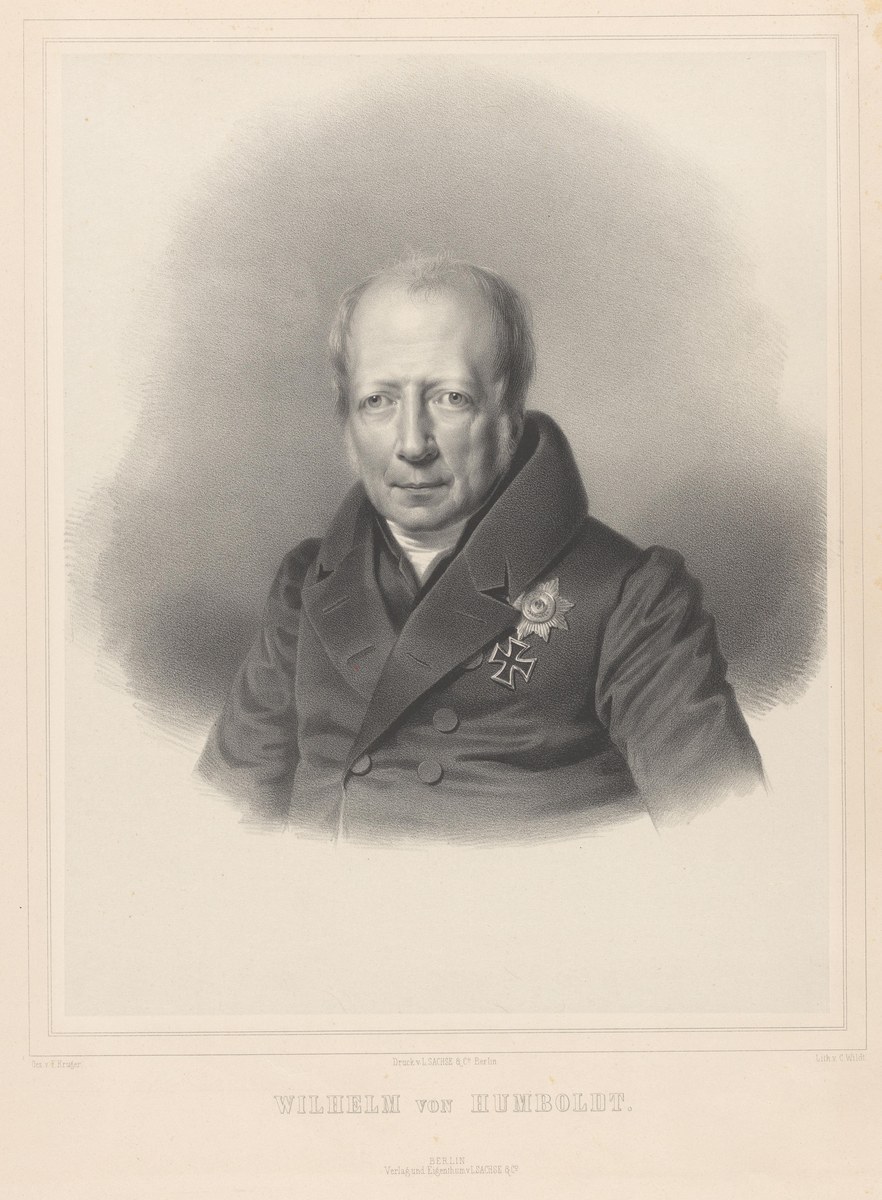
Carl Wildt after Franz Krueger, 'Portret van Wilhelm von Humboldt', lithograph, 1830-1860, Rijksmuseum, Amsterdam (RP-P-1903-A-23176), public domain · Lithographic portrait lettered 'WILHELM von HUMBOLDT.' by Carl Wildt after a drawing by Franz Krueger, printed by L. Sachse and Co., Berlin, made between 1830 and 1860; held by the Rijksmuseum, Amsterdam (RP-P-1903-A-23176). The museum scan (5,174 x 6,643 pixels) was cropped to the printed plate and lettering and downscaled once to 882 x 1,200 pixels; nothing was upscaled. Shown as a later print depiction, not as a documented sitting. · Public domain (Rijksmuseum Public Domain Mark; nineteenth-century lithograph)
philosopher · 19th Century
Wilhelm von Humboldt
1767–1835
Known For
Not yet included in personality matching — the documented evidence doesn't yet cover enough of the personality model. Everything else on this page is fully available.
Trait Constellation
Key Achievements
A philosopher of language, he argued that language is the formative organ of thought rather than a mere vehicle for existing ideas, and in 1820 submitted a plan for a new discipline of comparative linguistics; Britannica says his contribution to the scientific study of language became highly valued in the twentieth century.
As head of the Prussian ministry's education section in 1809-10 he reformed schooling and was chiefly instrumental in founding the University of Berlin, now Humboldt University, on the idea of combining teaching and research; the university calls him a co-founder, and historians note the 'Humboldt model' later grew beyond what he did alone.
Drawing on a correspondence network of missionaries, diplomats and scholars on six continents, he collected grammars and word lists across many languages and, in his Kawi work, showed that the languages of the South Pacific form what is now called the Austronesian family.
Moments That Reveal Them
In June 1820 he submitted to the Berlin Academy a plan for a new discipline of comparative linguistics, setting out its philosophy and methodology and a blueprint for a research programme.
This is consistent with building a general framework for a field rather than only collecting data. Systems Thinking
Settled at Jena from 1794, he acted as philosophical adviser and critical collaborator to Goethe and Schiller, and SEP says his criticism furthered Schiller's Letters on the Aesthetic Education of Man and Goethe's Hermann und Dorothea.
This is consistent with working closely with other creators and improving their work through criticism. Collaboration
Turning Points
Having entered the Prussian civil service in 1790, he took leave in 1791 because he found the post uninspiring and spent the following years on scholarly and philosophical work near Jena.
This is consistent with a preference for scholarly independence over an early official career. Need for Autonomy
Similar People
People whose overall profiles resemble theirs.


Aristotle

Ada Lovelace

Leonardo da Vinci

Ibn Sina

Maimonides
Sources
- Wilhelm von Humboldt (Q77888), verified live via the Wikidata API (2026-11-06): label 'Wilhelm von Humboldt', description 'Prussian philosopher, government official, diplomat, and educator (1767-1835)', born 22 June 1767, died 8 April 1835, Korean label 빌헬름 폰 훔볼트. Orientation only; not used as support for any row.
- Stanford Encyclopedia of Philosophy, 'Wilhelm von Humboldt' (introduction and the life sections from education and early writings to the later linguistic writings read in full, about 5,500 words). CANONICAL SIGNIFICANCE SOURCE: gives his work across philosophy, literature, linguistics, anthropology and education; his role with Goethe and Schiller at Jena; his Basque and American-language studies; the 1809-10 reform of the Prussian education system and the founding of the University of Berlin on the principle of combining teaching and research; his Kawi work and the demonstration of the Austronesian family against Bopp; the 1820 plan for comparative linguistics and the idea of language as the 'formative organ of thought'. Admiring in tone (written by a Humboldt specialist) and notes that his linguistics was long ignored or partially appropriated.
- Encyclopaedia Britannica, 'Wilhelm von Humboldt' (public-web portion read in full, about 800 words). General-encyclopedia account: language scholar, philosopher and educational reformer whose contribution to the scientific study of language became highly valued in the twentieth century; chiefly instrumental in founding the Friedrich Wilhelm University at Berlin; his Basque studies and the unfinished Kawi work with its introduction on the diversity of language structure. Diplomatic and treaty service in the entry was read but is not scored.
- Humboldt-Universitat zu Berlin, University Library collections portal, 'Biografie, Wilhelm von Humboldt' (record read in full, about 400 words, in German). The university's own account: one of the co-founders (Mitbegruender) of the Berlin university, reform of Prussian education with Nicolovius and Suvern including the concept of the Berlin university and the new humanist Gymnasium, and the insight that language is a dynamic phenomenon (energeia). Holder record for the portrait search; its rights page requires contacting the library for digital copies, so none of its images is used.
- Ian F. McNeely, 'Wilhelm von Humboldt and the World of Languages', Ritsumeikan University journal, vol. 23 no. 2, pp. 129-148 (a historian's lecture article; the opening sections and the sections on Sanskrit, Indo-European and the Austronesian family were read, about 3,500 words of roughly 8,000; the remainder was not read). Independent historian's account: Humboldt as tireless empirical researcher who built a correspondence network of missionaries, merchants, diplomats and scholars on six continents and collected word lists and grammars; his work on Sanskrit, Basque and the Austronesian family; helped recruit Bopp and A. W. Schlegel to professorships. COUNTER-VOICE: notes that he regarded Indo-European languages as superior because of inflection, rejected the idea of Sanskrit as a divine or racial marker, and that his comprehensive ambition left his work misunderstood by the professional disciplines he helped to create.
- Oleg Morozov, 'Wilhelm von Humboldt and Berlin University: A New Look at the Origin of the Humboldt Myth', National Research University Higher School of Economics working paper WP BRP 134/HUM/2016 (first section and framing read, about 2,500 words of a 16-page paper). COUNTER-VOICE: summarises historians (Ash, Paletschek, Langewiesche, Tenorth and others) who find the 'Humboldt model' of the university contained little new and was never fully implemented, that Berlin was not Humboldt's brainchild alone (Fichte and Schleiermacher were involved) and that he headed the education section for about sixteen months from early 1809.
- Rijksmuseum, Amsterdam, print 'Portret van Wilhelm von Humboldt' (RP-P-1903-A-23176), lithograph by Carl Wildt after a drawing by Franz Krueger, printed by L. Sachse and Co., Berlin, 1830-1860; linked-art collection record read (Public Domain Mark on the image, CC0 on the data; title on object 'Wilhelm von Humboldt'). Holder record for the portrait.