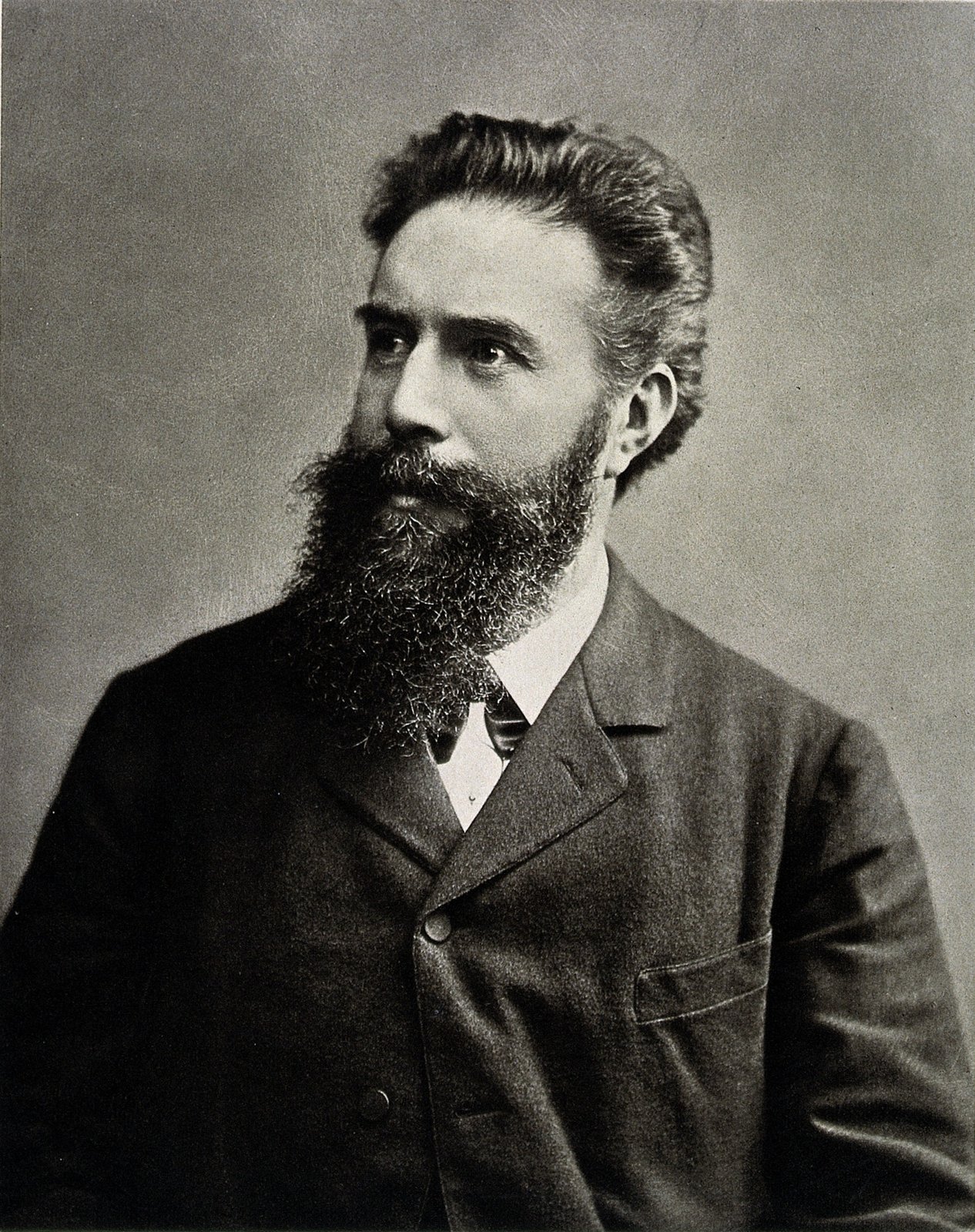

Wilhelm Conrad Roentgen, photogravure, Photographische Gesellschaft in Berlin; Wellcome Collection (Public Domain Mark); paper margin with plate number, imprint and signature cropped · Photogravure portrait of Wilhelm Conrad Röntgen published by the Photographische Gesellschaft in Berlin (plate no. 4345, publisher's imprint and facsimile signature 'Roentgen' in the margin; photographer not named), Wellcome Collection 13483i (Wellcome Images V0027091); scan via Wikimedia Commons · Public domain
Trait Constellation
Key Achievements
On 8 November 1895, working with a covered discharge tube at the Würzburg Physical Institute, Röntgen noticed a fluorescent screen glowing some distance away. After weeks of further experiments he submitted 'On a New Kind of Rays' to the Würzburg Physical-Medical Society at the end of December 1895, calling the new radiation 'X-rays'.
In three short communications between 1895 and 1897 he described how the rays passed through matter roughly according to its density, darkened photographic plates, travelled in straight lines, were not deflected by a magnet and could discharge electrified bodies. He also reported the tests that failed, such as his search for refraction and interference.
In 1901 he received the first Nobel Prize in Physics for the discovery of the rays. He gave the prize money to the University of Würzburg for the support of science.
Moments That Reveal Them
Röntgen told almost no one about his observation for about seven weeks. According to his biographer Otto Glasser, when his friend Theodor Boveri pressed him, he said he had found something interesting but did not know whether his observations were correct. In his first paper he wrote that, wherever possible, he had checked every important observation made by eye against a photographic plate.
Holding back a striking result until he had checked it from several directions is consistent with the profile's high analytical rigor score. Most of the personal detail comes from an admiring biographer, but Röntgen's own paper describes the same habit of checking. Analytical Rigour
In 1896 Max Levy, an engineer at the electrical firm AEG, approached Röntgen about the company's interest in developing the rays. As quoted by Glasser, Röntgen replied that university discoveries belonged to humanity and should not be hampered by patents, licences or contracts. The Würzburg Röntgen memorial also records that he declined to patent the process.
Turning down control over a valuable discovery offers one example of the moderate impact motivation in this profile. His later gift of the Nobel prize money to Würzburg sits alongside it, although he left medical applications of the rays to others. Impact Motivation
Turning Points
By 1894-95 Röntgen, then close to fifty, was an established physicist known for precise measurements on gases, crystals and liquids. He obtained a Lenard tube, repeated Lenard's cathode-ray experiments and set aside his studies of liquids under pressure to work on cathode rays. The historian Alexi Assmus notes that this was outside his usual research.
Moving into an unfamiliar line of work in mid-career is consistent with the profile's curiosity score. The discovery itself also involved chance, and this choice is one reasonable reading of how he came to be in a position to notice it. Curiosity
Similar People
People whose overall profiles resemble theirs.
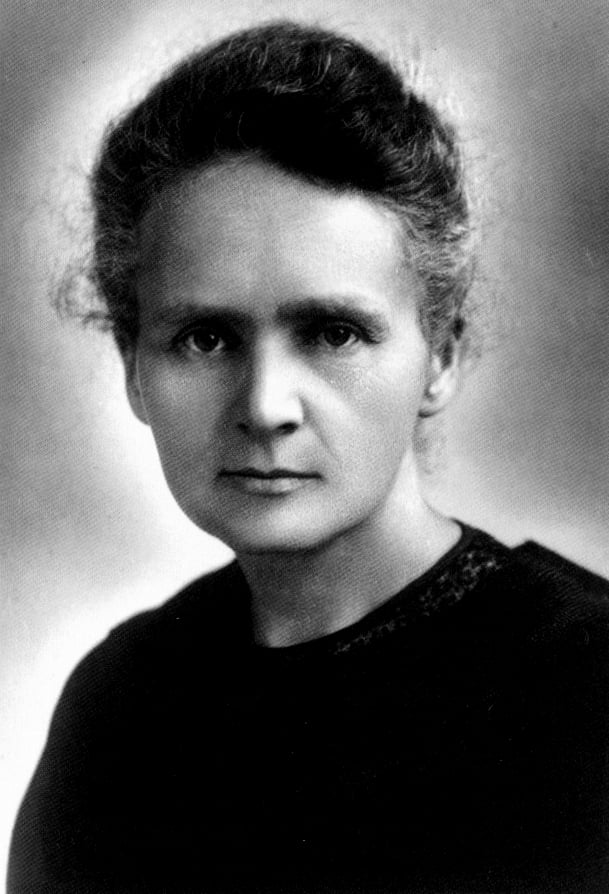

Marie Curie

Alan Turing

John D. Rockefeller

Ada Lovelace

Thomas Aquinas
Opposite Profile
Not a rival — a different profile shape worth a look.
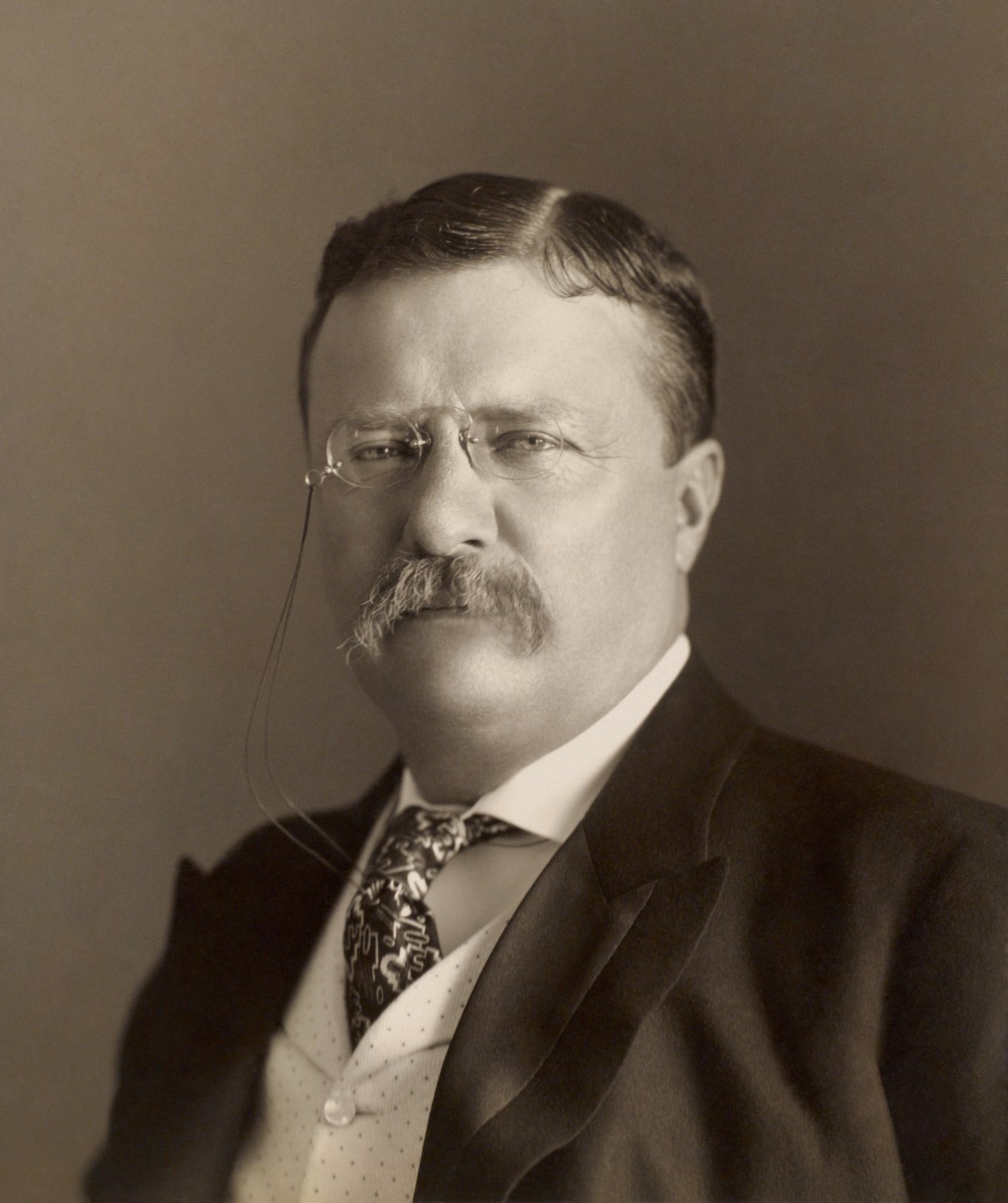
Theodore Roosevelt
Sources
- Wilhelm Röntgen (English Wikipedia) -- orientation only; not used as support for any scored row. Korean Wikipedia title '빌헬름 콘라트 뢴트겐' confirmed via the Wikidata kowiki sitelink.
- Wilhelm Röntgen (Q35149) -- verified live via wbgetentities (2026-10-03): en label 'Wilhelm Röntgen', description 'German physicist (1845–1923)', de label 'Wilhelm Conrad Röntgen' ('deutscher Physiker und Nobelpreisträger'), ko label '빌헬름 콘라트 뢴트겐', P569 1845-03-27, P570 1923-02-10, P18 'Wilhelm Conrad Röntgen (1888-1900), 88374 p.jpg', enwiki 'Wilhelm Röntgen', kowiki '빌헬름 콘라트 뢴트겐', dewiki 'Wilhelm Conrad Röntgen'. Orientation only.
- Otto Glasser, Dr. W. C. Röntgen (Springfield, Ill.: Charles C Thomas, 1945; 50th-anniversary condensation of his 1931/1934 biography 'Wilhelm Conrad Röntgen and the Early History of the Roentgen Rays', plus later letters and documents), archive.org Digital Library of India OCR text (in.ernet.dli.2015.63841), read: ch. I (schooling, Utrecht expulsion, Zurich), ch. II (Kundt years, Strassburg/Hohenheim/Giessen, 1888 Röntgen current, declined Jena/Utrecht calls, Würzburg rectorship 1894, Freiburg call declined), ch. III (8 Nov. 1895 discovery and the weeks of solitary work), ch. V (Jan.-March 1896: reprints sent 1 Jan., press storm, letter to Zehnder, Berlin demonstration, refusal of lecture invitations incl. the Reichstag, the single Würzburg lecture of 23 Jan. 1896), ch. VII in part (Sorrento retreat, AEG/Max Levy patent reply), ch. IX (1897-1923: teaching, publication habits, Lenard dispute, refused calls, Nobel 1901, 1905 congress, 1912 Laue diffraction reaction, wartime, will), and the chronology -- SCHOLAR/BIOGRAPHER (radiation physicist and historian of radiology; Glasser was a pupil of Röntgen's former Munich assistant Walter Friedrich and built the book from Röntgen's surviving letters, the Boveri family and Zehnder correspondence); admiring commemorative volume sponsored by radiological societies, with some narrative reconstruction ('one can only imagine') that is NOT used. Health, bereavement, childlessness, adoption and inflation-loss passages were read and are NOT used for any row.
- H. J. W. Dam, 'The New Marvel in Photography: A Visit to Professor Röntgen at His Laboratory in Würzburg -- His Own Account of His Great Discovery', McClure's Magazine vol. 6 no. 5 (April 1896), pp. 403-415, archive.org OCR text (sim_new-mcclures-magazine_mcclures-magazine_1896-04_6_5), the Röntgen article read in full (the following 'Röntgen Rays in America' feature was not used) -- JOURNALIST, FIRSTHAND (an interview at the Würzburg institute in Jan./Feb. 1896, with Röntgen's answers quoted directly). Read: his self-built tin-box darkroom; his declining to say what the rays were ('I don't know'); 'I did not think; I investigated'; 'I am not a prophet, and I am opposed to prophesying ... as fast as my results are verified I shall make them public'; 'When I have done it, I will tell you'; refusing a portrait or photograph ('No, that is nonsense'; 'I am too busy'); impatience with personal questions; 'There is much to do, and I am busy, very busy'. Dam makes factual errors about Röntgen's life (says he was born near Zurich and took his degree at Utrecht) and writes in a breathless popular style, so only the directly quoted exchanges and observed behaviour are used, at moderate weight.
- W. C. Röntgen, 'On a New Kind of Rays' (first communication, Würzburg, end of 1895), second communication (9 March 1896) and 'Further Observations on the Properties of the X-Rays' (third communication, 10 March 1897), English translation in G. F. Barker (ed.), Röntgen Rays: Memoirs by Röntgen, Stokes, and J. J. Thomson, Harper's Scientific Memoirs III (New York: Harper, 1899), pp. 1-40, archive.org OCR (rontgenraysmemoir00ront, Getty Research Institute copy) -- SELF. Read the first communication in full and the second and third in part. Read: the naming footnote ('For brevity's sake I shall use the expression "rays"; and to distinguish them from others of this name I shall call them "X-rays"'); 'wherever it has been possible ... I have controlled, by means of photography, every important observation which I have made with the eye'; 'I have tried in many ways to detect interference phenomena of the X-rays; but, unfortunately, without success'; experiments 'begun, but ... not yet finished'; his reasons for rejecting the ultraviolet hypothesis and his tentative longitudinal-ether-wave suggestion; second communication: 'I have, however, delayed the publication of my experiments until I could contribute results which are free from criticism'; third communication's control experiments (lead cylinder closed by 'the head of the observer'). Barker's preface (non-self editor, 1899) notes Lenard's prior observations and credits Röntgen with 'the first systematic study' -- used only as context.
- Alexi Assmus, 'Early History of X Rays', Beam Line (SLAC) vol. 25 no. 2 (Summer 1995), pp. 10-24, PDF from slac.stanford.edu read in full (text extracted locally) -- SCHOLAR (historian of physics; independent of the Röntgen-family/radiology-society tradition). Read: that after noticing the fluorescing screen the newly elected Rector 'spent the next six weeks in his laboratory, working alone, and sharing nothing with his colleagues'; that he 'refused the calls' from Giessen until Würzburg offered its institute; his 1894 rectorial address; 'an exact experimenter who often made his own apparatus' and could measure extremely small effects; the obvious tests he ran on the new rays (rectilinear propagation, refraction, reflection, magnetic deflection) and his tentative longitudinal-wave suggestion; that he published only three papers on X rays; that at Munich, in negotiations over the Reichsanstalt offer, he obtained a second institute for theoretical physics in return for staying, which went to Sommerfeld. Assmus misdates the society 'delivery' (the paper was submitted, not read, on 28 Dec. 1895); used for the dated facts above, and for the wider history of the rays' nature only as context.
- Nobel Prize in Physics 1901: presentation speech by C. T. Odhner (10 Dec. 1901) and the Nobel Foundation's biographical note on Röntgen (from Nobel Lectures, Physics 1901-1921, Elsevier 1967), nobelprize.org, both read in full -- INSTITUTIONAL. Used for achievement facts (prize 'for the discovery with which his name is linked for all time ... the so-called Röntgen rays or, as he himself called them, X-rays'; career dates; declined calls to Jena 1886, Utrecht 1888, Leipzig 1899, the Reichsanstalt presidency and the Berlin Academy chair). Its general characterisation ('strikingly modest and reticent', 'always shy of having an assistant, and preferred to work alone', 'much of the apparatus he used was built by himself') is an unattributed editorial summary and is used only as corroborating context, never as the main support of a row. The note's health/cause-of-death and adoption sentences are not used.
- Jean-François Monville and Robert F. Dondelinger, 'Father and Son Jointly Announced the Discovery of Röntgen Rays in Two Consecutive Press Articles -- Revisited', Journal of the Belgian Society of Radiology 107(1):3 (2023), CC BY 4.0, full text via Europe PMC (PMC9818045), read in full -- SCHOLARS (radiologist-historians; independent, source-critical study of the Vienna press leak). Read: Röntgen mailed his offprint and prints no earlier than 1 Jan. 1896 to a selection of physicists (Stokes and Warburg acknowledged receipt on 3 Jan.); in a letter to Kohlrausch of 15 Jan. 1896 (Deutsches Röntgen-Museum holdings, as cited) he explained he could send prints at first only to Warburg and Exner and that he had had to do it all on his own because his assistant was away for the Christmas vacation; the authors find no evidence he disclosed the discovery to Exner before the paper; the Presse articles were written by the editor Lecher and his physicist son, not by Röntgen. Used for the dated mailing facts and his self-reliant handling of it; the Lecher reconstruction is context only.
- Röntgen-Gedächtnisstätte Würzburg (memorial in the former Physical Institute, run by a Würzburg board of trustees), biography page 'Wilhelm Conrad Röntgen', wilhelmconradroentgen.de, read in full 2026-10-03 (German) -- INSTITUTIONAL. Read: that he named the rays 'X-Strahlen'; the 23 Jan. 1896 public talk at the invitation of the Physical-Medical Society and Kölliker's proposal of the name 'Röntgenstrahlen'; 'Röntgen lehnte es ab, sein Verfahren patentieren zu lassen'; that he gave the entire Nobel prize money (50,000 kronor) to the University of Würzburg for scientific research. Used only as independent institutional corroboration of these facts (alongside Glasser), never as sole support of a row.