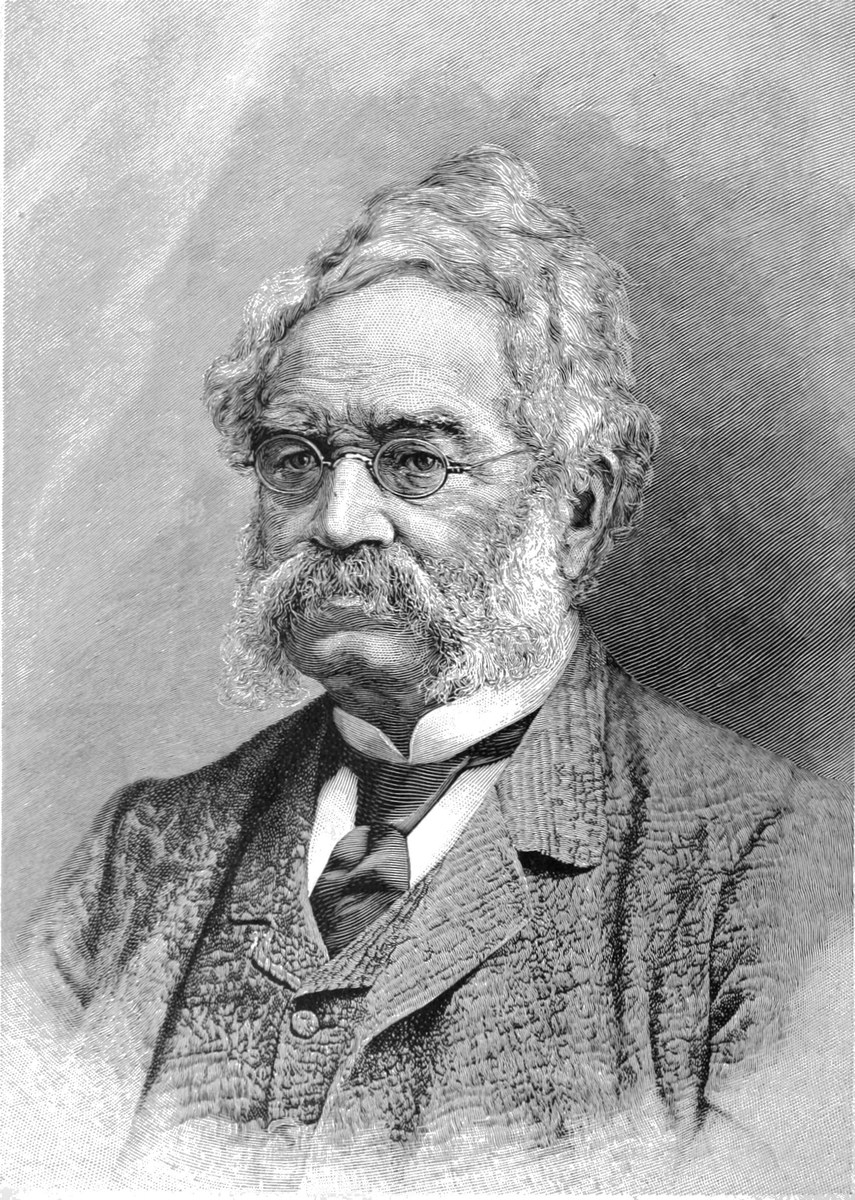

Unnamed engraver, portrait of Werner Siemens, The Popular Science Monthly vol. 43, 1893 (Internet Archive scan; extracted and downscaled). · Wood-engraved portrait of Werner von Siemens printed with the caption 'Werner Siemens' in The Popular Science Monthly, volume 43 (May to October 1893), New York, D. Appleton; scan at the Internet Archive (popularsciencemo43newyuoft); engraver not named. The file is the Wikimedia Commons extract of the engraving (1698 x 2384 pixels) downscaled to 855 x 1200 with no upscaling. The same volume carries the 'Sketch of Werner von Siemens'. · Public domain by age: published in New York in 1893 (before 1931); the engraver is not named and the Internet Archive record states no rights of its own
engineer · 19th Century
Werner von Siemens
1816–1892
Known For
Not yet included in personality matching — the documented evidence doesn't yet cover enough of the personality model. Everything else on this page is fully available.
Trait Constellation
Key Achievements
Founded the telegraph construction firm Siemens & Halske in Berlin in 1847 with the mechanic Johann Georg Halske; it built the Berlin-Frankfurt line, the Russian state network and submarine cables, and organised the Indo-European telegraph from London to Calcutta, completed in 1870.
Announced the dynamo-electric principle to the Berlin Academy of Sciences in January 1867: a generator that excites its own electromagnets, replacing permanent magnets; the Dictionary of Scientific Biography notes that others reached the principle at about the same time but that he foresaw its uses for power and developed them, and his firm moved into electric traction and central generating stations.
Held that technology should be built on science and in return analysed to derive theory; he advised the Prussian government that a nation must excel in research, and his money and land helped found the Physikalisch-Technische Reichsanstalt in Berlin (1887), first headed by Helmholtz.
Moments That Reveal Them
After his published criticism of the careless construction and repair of the Prussian state telegraph lines, the government stopped giving his firm work for several years; the firm then took on railway telegraphy and foreign contracts, notably the Russian telegraph network.
The episode is consistent with a willingness to accept a commercial cost for criticism and with adaptability in redirecting the firm. Adaptability
In his report to the Berlin Academy in early 1867 he wrote that technology now had the means to generate electric power of unlimited strength cheaply wherever labour was available.
This forecast is consistent with an eye for where a new technology would lead, though it is quoted in a company biography and the principle was reached by others at about the same time. Opportunity Sensing
Turning Points
In June 1849 he resigned his army commission to devote himself to the telegraph firm he had founded with Halske two years earlier.
Leaving a secure commission for the firm is consistent with proactive agency in building his own enterprise. Proactive Agency
Similar People
People whose overall profiles resemble theirs.


Benjamin Franklin

Aristotle

Alexander Hamilton

Ibn Khaldun

Nelson Mandela
Sources
- Werner von Siemens (Q58577), verified live via the Wikidata API (2026-11-06): English label 'Werner von Siemens', description 'German electrical engineer, inventor and industrialist (1816-1892)', Korean label 에른스트 베르너 폰 지멘스, born 1816-12-13, died 1892-12-06, citizenship Kingdom of Prussia. Orientation only; not used as support for any row.
- Complete Dictionary of Scientific Biography entry 'Siemens, Ernst Werner von' by Thomas Parke Hughes (Gale, reproduced on Encyclopedia.com; read in full including its bibliography). CANONICAL SIGNIFICANCE SOURCE: invented improvements to the indicator telegraph and developed an entire telegraph system with seamless gutta-percha insulation; founded Telegraphenbauanstalt von Siemens & Halske in 1847; Prussian contracts ended after 1850 and the firm expanded into Russia; Indo-European telegraph from London to Calcutta completed in 1870; the dynamo principle announced to the Berlin Academy in January 1867 (the entry notes that Hjorth, Jedlik, Varley, Wheatstone and Farmer found the principle at about the same time and that Siemens foresaw its power uses and developed practical applications); electric streetcars, mine locomotives and central stations; his insistence that technology rest on science; his money and determination behind the Physikalisch-Technische Reichsanstalt (1887); retired from management in 1889 with about 5,000 workers in the family firms. Reference-work biography; balanced on priority, admiring on character.
- Jakub Kastl and Lyndon Moore, 'Wily welfare capitalist: Werner von Siemens and the pension plan', Cliometrica 2009 (economic-history article, read in full from the author PDF). COUNTER-VOICE: Siemens & Halske's profit sharing from 1855, Christmas bonuses, a 54-hour week after the move to piece-rates, and the 1872 pension, widows' and orphans' fund; the authors find the welfare system raised productivity and discouraged strikes, estimate the gains at least equalled the cost of the pension fund, and note that a striker lost his pension entitlement; they quote Siemens saying the money 'would burn my hands' if he did not share it with loyal helpers and that strikes were best coped with by such a fund. Also: his decision in 1850 to expand abroad (agency in London under his brother Wilhelm, Russian branch under his brother Carl) and the 40/35/25 profit split among the brothers. Independent quantitative scholarship; challenges a purely humanitarian reading.
- 'Sketch of Werner von Siemens', The Popular Science Monthly vol. 43 (May-October 1893, New York, D. Appleton), pp. 831 ff., with the portrait captioned 'Werner Siemens' (Internet Archive scan, OCR text read for the whole sketch). Contemporary English-language biography drawn largely from his Recollections (so partly his own account): the 1840 prison electroplating experiments, his gun-cotton work and loss of priority to Otto, his pamphlet criticising Prussian state telegraph management after which the government cut off his firm for several years, expansion to Russia, the 1857 Sardinia-Algeria cable, his 1859 shipwreck in the Red Sea, the 1866 dynamo and his acknowledgement of predecessors. Contains a dating slip (the Frankfurt line is given as winter 1879 instead of 1849), and Siemens's own wartime activity at Kiel is recorded but not scored.
- Encyclopaedia Britannica, 'Werner von Siemens' (read): joined the Prussian artillery at 17 for training his father could not afford; prison experiments that led to the 1842 electroplating process; improved Wheatstone's telegraph and persuaded the mechanic Halske to start a telegraph factory in 1847; laid the Berlin-Frankfurt line in 1848; resigned his commission in 1849; used gutta-percha insulation; subsidiary factories in London, St Petersburg, Vienna and Paris with his brother Carl; cables across the Mediterranean and to India; self-excited generator in 1866; ennobled 1888. Short reference article, celebratory.
- IEEE Engineering and Technology History Wiki, 'Werner von Siemens' (read in full; IEEE honorary member 1892): prison chemistry and the 1842 electroplating invention, the 1847 firm with Halske, the 1848 Berlin-Frankfurt line, offices in London, Paris, St Petersburg and Vienna, the 1866 dynamo-electric principle, the 1879 electric railway and 1882 street lighting, honorary doctorate 1860 and ennoblement. Short professional-society biography, admiring; used only for consistent dates and facts.
- Siemens Historical Institute, 'Werner von Siemens (1816-1892)' biography (company-owned, 4-page PDF, read in full). COMPANY SOURCE (self-interested): the Prussian government ended his firm's contracts and the firm turned to Russia; his stated aim of 'an enterprise of world standing comparable to that of Fugger' and his 1887 letter to his brother Carl that he saw the business 'only secondarily as a financial asset'; the 1866 inventory premium and 1872 pension fund described as serving both humanitarian and personnel-policy aims, in his words 'not just humanity, but rather healthy egoism'; his donation of funds and land for the Physikalisch-Technische Reichsanstalt, his role in the Patent Office (1877) and in founding the Elektrotechnischer Verein (1879). Contains 'world's first' claims by the company that are not repeated here; also describes his service in the Prussian state assembly 1862-66 (unscored).