Leonardo da Vinci
94% Profile Match
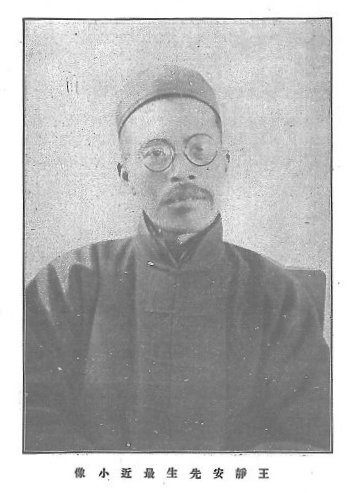
Photographer unknown, Wang Guowei, photograph reproduced in the Wang Jing'an memorial number, Tsinghua School Research Institute, 1927-28, public domain · Photographic portrait of Wang Guowei reproduced as a plate captioned 'Wang Jing'an xiansheng zuijin xiaoxiang' (Mr Wang Jing'an, recent small portrait; Jing'an is his courtesy name) in the Wang Jing'an memorial number published by the Tsinghua School Research Institute; Wikimedia Commons attributes the scan to that memorial issue and dates the photograph to before June 1927, and the issue of Guoxue luncong vol. 1 no. 3 that carries Liang Qichao's preface is dated April 1928 on Chinese Wikisource. The photographer is not named. The image is used at its original 357 x 493 pixels (a plate scan; nothing was resized or upscaled). Caveats: the holder of the scan is not identified (the Commons page gives no URL or library record), the exact issue year of the plate is taken from Commons' attribution to the memorial number, and the basis is publication in China in 1927-1928, well before 1931, not a Commons tag. Shown as a published photograph of the sitter, identified by the plate caption. · Public domain (photograph published in China in 1927-1928)
scholar · 20th Century
1877–1927
Not yet included in personality matching — the documented evidence doesn't yet cover enough of the personality model. Everything else on this page is fully available.
He set the study of ancient Chinese history on a new footing by reading oracle-bone and bronze inscriptions together with the old texts, work gathered in his self-edited Guantang jilin, and Tsinghua University counts him among the most influential masters of twentieth-century Chinese scholarship.
In literary criticism he applied Western aesthetics to Chinese literature in Hongloumeng pinglun (1904) and Renjian cihua (1908), which set out his 'theory of realm', and he finished Song-Yuan xiqushi, a history of Song and Yuan drama, in 1913.
From 1925 to 1927 he was a tutor at the Tsinghua Research Institute of Chinese Studies, where he taught ancient history and bronze inscriptions and worked on annotated editions of Mongol and Liao-Jin sources.
His 1909 catalogue of Song-to-Qing drama, the Qulu, listed some three thousand titles; when Hu Shih reviewed it in 1923 he pointed out works that were misclassified or missing and hoped Wang would revise it in light of the new material found since.
This is consistent with large-scale cataloguing work that was careful but, as a contemporary reviewer showed, not error-free. Detail Orientation
Liang Qichao, his colleague at the Tsinghua Institute, wrote in 1927-28 that Wang would not put a conclusion in writing if he had the slightest doubt about it, and discarded any statement earlier scholars had already made.
This admiring colleague's account is consistent with a cautious, self-checking approach to evidence. Analytical Rigour
From about 1909, according to his pupil Wu Qichang, he set aside literary criticism and Schopenhauer-inspired aesthetics and turned to ancient history and inscriptions, helping to prepare Luo Zhenyu's oracle-bone publications, while still completing his history of drama in 1913.
This is consistent with moving his work into a new field while finishing the old project. Adaptability
People whose overall profiles resemble theirs.