Yayoi Kusama
95% Profile Match
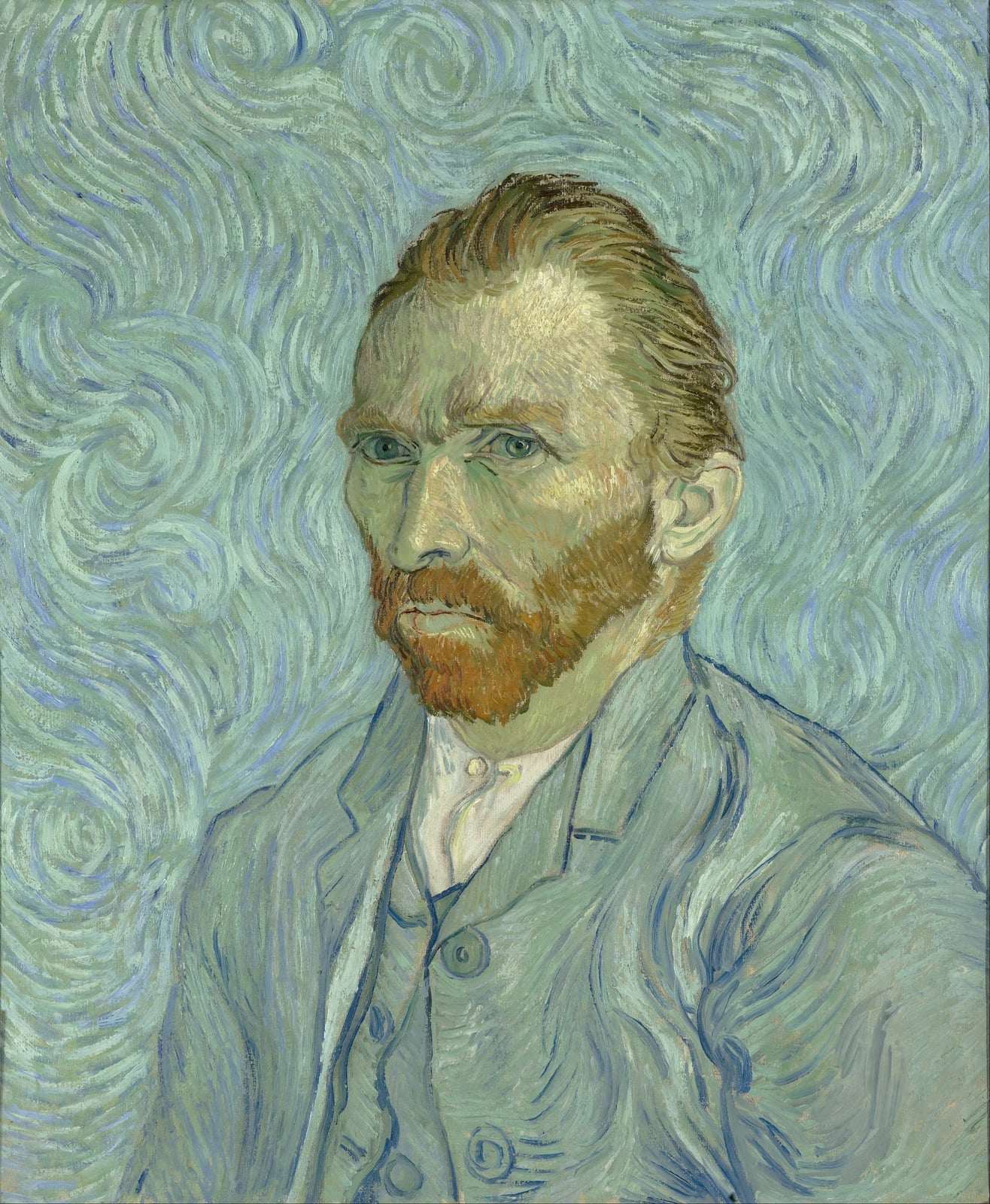
Vincent van Gogh, self-portrait, 1889, Musée d'Orsay, Paris, Public Domain · Wikimedia Commons (hosted locally by this app as a resized/compressed derivative; see licenseUrl for the full-resolution original) · Public Domain
1853 — Born.
1880 — Committed to painting full-time at 27, after leaving earlier paths in art dealing, teaching, and preaching.
1888 — Moved to Arles to secure his own independent studio.
1888 — Invited Paul Gauguin to share the studio; the arrangement ended within two months.
1889–1890 — Produced roughly 200 paintings in his final fifteen months, in Arles and Saint-Rémy.
1890 — Died.
Left nearly 900 surviving letters, mostly to his brother Theo, directly documenting his deliberate reasoning about color relationships and composition alongside a body of more than 2,000 surviving works — a distinctive style built on thick impasto and expressive color choices that departed clearly from the academic and Impressionist conventions of his time.
During his final roughly fifteen months in Arles and Saint-Rémy alone, he produced around 200 paintings, with individual works documented to have sometimes been completed within a single sitting or day.
Continued producing work at a high rate for roughly a decade despite a documented, near-total absence of commercial success in his lifetime — he is recorded to have sold only one or two paintings while alive — evidence against a success- or reward-driven reading of his output.
His attempt at a shared studio arrangement with the painter Paul Gauguin in Arles — the "Yellow House" period, which he had proactively invited Gauguin to join as the seed of a shared artists' colony — lasted only about two months before ending in a well-documented breakdown.
The profile's collaboration score is drawn narrowly from this one arrangement's documented outcome, not from a broader claim about how he got along with people. Collaboration
He studied and collected Japanese ukiyo-e prints extensively, directly incorporating their flattened perspective and bold outlines into his own compositions — a documented interest that reached beyond his immediate painting practice.
He moved to Arles specifically to secure his own independent studio space, which his letters describe as a deliberate choice for creative independence rather than a matter of circumstance.
Worth noting for the profile's autonomy_need score: the studio wasn't where he happened to end up, but a space his own letters describe seeking out deliberately. Need for Autonomy
At 27, after leaving a series of earlier, more conventional paths — art dealing, teaching, lay preaching — with no proven ability as a painter, he committed to painting full-time, relying on his brother Theo's financial support to make the shift possible.
The profile's risk_tolerance score is grounded in this one dated, comparatively late decision, not a general claim about risk running through his whole life. Risk Tolerance
Van Gogh died on 29 July 1890, two days after being shot in the chest in a wheat field near Auvers-sur-Oise; questioned by police, he said only, "Do not accuse anybody, it is I that wished to commit suicide," and the Van Gogh Museum's own account of his death still describes it as self-inflicted. A 2011 biography by Steven Naifeh and Gregory White Smith, already cited elsewhere in this profile, argued instead that he was shot accidentally by two local teenagers and covered for them — a theory Van Gogh Museum researchers formally rebutted in 2013 and that has not been accepted by most scholars, but that means the manner of his death is not treated as fully settled across every account this profile draws on. His posthumous reputation diverged sharply from his lifetime obscurity: paintings that went almost entirely unsold while he lived are now among the most sought-after and expensive in the history of Western art.
People whose overall profiles resemble theirs.
Not a rival — a different profile shape worth a look.