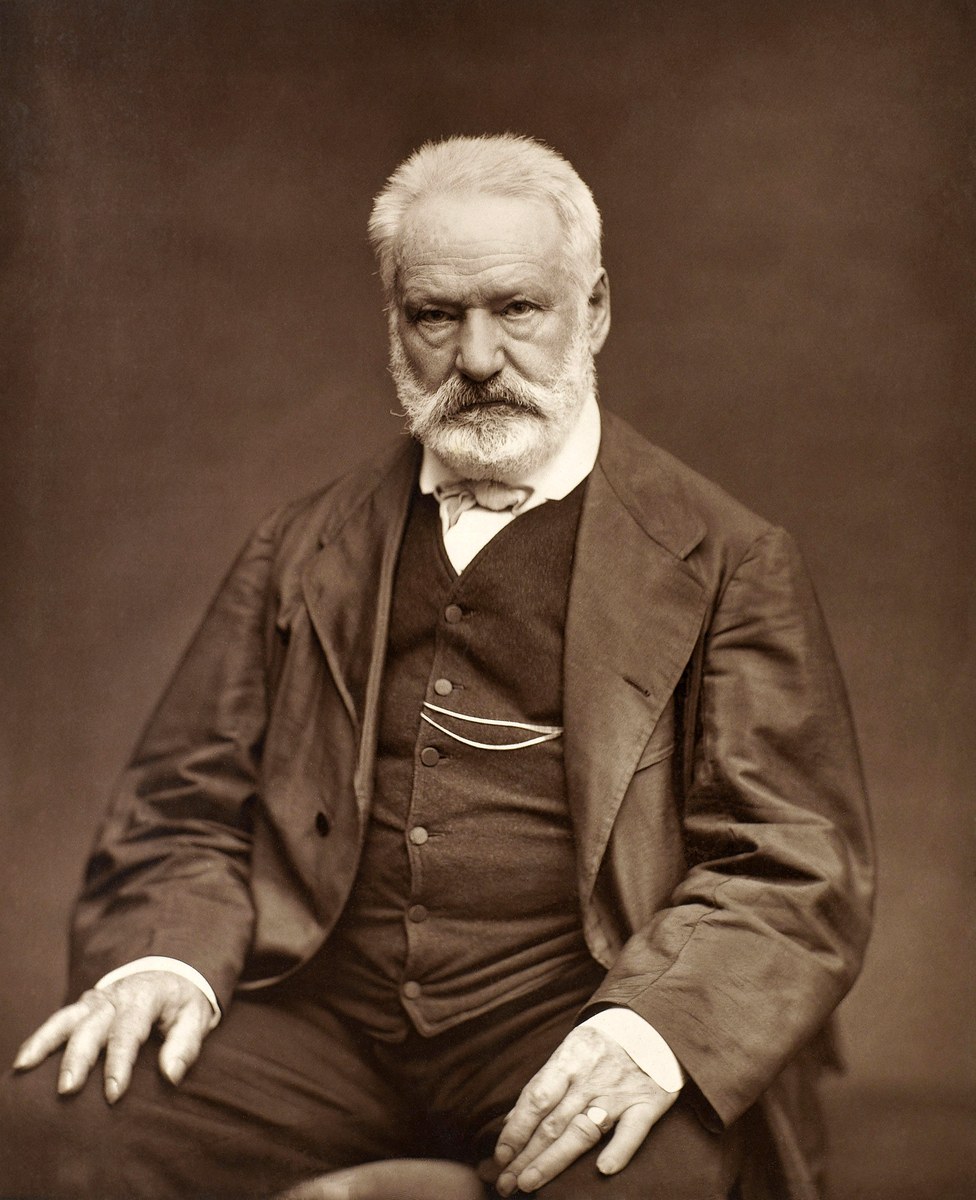
Etienne Carjat, Victor Hugo, 1876, public domain, via Wikimedia Commons (original from the Bibliotheque nationale de France) · Portrait photograph of Victor Hugo by Etienne Carjat, published in 1876 in the serial Galerie contemporaine, litteraire, artistique (Goupil & Cie) as a woodburytype; Commons file 'Victor Hugo by Etienne Carjat 1876 - full.jpg', cited to the Gallica copy of the Bibliotheque nationale de France. Downscaled from 2140 x 2632 pixels to 976 x 1200 with no cropping and no upscaling. · Public domain (photographer died 1906; published 1876)
writer · 19th Century
Victor Hugo
1802–1885
Known For
Not yet included in personality matching — the documented evidence doesn't yet cover enough of the personality model. Everything else on this page is fully available.
Trait Constellation
Key Achievements
Poet, dramatist and novelist, described by Britannica as the most important of the French Romantic writers: his preface to Cromwell (1827) set out a Romantic theory of drama and the first night of Hernani (25 February 1830) was the Romantics' victory over the Classicists.
Wrote the novels Notre-Dame de Paris (1831) and Les Miserables (1862); the latter was serialised in ten instalments and became an immediate bestseller across Europe and North America.
Regarded in France as one of its greatest poets, with collections from Les Orientales to Les Contemplations (1856); elected to the Academie francaise in 1841.
Moments That Reveal Them
In 1827 he published the verse drama Cromwell with a long preface demanding a drama that mixed tragic and comic elements and abandoned the rules of classical tragedy; Britannica says the preface proved far more important than the play.
This is consistent with a writer who set out a new form in theory and in practice. Creative Originality
After the success of Les Contemplations he bought Hauteville House in Guernsey in 1856, collected second-hand furniture and objects on the island, and spent months overseeing a major conversion and its decoration.
This is consistent with a strong personal taste, expressed in building and decorating a whole house. Aesthetic Sensitivity
Turning Points
Settled in Guernsey from 1856 to 1870, he wrote, completed or published most of his best-known works there, including Les Contemplations, Les Miserables and Les Travailleurs de la mer.
This is consistent with a long, steady working routine in a settled place. Discipline
Similar People
People whose overall profiles resemble theirs.


Yayoi Kusama

Frida Kahlo

Rabindranath Tagore

Maya Angelou

Chinua Achebe
Opposite Profile
Not a rival — a different profile shape worth a look.
Theodore Roosevelt
Sources
- Victor Hugo (Q535), verified live via the Wikidata API (2026-10-31): English description 'French novelist, poet, dramatist and politician (1802-1885)', born 1802-02-26, died 1885-05-22, Korean label present, image 'Victor Hugo by Etienne Carjat 1876 - full.jpg'. Orientation only; not used as support for any row.
- Jean-Bertrand Barrere (Professor of French Literature, Cambridge), 'Victor Hugo', Encyclopaedia Britannica, read from the start through the 1851 coup (the exile and last-years sections are behind the subscription wall and were not read). CANONICAL SIGNIFICANCE SOURCE: 'the most important of the French Romantic writers', regarded in France as one of its greatest poets and better known abroad for Notre-Dame de Paris (1831) and Les Miserables (1862); founded a review at about seventeen, the Conservateur Litteraire (1819-21); the long preface to Cromwell (1827) as a Romantic manifesto that 'has proved far more important than the play itself'; the first performance of Hernani on 25 February 1830 as the victory of the Romantics over the Classicists; a sidebar stating that he wrote 100 lines of verse or 20 pages of prose each morning; a wish to be the 'sonorous echo' of his time; election to the French Academy in 1841 'after three unsuccessful attempts'. Reference entry by a specialist; the praise is retrospective.
- Academie francaise, page on Victor Hugo (seat 14), read through a summarising fetch and not as raw text: elected 7 January 1841 by 17 votes out of 32 and received on 3 June 1841; first stood in 1836; his major works; the Hernani premiere described as a battle between literary camps and a triumph for the Romantics; he refused to become directeur while Alfred de Vigny was effectively ostracised by the Academy, and after Nisard's election in 1850 called for academicians to be chosen by writers' societies; he bequeathed his manuscripts and drawings to the national library. Institutional page; its account of the Academy is partly self-interested.
- Algernon Charles Swinburne, 'Hugo, Victor Marie', Encyclopaedia Britannica, 11th edition (1911), read on Wikisource through the mid-1840s: a long, openly admiring appreciation by a fellow poet that lists his odes, ballads, Cromwell, Les Orientales, the plays Hernani, Le Roi s'amuse, Ruy Blas and Les Burgraves, the novels, the essays and the travel letters Le Rhin, and records that he refused to allow Marion de Lorme, banned under Charles X, to be staged under the next government. Period source; strongly admiring, so used only for the list of forms and works, not for any judgement of quality.
- Guernsey Museums, 'A Brief Summary of Victor Hugo's Life', read in full: he realised a literary calling by thirteen, led the Romantic movement in the 1820s, the 'battle' of Hernani as a turning point in French literary history, mixed success in the theatre in the 1830s, election to the Academy 'at the fifth attempt', and during the Guernsey years (1855-70) he wrote, completed or published most of his best-known works, including Les Contemplations (1856), Les Miserables (1862), Les Travailleurs de la mer (1866) and Quatre-vingt-treize (1874). Local museum biography; sympathetic to its famous resident, and its attempt count differs from Britannica's.
- Guernsey Museums, 'Hauteville House', read in full: he bought the house on 16 May 1856 with the proceeds of Les Contemplations, was an enthusiastic collector of second-hand furniture and bric-a-brac, spent months overseeing a major conversion on a medieval pattern, and filled it with decoration; his son Charles called it 'a veritable three-storey autograph, a poem in several rooms'; the house was given to the City of Paris in 1927. Museum page for the house, with a family quotation; partly promotional.
- Charles Walton (Yale historian), 'The Missing Half of Les Mis', History News Network (adapted from Foreign Affairs), read as the excerpt available: Les Miserables (1862) was serialised in ten instalments by a market-savvy publisher and became an immediate bestseller across Europe and North America, police were called to hold back crowds on days of new instalments, Flaubert postponed his own book, an Atlantic reviewer called the publicity 'the grossest bookselling humbug', and the novel's reception in France was mixed. Historian's opinion piece; only the excerpt was read.
- Paste Magazine review of David Bellos, 'The Novel of the Century' (on Les Miserables), read in full: Hugo wrote the novel from scribbled notes into a vast work, it was published in 1862 and stayed profitable, and contemporaries such as Baudelaire (privately), Flaubert, Dumas and Merimee reacted with open scorn. The critical quotations reach this profile only through the reviewer's summary of the book, not from the letters themselves. Independent and adversarial voice, but second-hand.