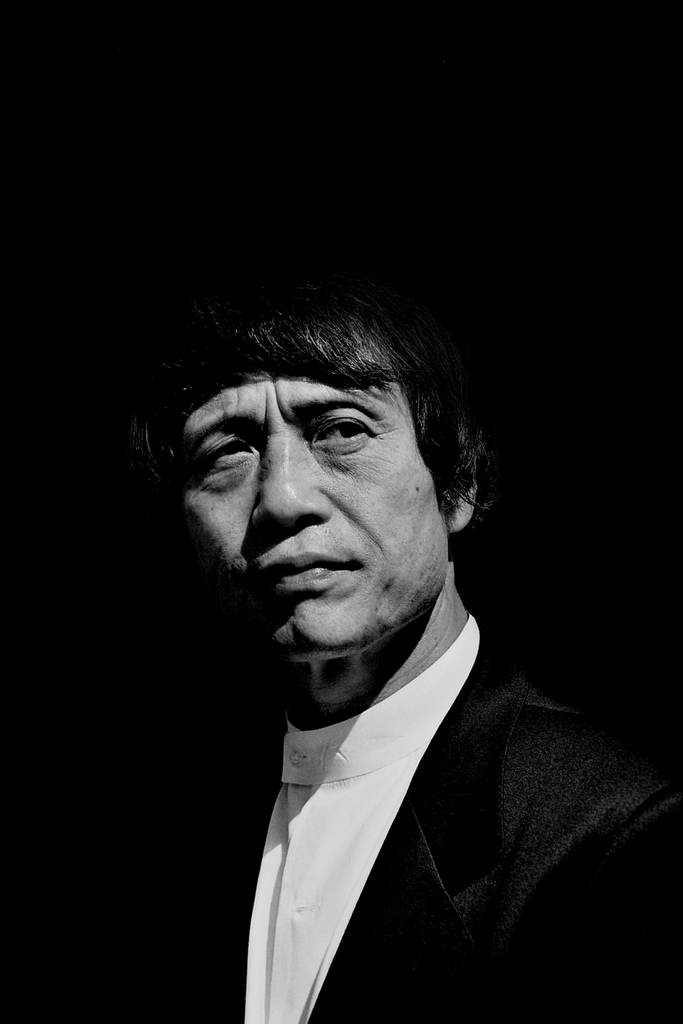

Photo: Christopher Schriner, 2004, CC BY-SA 2.0 · Wikimedia Commons, 'Tadao Ando 2004.jpg' -- photograph by Christopher Schriner (Cologne), taken September 2004 at the opening of the Langen Foundation exhibition building, Germany; Flickr source passed an automated Flickr licence review (6 January 2011) as CC BY-SA 2.0. Original 683 x 1024 pixels, saved unchanged, never upscaled. · CC BY-SA 2.0
architect · Contemporary
Tadao Ando
b. 1941
Known For
Not yet included in personality matching — the documented evidence doesn't yet cover enough of the personality model. Everything else on this page is fully available.
Trait Constellation
Key Achievements
Self-taught without formal architectural training, he built an architecture of smooth poured concrete, simple geometry and natural light.
Won the Pritzker Architecture Prize in 1995; the jury praised work that 'both serve[s] and inspire[s]' and a 'powerful inner vision'.
Designed landmark works such as the Row House in Sumiyoshi, the Church of the Light, and the Chichu Art Museum on Naoshima.
Moments That Reveal Them
For the Chichu Art Museum on Naoshima, the building was largely sunk into the hillside, with every artwork to be lit by natural light.
This is consistent with a sustained sensitivity to light and spatial atmosphere. Aesthetic Sensitivity
In the Row House in Sumiyoshi (1976), a windowless concrete front hid a roofless courtyard that residents had to cross to move between rooms.
This is consistent with a willingness to put an original idea ahead of conventional convenience. Creative Originality
Turning Points
In 1969, at 28, he opened his own practice in Osaka rather than Tokyo, and the Row House in Sumiyoshi (1976) then brought him wide recognition.
This is consistent with a self-directed career path built outside the usual route. Independent Thinking
Similar People
People whose overall profiles resemble theirs.

James Joyce

Yayoi Kusama

Sigmund Freud

Wolfgang Amadeus Mozart

Oscar Niemeyer
Opposite Profile
Not a rival — a different profile shape worth a look.
Alexander Hamilton
Sources
- Tadao Ando (Q208220) -- verified live via the Wikidata API (2026-10-23): English label 'Tadao Ando', description 'Japanese architect (born 1941)', born 13 September 1941, no date of death, citizenship Japan, Korean label '안도 다다오', P18 image 'Tadao Ando 2004.jpg'. Orientation only; not used as support for any row.
- The Pritzker Architecture Prize, 'Tadao Ando -- Laureate 1995' page (pritzkerprize.com), read in full: the jury citation (work as 'an assemblage of artistically composed surprises in space and form'; a 'powerful inner vision' that ignores passing movements, schools and styles; linked to international Modernism and the Japanese aesthetic tradition), Jay A. Pritzker's remark that Ando 'conceives his projects as places of habitation not as abstract designs in a landscape' (presentation on 22 May 1995 at Versailles), and the laureate biography: woodworking learned from a carpenter as a boy, a brief boxing stint, short apprenticeships, self-study of temples, shrines and teahouses in Kyoto and Nara, study trips to Europe and the United States in the 1960s with detailed sketching, a secondhand Le Corbusier book whose drawings he traced until the pages 'turned black' (self), and a description of his method (thick concrete walls, basic geometry, watertight varnished wooden formwork for a smooth finish, evenly spaced formwork bolt holes left visible, light as a central element) with a list of works (Azuma House 1977, Church on the Water 1988, Church of the Light 1989, Naoshima Contemporary Art Museum 1992, Japan Pavilion Expo '92, Rokko Housing). CANONICAL SIGNIFICANCE SOURCE (award body; admiring institutional record). The speech texts it links to were not opened.
- Encyclopedia.com compilation of reference entries 'Ando, Tadao' (Gale 'Newsmakers 2005 Cumulation' and 'Encyclopedia of World Biography', and James Stevens Curl's 'A Dictionary of Architecture and Landscape Architecture', Oxford), read in full: professional boxing at 17 after his twin brother, travels in Japan, Europe and the United States (Oxford adds Africa), carpenter apprenticeship, self-training through the four-year architecture-student reading list in one year, being dismissed from apprenticeships for 'stubbornness and temper' (self-reported, 1993/2005 interview material), opening his practice in Osaka in 1969 rather than Tokyo, the Row House in Sumiyoshi (Azuma House, 1976; Architectural Institute of Japan annual prize 1979), his habit of pressing clients to accept unconventional designs, high-quality cast concrete, comparisons with Kahn, Le Corbusier and Mies, and critiques (Manchester Piccadilly Gardens mixed reviews, a 'defensive' inward-turning architecture, 'domesticated' nature). Independent reference compilation with some critical notes; some dates differ between entries (Azuma House 1976 vs 1977/1979), so only the Gale 1976 date is used here.
- Kieran Long, 'Tadao Ando' profile, Icon magazine (issue 039, September 2006; online 2007), read in full: a critical profile written after a London press breakfast following his City of London Festival lecture -- no formal architectural education, a 1965 trip to Paris by Trans-Siberian express to meet Le Corbusier (arriving weeks after his death), his early Osaka schemes repeatedly rejected by city authorities, his statement that there is 'no direct correlation' between architecture and boxing 'except that you're on your own', his corporate clients (Novartis in Basel, Armani in Milan), the Omotesando Hills redevelopment for developer Minoru Mori (137 dwellings and one shop in the 1927 Dojunkai apartments replaced by 38 dwellings and 93 commercial units, per critic Julian Worrall), the author's view that the 'perfect concrete' look now seems familiar and cold, and an account of Ando ending the interview abruptly ('I don't understand your questions'). Critical, independent press voice; the author's comments on Ando's manner are interview-room impressions and are not used as a character judgement.
- Google Arts & Culture story 'Early Life' on Tadao Ando (artsandculture.google.com), read in full: raised by his grandmother in an Osaka neighbourhood of woodworkers and metalworkers, building from scrap wood, a roof-hole light episode he treats as the origin of his architecture (self-attributed), boxing from high school with a professional debut at 17 and quitting after watching Fighting Harada spar, self-study while working at interior and furniture design firms, a 1960s European trip by ship and the Trans-Siberian Railway to see the Parthenon, the Pantheon and Le Corbusier's buildings, founding his Osaka studio in 1969, the Urban Guerrilla Houses (1972; only the Tomishima House, 1973, built) and the Row House in Sumiyoshi (1976) that brought him wide recognition, and his insistence that 'architects are made through traveling' (self). Institutional digital-exhibit narrative, admiring; the publisher partner of the story was not verified and its dates for the European trip differ from other sources (1964 vs 1965), so trip dates are not relied on.
- 'An Architect's Paradise: The Hidden Treasures of Tadao Ando's Art Island', Architizer Journal (by 'The Angry Architect'; undated), read in full: Ando's Naoshima buildings -- the Chichu Art Museum, largely sunk into the hillside, where 'every piece of art would be lit by natural light sources' with rooms designed around specific works by Monet, Walter De Maria and James Turrell; the Benesse House Museum; the Lee Ufan Museum, where the artist wanted a gallery wall white against Ando's preference for grey; and the Ando Museum inserting concrete planes inside a traditional timber house. Independent architecture-press travel feature, admiring in tone; no construction years or commissioning details given.
- Cat Garcia Menocal, 'tadao ando's green wall of hope incites controversy', designboom, 27 June 2013, read in full: Ando's planned 78-metre green wall (stainless-steel net, 900 planters) in the grounds of the Shin Umeda City complex in Osaka; landscape architect Motoo Yoshimura, who designed the ground-level garden, filed a petition to suspend construction, arguing it would fundamentally change the identity of his garden and violate copyright law. No response from Ando is reported and no outcome is given. Independent trade-press report of a professional dispute; one-sided in what it reports.
- Wikimedia Commons file page 'Tadao Ando 2004.jpg' (wikitext and API record) -- checked for the portrait's licence: photograph by Christopher Schriner (Cologne), taken September 2004 at the opening of the Langen Foundation exhibition building, Germany; Flickr source passed an automated Flickr licence review on 6 January 2011 as CC BY-SA 2.0; original 683 x 1024 pixels. Not used for any scoring.