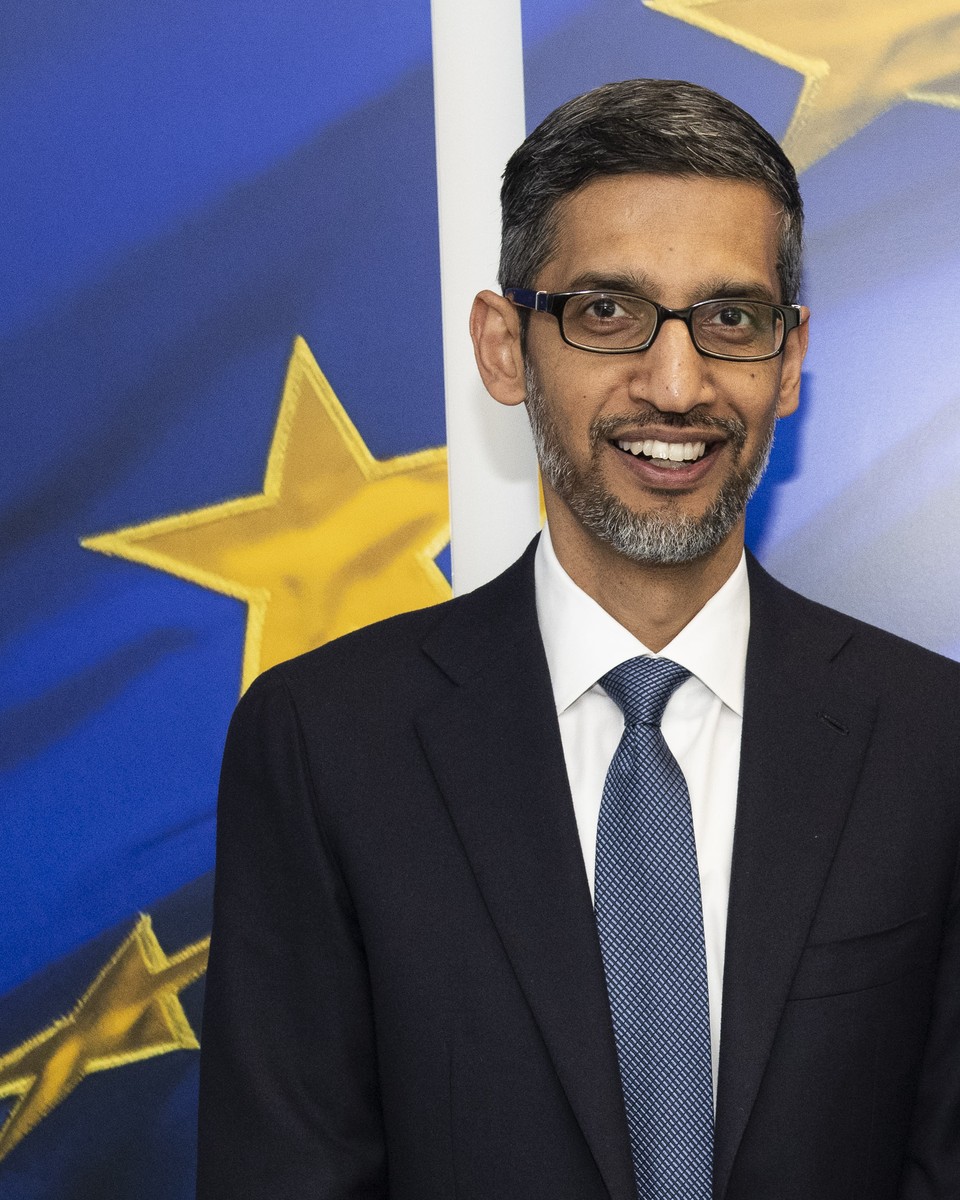

(c) European Union, 2023, licensed under CC BY 4.0. Photo: Lukasz Kobus, European Commission; cropped and resized · European Commission Audiovisual Service photograph P-061142/00-14, 'Visit of Sundar Pichai, CEO of Google, to the European Commission', 24 May 2023, Brussels (Berlaymont), photographer Lukasz Kobus (European Commission). Downloaded the Wikimedia Commons original of 'Pichai-Schinas meeting (2023).jpg' (5612 x 3741 pixels, 4,176,149 bytes, SHA-1 d55af0250fba5ca47582e2c653fab6af677104d3, matching the Commons record), uploaded by the Commons user Sikander on 2024-03-12 under the template for EC Audiovisual content, which links to the EC page above. EC Conditions of use (audiovisual.ec.europa.eu/en/conditions-of-use, read): EU-owned content is licensed under Creative Commons Attribution 4.0 International, reuse requires credit '(c) European Union, 202X, licensed under CC BY 4.0' and a clear statement of changes; the licence does not cover third-party copyright, personality or publicity rights, or logos. Changes: cropped to the left-hand subject (the EC Vice-President standing beside him is removed) and downscaled once to 960 x 1200 (never upscaled). Residual risk noted for the lead: the EC page warns that identifiable private individuals may need separate clearance, but the sitter is a public executive photographed at an official EC visit. · CC BY 4.0
executive · Contemporary
Sundar Pichai
b. 1972
Known For
Not yet included in personality matching — the documented evidence doesn't yet cover enough of the personality model. Everything else on this page is fully available.
Key Achievements
Sundar Pichai joined Google in 2004 as head of product management and development and worked first on the Google Toolbar, which made it easy to reach Google search from Internet Explorer and Firefox. Britannica says he was then directly involved in developing Google's own browser, Chrome, released in 2008, and Fortune reports that his argument that Microsoft could threaten the toolbar came shortly before Google approved Chrome, though it gives him no clear role in pitching it.
After Chrome's launch Pichai climbed through Google's product organisation. Britannica says he became vice president of product development in 2008, a senior vice president by 2012, and in 2014 product chief over both Google and Android. Fortune adds that he oversaw apps such as Gmail, took charge of Android when its founder Andy Rubin moved to Google's robotics work, and was then put in charge of most of the company's products apart from units such as YouTube.
When Larry Page and Sergey Brin created the holding company Alphabet in August 2015, Pichai was named CEO of Google, and in December 2019 he also became CEO of Alphabet. Britannica credits him with strongly supporting Alphabet's artificial intelligence initiatives, including Waymo and Google's Gemini chatbot, and says he oversaw products from the Pixel phones to Google Workspace and Google Cloud.
Moments That Reveal Them
Fortune reports that in tense 2006 talks with senior Google leaders, Pichai, then director of product management for the toolbar, argued that Microsoft could change Internet Explorer to block it and threaten a large part of Google's business; two unnamed executives described the stakes as severe, and Google approved Chrome shortly afterwards. Reuters quotes a former colleague saying he advanced his agenda through quiet advocacy rather than seeking attention.
This is consistent with arguing for a position inside the company through reasoned advocacy rather than public display. Persuasiveness
In February 2024, after Google's Gemini chatbot produced historically inaccurate images, Pichai told staff in a memo, published by Semafor, that the problems were unacceptable. Engadget reports that he said image generation would stay paused until a fix was developed and listed the changes needed first, including updated product guidelines, improved launch processes and more thorough testing and red-teaming.
This is consistent with publicly acknowledging an error and committing to process changes, although the evidence is his own memo. Belief Updating
Turning Points
In August 2015, when Larry Page and Sergey Brin announced the creation of Alphabet, Pichai was named CEO of Google. Reuters reports that colleagues said he had never seemed destined for the top job, with other executives mentioned as possible chiefs, and that he rose from the toolbar through Chrome, Gmail and Android; Britannica says it came as no surprise to industry insiders.
This is consistent with a rise built on working relationships and results across roles rather than on a long-signalled path to the top. Collaboration
Similar People
People whose overall profiles resemble theirs.

Niels Bohr

Catherine the Great

Nelson Mandela

Elizabeth Cady Stanton

Benjamin Franklin
Sources
- Sundar Pichai (Q3503829) -- verified live via the Wikidata API (2026-10-22): English label 'Sundar Pichai', description 'Indian-American business executive, CEO of Google LLC & Alphabet Inc.', born 1972-06-10, no date of death, citizenship United States and India, Korean label present. Orientation only; not used as support for any row.
- Encyclopaedia Britannica, 'Sundar Pichai' (biography entry by Melinda C. Shepherd; britannica.com) -- read in full for his career: joined Google in 2004 as head of product management and development, working first on the Google Toolbar for Internet Explorer and Firefox; directly involved in developing the Chrome browser released in 2008, when he became vice president of product development; senior vice president by 2012; product chief over Google and Android in 2014; named CEO of Google when Alphabet was created in August 2015 and CEO of Alphabet in December 2019; and, as CEO, support for AI initiatives, Waymo, the Gemini chatbot, Pixel, Nest, Workspace, Meet, Wing and Cloud. Education and early-life passages, the account of retention offers and personal details were read and not used. Encyclopedic summary, uncritical in tone. CANONICAL SIGNIFICANCE SOURCE (his primary historical contribution: Google's browser and product leadership and then its chief executive role).
- Miguel Helft, 'Google: The rise of Sundar Pichai' (Fortune, 27 October 2014) -- read in full: as director of product management he led the Google toolbar that made Google the default search engine in Internet Explorer and Firefox; his argument in tense 2006 talks that Microsoft could change Internet Explorer to block it and threaten a large part of Google's business, after which Google approved Chrome (the article gives him no clear role in pitching Chrome to the founders); the chaotic 2008 Chrome launch after a blogger posted the comic book early; promotion to vice president and senior vice president, oversight of apps including Gmail, a seat on the executive team, then Android and most of Google's other products; a 'warm, easygoing rapport' with Larry Page. Business-press profile written when he was promoted; admiring and without critical voices, with unnamed executives as sources for the 2006 episode.
- Reuters (via The Daily Star), 'New Google CEO made ascent with low-key style' (August 2015) -- read in full: he joined shortly before the 2004 IPO, was not seen as destined for the top job (Salar Kamangar, Marissa Mayer and Susan Wojcicki were also mentioned), and rose from the toolbar through Chrome, apps such as Gmail and Android to lead the 'slimmed-down' Google under the new Alphabet; named colleagues' characterisations: former Google colleague and investor Keval Desai says he advanced his agenda through quiet advocacy and was 'very good at letting other peoples' opinions emerge before he gives his own', Jive Software executive chairman Tony Zingale calls him 'incredibly insightful and direct' as an outside director, and Google product manager Chris Beckmann (on Quora) says he 'excels at managing relationships'; an 'often difficult relationship' with partners such as Samsung. News-agency profile; admiring, no direct criticism.
- Alice Truong, 'Get to know Sundar Pichai, Google's new CEO' (Quartz, republished by Nextgov, 15 August 2015) -- read in full: the toolbar and Chrome origins as retold from the 2010 Fortune story; he took over Android in 2013 after Andy Rubin's move, reported by Bloomberg as under somewhat contentious circumstances, with Pichai saying they 'never had any major disagreements'; generally described as 'a nice guy' who handled company politics diplomatically; praised by employees as a compassionate leader who recruited, mentored and invested in his team; Nicholas Carlson's note that his career rose as Marissa Mayer's stalled. Largely a digest of the Fortune and Bloomberg reporting, so not independent of them; admiring.
- Sundar Pichai, 'A difficult decision to set us up for the future' (message to Googlers published on Google's blog, January 2023) -- read in full: the announcement of about 12,000 job cuts across Alphabet, the reasons given (rapid hiring in the previous two years for an economic climate that no longer applied; a review of product areas and functions; a priority on AI), his statement that he takes 'full responsibility for the decisions that led us here' and is 'deeply sorry', and the support offered (notice pay of at least 60 days, severance from 16 weeks, accelerated vesting, 2022 bonuses, six months of healthcare, job placement and immigration help). The subject's own corporate statement; used only for what he publicly said and committed to, not for how it was received.
- CNBC, 'Google employees criticize CEO Sundar Pichai for rushed, botched announcement of GPT competitor Bard' (10 February 2023) -- read in full: staff criticism on the internal Memegen forum of the handling of the Bard chatbot announcement (messages 'viewed by CNBC' calling it 'rushed', 'botched' and 'un-Googley', one meme asking him to 'return to taking a long-term outlook'); the sequence in which Google had Pichai disclose details on Monday to get ahead of a Microsoft event, followed by a thin Paris event on Wednesday; an error in a Bard ad about a telescope; a share fall of more than 9% that week; a December all-hands in which executives said the company's reputation could suffer if it moved too fast on AI chat; and that a Google representative did not immediately respond. COUNTER-VOICE: critical reporting built on anonymous employee memes, not on measured assessment.
- Lawrence Bonk, 'Google CEO says Gemini image generation failures were unacceptable' (Engadget, 28 February 2024) -- read in full: Pichai's internal memo (published by Semafor) calling the Gemini image-generation problems 'unacceptable', saying the team was working around the clock on a fix and would keep image generation paused until it was developed, and listing the changes needed first (structural changes, updated product guidelines, improved launch processes, more thorough evaluations and red-teaming, technical recommendations); Google executive Prabhakar Raghavan's explanation of tuning errors and over-caution; the author's own commentary on how hard tuning models is. Trade-press report of a leaked memo; the memo is the subject's own statement, and the reported actions (the pause) are the only external evidence of follow-through.
- European Commission Audiovisual Service, photograph P-061142/00-14 'Visit of Sundar Pichai, CEO of Google, to the European Commission' (24 May 2023, Brussels; photographer Lukasz Kobus) and the Audiovisual Service's Conditions of use page, with the Wikimedia Commons records for the file 'Pichai-Schinas meeting (2023).jpg' and its crop 'Sundar Pichai - 2023 (cropped).jpg' -- checked for the portrait's licence only: EU-owned content licensed under Creative Commons Attribution 4.0 with credit and a statement of changes, with exclusions for third-party rights, personality rights and logos. Not used for any scoring.