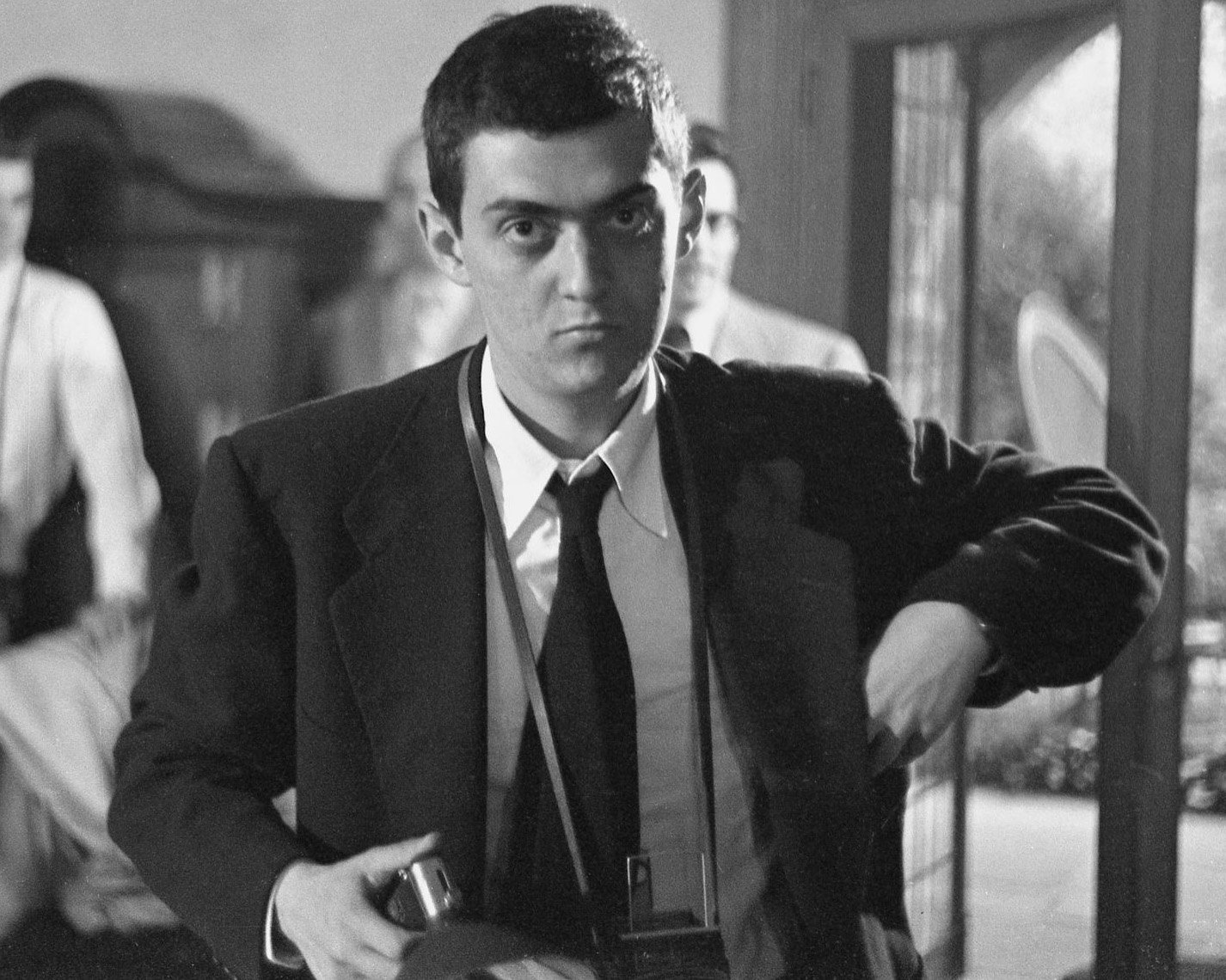
Phillip Harrington, photographer, LOOK Magazine Photograph Collection, Library of Congress, Prints & Photographs Division, LC-DIG-ds-01160 (1949) · Library of Congress, LOOK Magazine Photograph Collection (Cowles Communications; LOOK Job 49-U31 'Sadler's Wells Ballet', reproduction number LC-DIG-ds-01160), via Wikimedia Commons · Public domain (LOC LOOK Magazine Photograph Collection; Commons PD-Look)
Trait Constellation
Key Achievements
For Barry Lyndon, Kubrick used a Zeiss Planar 50 mm f/0.7 lens, of a type of which only ten were made, six of them for NASA. Cinema Products president Ed DiGiulio adapted it to Kubrick's Mitchell BNC camera so that candlelit interiors could be filmed without added fill light. DiGiulio wrote in American Cinematographer that Kubrick wanted to preserve the natural patina of old castles at night, and that the whole film was push-developed one stop.
In 1974 Kubrick received a demonstration film made with the prototype Steadicam and replied to Cinema Products by telex. For The Shining he had many sets designed with the Steadicam's possibilities in mind, and operator Garrett Brown, writing in American Cinematographer in August 1980, states that every frame of the hedge maze was shot with it.
Kubrick wrote to Arthur C. Clarke in late March 1964 proposing a collaboration on a science-fiction film, and the two met at New York's Plaza Hotel on 22 April 1964. A 1999 retrospective says Kubrick personally supervised the effects team for 2001, which included Douglas Trumbull, who developed the Slit Scan machine used for the Star Gate sequence. The film opened on 2 April 1968.
Moments That Reveal Them
2001: A Space Odyssey opened on 2 April 1968. Kubrick observed that early audiences disliked it, and between 5 and 9 April he and editor Ray Lovejoy cut about 19 minutes, sending instructions to theatres already showing the film. He explained that it takes a few showings to settle how long scenes should run, and said he did not think the trims made a critical difference.
The re-cut is consistent with a willingness to revise a finished work after watching audiences respond. His own remark that the trims mattered little to those who liked or disliked the film suggests the change in his view of the work itself was limited. Belief Updating
According to Warner publicist Julian Senior, speaking in London in February 1980, Kubrick learned that the walls and ceiling of a New York cinema due to show A Clockwork Orange were painted in shiny white lacquer that would cause reflections. He sent from London a list of Manhattan firms able to erect scaffolding and repaint, and a few days later asked which black was being used, since a gloss black would cause the same problem. The walls were repainted in matte black.
Senior presents the episode as an example of Kubrick's precision in technical matters. It is consistent with attention to the conditions in which a finished film is seen, not only to the film itself. Detail Orientation
Turning Points
In 1959, a few days into shooting Spartacus, Kirk Douglas asked the Harris-Kubrick company to lend him Kubrick to replace the film's first director, and the company agreed, partly because the arrangement brought it money, according to producer James B. Harris. Kubrick later said his experience showed that his decisions were unlikely to be respected unless a contract stipulated it.
His remark is consistent with a strong preference for holding decision-making authority. It is his own retrospective framing, not an independent account of what he would later have been able to control. Need for Autonomy
Similar People
People whose overall profiles resemble theirs.

Rosalind Franklin

Marie Curie

Sigmund Freud

Carl Jung

Ada Lovelace
Sources
- Stanley Kubrick -- orientation only (birth/death dates, citizenship, feature-film list and years, 1961 move to England, Look staff-photographer years); not used as support for any scored row. Fetched and read.
- Stanley Kubrick (Q2001) -- identity verified live via the wbgetentities API: label 'Stanley Kubrick', description 'American filmmaker and photographer (1928-1999)', born 26 Jul 1928, died 7 Mar 1999, ko label '스탠리 큐브릭', P18 'Stanley Kubrick (1949 portrait by Phillip Harrington - cropped).jpg'. Orientation only.
- Ed DiGiulio (president, Cinema Products Corp.), 'Two Special Lenses for Barry Lyndon', American Cinematographer (1976; issue date not stated on the page), mirrored on The Kubrick Site (visual-memory.co.uk) -- FIRSTHAND supplier's account (non-self for Kubrick; the author sells the equipment he describes) of the 1972-75 adaptation of a Zeiss f/0.7 lens to a Mitchell BNC, the 36.5 mm adapter, the 24 mm lens Kubrick rejected, the 20-to-1 zoom, push-processing of the whole film and Kubrick's stated reasons. The page's TLS certificate has expired, so it was fetched over plain HTTP with curl and read in full (page 1 of 1; pages 2-3 return 404).
- Garrett Brown, 'The Steadicam and The Shining Revisited', American Cinematographer (original Aug 1980; revised 1 Mar 2022; theasc.com) -- FIRSTHAND operator's account (non-self) of the 1974 Kubrick telex about the Steadicam demonstration film, the sets designed for Steadicam use, take counts and framing demands, the 'harp test' variant, the rebuilt track and the year-long shoot. Fetched (whole article via WebFetch extraction); every passage cited was checked against the raw page text.
- 'Interviews with Colleagues' on The Kubrick Site (visual-memory.co.uk), excerpted from Michel Ciment, Kubrick (1982): interviews with producer James B. Harris (Cannes, May 1973), production designer Ken Adam, cinematographer John Alcott (London, Feb 1980) and Warner publicist Julian Senior (London, Feb 1980) -- four distinct FIRSTHAND colleague accounts (non-self) of Kubrick's preparation, sets, lighting, take practice, release and exhibition supervision. Ciment is the interviewer/compiler common to all four, so the page is counted conservatively as one source record although the speakers differ. TLS certificate expired; fetched over HTTP with curl and read in full.
- Nick Pinkerton, 'Interview: James B. Harris (Part One)', Film Comment (undated on the page) -- FIRSTHAND account (non-self) by Kubrick's producing partner of the Harris-Kubrick company from 1955, the Brando/One-Eyed Jacks arrangement, Spartacus (Kirk Douglas asking to borrow Kubrick), Lolita's script and its UK production (economic incentive) and the Red Alert-to-Dr. Strangelove satire decision. Fetched; the passages cited were checked against the raw page text (a long interview, not every line read).
- Sam Wigley, 'Producing The Shining: Jan Harlan on Kubrick', BFI, 31 Oct 2012 -- FIRSTHAND account by Kubrick's executive producer and brother-in-law (non-self): the Warner offer of The Shining, Kubrick's condition of writing what he wanted, and his agreeing to shorten the film for release outside the US ('He was not that stubborn'). All Harlan interviews and quotes (this, Sight and Sound, Zeiss) count as ONE perspective. Fetched and read in full.
- Nick Wrigley, 'The right-hand man: Jan Harlan on Stanley Kubrick', Sight and Sound / BFI (published 2013, page shows 'Updated: 22 November 2019') -- Harlan on Traumnovelle (Warner contract 1970, postponed, revisited before The Shining, abandoned again, realized as Eyes Wide Shut), weekend home viewings, and 'Fast he was not - neither was Vermeer'. Same Harlan perspective as src_kubrick_harlan_bfi. Fetched; the interview text was read from the raw page (the Room 237 and exhibition sections were skimmed).
- ZEISS press release, '(Probably) the most famous lens in the world comes back home', 21 Sep 2022 -- carries Jan Harlan's first-person recollection of how Kubrick learned of the Planar 0.7/50 in American Cinematographer, was told by Zeiss it could not be used on a motion-picture camera, and pursued the question; a company page re-telling Harlan, so the SAME Harlan perspective (and the same episode DiGiulio describes from his side). Fetched and read.
- Kaleem Aftab, 'I'm Envisaging a New Kind of Movie: SFX Legend Douglas Trumbull on Kubrick, Malick and the Future of Film', Filmmaker Magazine, 28 Aug 2013 -- FIRSTHAND interview with the 2001 effects artist (non-self): Kubrick's command of technology, the moon-terrain disagreement ('agreed to disagree'), the Saturn-to-Jupiter switch and his backing of the spherical scanner. Fetched; the passages cited were checked against the raw page text; the Kodak perforation call is reported by Trumbull only as a 'legendary story' and is not used as a documented episode.
- Scott Tennent, 'Full Metal Jacket Diary: A Q&A with Matthew Modine', LACMA Unframed, 4 Mar 2013 -- FIRSTHAND actor's interview (non-self): Kubrick's use of repetition to strip actors' posing, about two years in London on the shoot (stated in the interviewer's question and not disputed), Kubrick encouraging Modine's diary. Modine's remarks on Kubrick's temperament and his own family are not used. Fetched; the Q&A was read from the raw page text through the diary answers.
- Thomas E. Brown, '2001's Pre- and Post-Premiere Edits', The Kubrick Site (undated) -- secondary research note quoting Kubrick's own remarks: 2001 opened 2 Apr 1968, early audiences and reviews were unfavourable, Kubrick and editor Ray Lovejoy re-cut it 5-9 Apr 1968 (about 19 minutes), and the helmetless airlock sequence was kept once published experiments suggested it was survivable. Quotes from Kubrick are self-reported; the perspective is the author's. TLS certificate expired; fetched over HTTP with curl; the premiere/trims section and Kubrick quotes were read, the shot-by-shot reconstruction of the trims was not used.
- George D. DeMet, 'The Special Effects of 2001: A Space Odyssey', DFX (July 1999), reproduced on The 2001 Archive -- secondary retrospective: pre-production from mid-1965, consultants Ordway and Lange, the monolith models rejected, the corset-factory effects reel used to sell the film, the Slit Scan machine. Fetched; read from the raw page text (the closing effects paragraphs were skimmed). Quotes Kubrick's published remark on 'completely convincing' effects (self).
- Fondation Napoleon page for Alison Castle (ed.), Stanley Kubrick's Napoleon: The Greatest Movie Never Made (Taschen, 2011) -- reproduces the PUBLISHER's blurb (promotional language): about two years of research, dozens of assistants, an Oxford Napoleon specialist, about 15,000 location photographs and 17,000 slides. Counted as one secondary/publisher perspective and only corroborating the firsthand Alcott account. Fetched and read.
- Tim Greiving, 'From Kubrick to Spielberg: The Story of A.I.', The Ringer, 29 Jun 2021 -- long-form retrospective drawing on Aldiss, Ian Watson's essay, Sara Maitland, Jan Harlan and Bonnie Curtis: the Brian Aldiss story kindled in 1977, revived 1982, writers cycled through to 1995, the November 1993 announcement after Jurassic Park, and Harlan's statement that Kubrick believed Spielberg the better director for it. Secondary; Harlan's quote is the same Harlan perspective. Fetched; the passages cited were checked against the raw page text.
- A J Black, 'Spartacus | Stanley Kubrick and the wrong Mann', Film Stories, 9 Sep 2024 -- secondary feature: Anthony Mann's replacement, Kubrick's requests on set (Rome extras, soundstages, a battle scene), his disputes with Douglas, Trumbo and Russell Metty, and his later remarks (to Gene D. Phillips and Charles Kohler) about decisions not being respected. The remarks are Kubrick's own (self); the author's claim that it was the last film without his control is one writer's characterization. Fetched; the Kubrick/Spartacus sections were read from the raw page text.
- Sam Wigley, 'The letter from Stanley Kubrick that started 2001: A Space Odyssey', BFI, 3 Dec 2014 -- reproduces and describes Kubrick's late-March 1964 letter proposing a science-fiction collaboration with Arthur C. Clarke (three stated areas of interest), Clarke's 8 April reply and the 22 April 1964 Plaza Hotel meeting; letters courtesy of SK Film Archives LLC. The letter is Kubrick's own words (self); the dated action is what is used. Fetched and read in full.