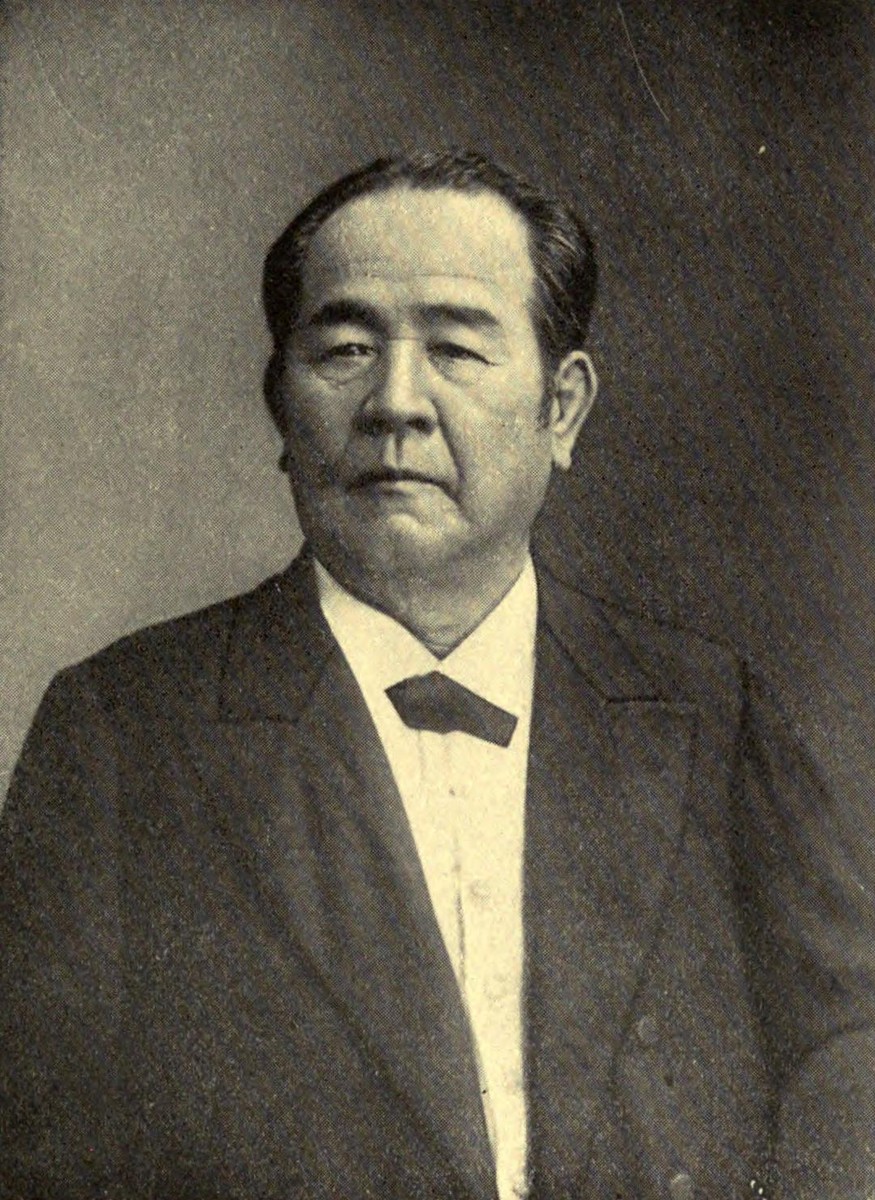
Unknown photographer, Viscount Eiichi Shibusawa, plate in David Starr Jordan, The Days of a Man, volume 2 (Yonkers-on-Hudson: World Book Company, 1922), Internet Archive copy from the University of California Libraries, public domain · Halftone photographic plate captioned 'Viscount Eiichi Shibusawa' in David Starr Jordan's memoir The Days of a Man, volume 2 (World Book Company, Yonkers-on-Hudson, New York, 1922), facing page 370, as scanned by the Internet Archive from a University of California Libraries copy (the scan is the leaf after page 369; the Internet Archive marks the item as not in copyright in the United States). The photographer is not named; the photograph shows an older man in a dark suit and bow tie and is the sitter's own portrait photograph as printed by the book, with the sitter named by the printed caption. The book was published in the United States in 1922, more than 95 years ago, and Shibusawa died in 1931. The file is the Internet Archive page scan (2134 x 3472 pixels, rotated upright), cropped to the plate's left-hand photograph and reduced (downscaled only, never enlarged) from 1083 x 1485 to 875 x 1200 pixels; the right-hand plate (a different sitter) is not used. · Public domain (photograph published in the United States in 1922; photographer unknown)
entrepreneur · 19th Century
Shibusawa Eiichi
1840–1931
Known For
Not yet included in personality matching — the documented evidence doesn't yet cover enough of the personality model. Everything else on this page is fully available.
Trait Constellation
Key Achievements
After serving in the Ministry of Finance he left in 1873 to build private enterprise, becoming head of the First National Bank (forerunner of Mizuho Bank) and helping set up the stock exchange in 1878; he is known as the 'father of Japanese capitalism'.
Helped found or run roughly 500 companies, mostly in finance but also in paper, textiles, gas, railways and insurance, among them Oji Paper, Osaka Spinning and Tokyo Gas.
Backed education and charity, including the Commercial Training School that became Hitotsubashi University and Japan Women's University (where he was president), and taught that business should unite morality and economy, drawing on the Analects.
Moments That Reveal Them
In 1867 he joined the shogunal delegation to the Paris World Fair and stayed about a year and a half in Europe studying its social and economic systems, and after the Restoration he founded a joint-stock company in the Shizuoka domain.
This is consistent with a person who studied foreign institutions closely and then set out to build Japanese equivalents. Opportunity Sensing
Unlike Iwasaki Yataro of Mitsubishi, he is reported not to have tried to build a large family conglomerate and usually sold his stakes once companies could stand on their own.
This is consistent with a preference for pooling many investors' capital rather than concentrating control. Collaboration
Turning Points
In 1873, after about four years in the new government and a year as a senior Finance Ministry officer, he resigned to found and lead the First National Bank and move into private business.
This is consistent with choosing to build private institutions rather than remain in government service. Adaptability
Similar People
People whose overall profiles resemble theirs.

Akio Morita

Nelson Mandela

Mahatma Gandhi

Malala Yousafzai

Wangari Maathai
Opposite Profile
Not a rival — a different profile shape worth a look.
Rosalind Franklin
Sources
- Shibusawa Eiichi (Q704995), verified live via the Wikidata API (2026-11-01): label 'Shibusawa Eiichi', description 'Japanese industrialist known as the "father of Japanese capitalism" (1840-1931)', born 1840 (13 February or 16 March in the item's two values), died 11 November 1931, citizenship Japan, Korean label present, images include a portrait photograph. Orientation only; not used as support for any row.
- 'Shibusawa Eiichi: Japan's Moral Capitalist', Shapers of Japanese History series, Nippon.com (Nippon Communications Foundation, 23 October 2017; unsigned), read in full. CANONICAL SIGNIFICANCE SOURCE: the 'father of Japanese capitalism': born in 1840 to an affluent farming and indigo family, joined the 1867 shogunal delegation to the Paris World Fair and spent about a year and a half studying European economic systems, founded a joint-stock company in the Shizuoka domain at the start of the Meiji era, served in the Ministry of Finance and helped lay legal and administrative groundwork for modern corporate and financial systems, left government in 1873 and founded and helped run roughly 500 companies, mostly in finance (a key legacy being the First National Bank, forerunner of Mizuho Bank), was involved with roughly 600 charitable organisations in education and welfare until his death at 91, held that morality and business are inseparable. A general-interest article from a foundation that promotes Japan; favourable and says nothing about criticism.
- 'SHIBUSAWA Eiichi', National Diet Library, Portraits of Modern Japanese, biography entry, read in full: born 16 March 1840 and died 11 November 1931 in Saitama, a rich farmer's first son who served the Hitotsubashi family, attended the 1867 Paris International Exposition with Tokugawa Akitake, served in the new government from 1869 and as an officer of the Finance Ministry from 1872, retired from it in 1873, became general supervisor and president of the First National Bank and helped establish and develop Oji Paper, Osaka Spinning and Tokyo Gas, based moral education on the Analects and advocated harmony of morality and the economy, retired from business in 1916 but continued social, public and international friendship work, made baron in 1900 and viscount in 1920. A national-library biography with no rights statement for its portraits; a short, factual, neutral entry.
- 'Lessons from Shibusawa Eiichi', KIZUNA magazine, Public Relations Office, Cabinet Office, Government of Japan (25 January 2022; unsigned), read in full: sent to Europe at 27, rose to a senior Finance Ministry post and resigned at 33 for the private sector, took part in establishing and managing nearly 500 companies, associated with Japan's first bank (1873), the stock exchange (1878), the Commercial Training School (now Hitotsubashi University), Tokyo Jogakkan Schools for Women and Japan Women's University (where he was president), his doctrine of gapponshugi combining profit with public benefit, his emphasis on talent development and business education, and his selection as the face of the 2024 10,000-yen note. A promotional government publication; one-sided and says nothing about criticism.
- Peter Tasker, 'The Coming of Shibusawa: the Politics of Japan's New Banknotes' (first published in Japan Forward, 27 June 2024), read in full: founded or invested in over 500 companies including banks, insurers and breweries, recruited to the Ministry of Finance for his grasp of double-entry accounting and left after about a year to found Daiichi Bank, did not try to build a large zaibatsu like Iwasaki Yataro of Mitsubishi and usually sold his stakes once companies could stand on their own, founded Hitotsubashi University, rejected the official slogan of respect for bureaucrats and contempt for the people, quoted Peter Drucker's praise ('maximise talent, not profits'); the article's critical edge is aimed at Fukuzawa Yukichi, not at him. Opinion journalism by an investment analyst and commentator; admiring, with some unsourced anecdotes that were not used.
- Jason Morgan, review of John H. Sagers, Confucian Capitalism: Shibusawa Eiichi, Business Ethics, and Economic Development in Meiji Japan (Palgrave Macmillan, 2018), Quarterly Journal of Austrian Economics (Spring 2019), read in full: facts that Shibusawa was born to a small indigo farmer, studied the Analects, helped found hundreds of corporations, worked in the Ministry of Finance and then led the First National Bank, moved into the private sector in 1873, was a major philanthropist and called himself a 'person of practical affairs'; the reviewer's criticism that Sagers never defines capitalism and that Shibusawa's close ties to government undercut calling him a capitalist reformer. Academic book review from a market-liberal journal; a counter-voice, not a biography.
- Hakushika Memorial Museum of Sake, 'Shibusawa Eiichi and Tatsuuma Kichizaemon' (Sake Talk column, 1 July 2024; unsigned), read in full: a 12 November 1901 letter from Shibusawa about the Seoul-Busan (Gyeongbu) railway, which the page says he strongly promoted, urging a second stock offering and asking a sake brewer to take a share and ask his family to invest (no record that he did), and his earlier part in a shipping company founded in 1882 in opposition to Iwasaki Yataro's Mitsubishi, which merged with Mitsubishi's shipping arm in 1885 to form NYK Line. A museum column based on one letter; narrow but documentary.
- Kim Jonghwa, 'New Face on Japan's 10,000 Yen Note: Shibusawa Eiichi', The Asia Business Daily (English edition, 1 July 2024; an AI-translated page), read in full: summarises him as founder of about 500 companies and 600 social-contribution organisations and as a pioneer of Japan's first bank and stock exchange, and reports Korean criticism of him for laying railways on the Korean Peninsula and for the Dai-Ichi Bank notes issued in Korea from 1902 to 1904, quoting a Korean university professor who objected to the new banknote; the railway and banknote claims are stated without sources. Korean news report; a counter-voice about his Korea-related business ventures, not independent verification, and its page warns of translation errors.
- David Starr Jordan, The Days of a Man, volume 2 (World Book Company, Yonkers-on-Hudson, 1922), Internet Archive copy from the University of California Libraries (page scan with the photographic plate captioned 'Viscount Eiichi Shibusawa', facing page 370), opened for the portrait review only. Not used for any row.