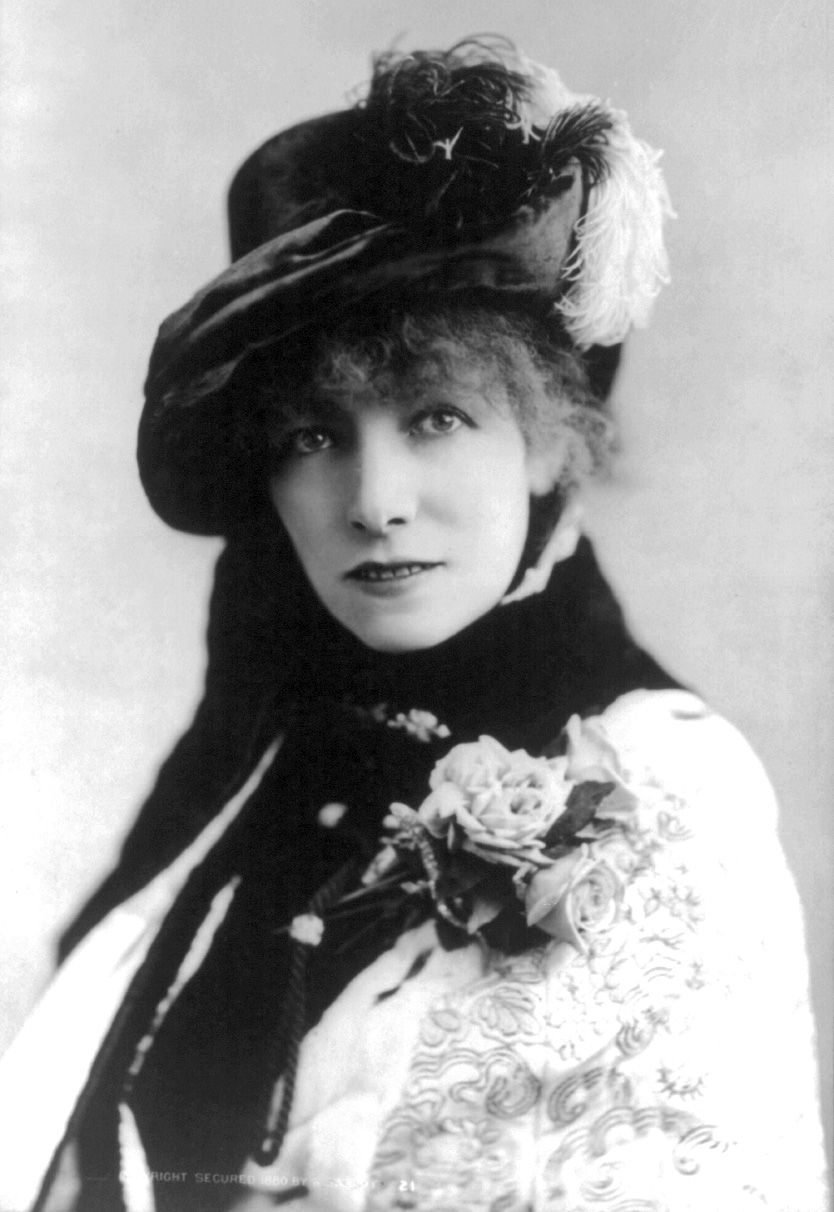

Napoleon Sarony, Sarah Bernhardt, 1880, public domain, Library of Congress via Wikimedia Commons · Bust-length portrait photograph of Sarah Bernhardt by Napoleon Sarony, 1880, from the Library of Congress Prints and Photographs collection (call number cph 3a38656), via Wikimedia Commons. The print itself bears the line 'Copyright secured 1880 by N. Sarony'. Used at the original 834 x 1212 pixel size with no resizing and no upscaling. · Public domain (photograph published in the United States in 1880; photographer died 1896)
actor · 19th Century
Sarah Bernhardt
1844–1923
Known For
Not yet included in personality matching — the documented evidence doesn't yet cover enough of the personality model. Everything else on this page is fully available.
Trait Constellation
Key Achievements
Called by Britannica the greatest French actress of the later 19th century: after triumphs at the Odeon and the Comedie-Francaise, including Zaire (1874), Phedre and Hugo's Hernani, she became an international star in La Dame aux camelias and Sardou's melodramas.
In 1880 she formed her own travelling company, touring Europe, the Americas and Australia, and she managed Paris theatres: the Renaissance from 1893 and from 1899 the former Theatre des Nations, renamed the Theatre Sarah Bernhardt, until her death in 1923.
Played male roles, including Hamlet in 1899 and Napoleon's son in L'Aiglon in 1900, and was among the early stage stars to make sound recordings and films.
Moments That Reveal Them
In 1880 she paid a large forfeit to break her contract with the Comedie-Francaise, gave a series of performances in London to cover it, and went on to tour Russia, Denmark and the United States with her own company.
This is consistent with a performer who chose independence over a secure national post. Need for Autonomy
She recorded Phedre at the home of the American inventor Thomas Edison in the 1880s and, from 1900, began to appear in films, playing some of her most famous stage parts.
This is consistent with an early readiness to use new media to reach larger audiences. Opportunity Sensing
Turning Points
After her 1879 London triumph with the Comedie-Francaise, she left it in 1880 to form her own company, and New York saw her for the first time on 8 November 1880, the first of eight American visits.
This is consistent with a career redirected from a national company toward an international touring career of her own. Leadership Drive
Similar People
People whose overall profiles resemble theirs.

Rabindranath Tagore

Mustafa Kemal Atatürk

Wu Zetian

Simón Bolívar

Hildegard of Bingen
Opposite Profile
Not a rival — a different profile shape worth a look.

Katherine Johnson
Sources
- Sarah Bernhardt (Q4605), verified live via the Wikidata API (2026-10-31): English description 'French stage actress, painter and sculptor (1844-1923)', born 1844-09-25 with conflicting October values, died 1923-03-23 with a conflicting 26 March value, country France, Korean label present, image 'SarahBernhardt1880.jpg'. Orientation only; not used as support for any row.
- Alois M. Nagler, 'Sarah Bernhardt', Encyclopaedia Britannica, read in full. CANONICAL SIGNIFICANCE SOURCE: 'the greatest French actress of the later 19th century and one of the best-known figures in the history of the stage'; Conservatoire in 1860, the Comedie-Francaise in 1862 (contract cancelled 1863 after a quarrel), the Odeon from 1866, Zaire (1874) and Phedre, where critics who doubted her revised their view, Doña Sol in Hugo's Hernani; her own travelling company formed in 1880, eight American visits and a 1891-93 world tour; manager of the Theatre de la Renaissance from 1893 and, from 1899, of the former Theatre des Nations, renamed the Theatre Sarah Bernhardt, until her death; Sardou's melodramas written for her; male roles including Hamlet (1899) and L'Aiglon (1900); the line that 'her career was also helped by her relentless self-promotion and her unconventional behaviour'; the warning that facts and fiction are hard to disentangle in her memoir. Reference entry by a theatre historian; the praise is retrospective.
- August W. Staub, 'Sarah Bernhardt', EBSCO Research Starters (2024), read in full: the Conservatoire prizes of 1861 and 1862, the Odeon and Comedie-Francaise years, sculpture exhibited at the Paris Salon in 1876 (honourable mention) and paintings in 1880, a large forfeit paid in 1880 to break her contract with the Comedie-Francaise, management of the Theatre Porte Saint-Martin from 1883 and of the Renaissance from 1893, a sound recording of Phedre made at Edison's home in the 1880s, eight feature films from 1900, three books and a stated total of 112 roles. Summary article; some biographical details differ from Britannica's, so only dated professional facts are used.
- University of Glasgow, 'Sara Bernhardt', biography entry in the Whistler Paintings catalogue project, read in full: actress, theatrical manager, painter and sculptor; left the Comedie-Francaise after a quarrel and set up her own troupe in 1880, designing her own clothes and working closely with her stage designers; studied sculpture and exhibited at the Salon through the 1870s and 1880s and abroad in London (1879), New York (1880), Chicago (1893) and Paris (1900); principal patron of Alphonse Mucha and Rene Lalique in the 1890s; an anecdote from W. Graham Robertson that she arrived late to a Whistler sitting and missed appointments. University research entry written for Whistler scholarship; neutral in tone, with the anecdote recorded second-hand.
- Paris Update, review of the Petit Palais exhibition 'Sarah Bernhardt: Et la femme crea la star' (2023), read in full: presents her, from about 400 objects, as an accomplished sculptor and painter, a hard-driving theatre manager and impresario, and an entrepreneur who made, lost and remade fortunes; her image used to advertise biscuits, face powder and absinthe; Mucha's posters for her roles; melodrama and deathbed scenes that critics took 'with a pinch of salt'; caricatures by Andre Gill showing her as 'a difficult woman'. Exhibition review by a Paris arts journalist; part of its text covers family history, health and politics, which is not used. A second review of the same exhibition (Artlyst) was also read and repeats these points, so it is not counted as an independent source.
- Deirdre Kelly, review of Arthur Gold and Robert Fizdale's biography 'The Divine Sarah' (Critics at Large, 2018), read in full: quotes the critics Francisque Sarcey and Alphonse Daudet in praise, and George Bernard Shaw's complaint that she 'does not enter into the leading character; she substitutes herself for it', says that by the end of the century her style seemed excessive to the new school, that she refused to perform Ibsen and Chekhov, and that the biographers are too admiring. Independent critical voice from a reviewer of a biography; much of the review is sensational about her private life, which is not used, and the claims about her later refusals are the reviewer's, not documented here.