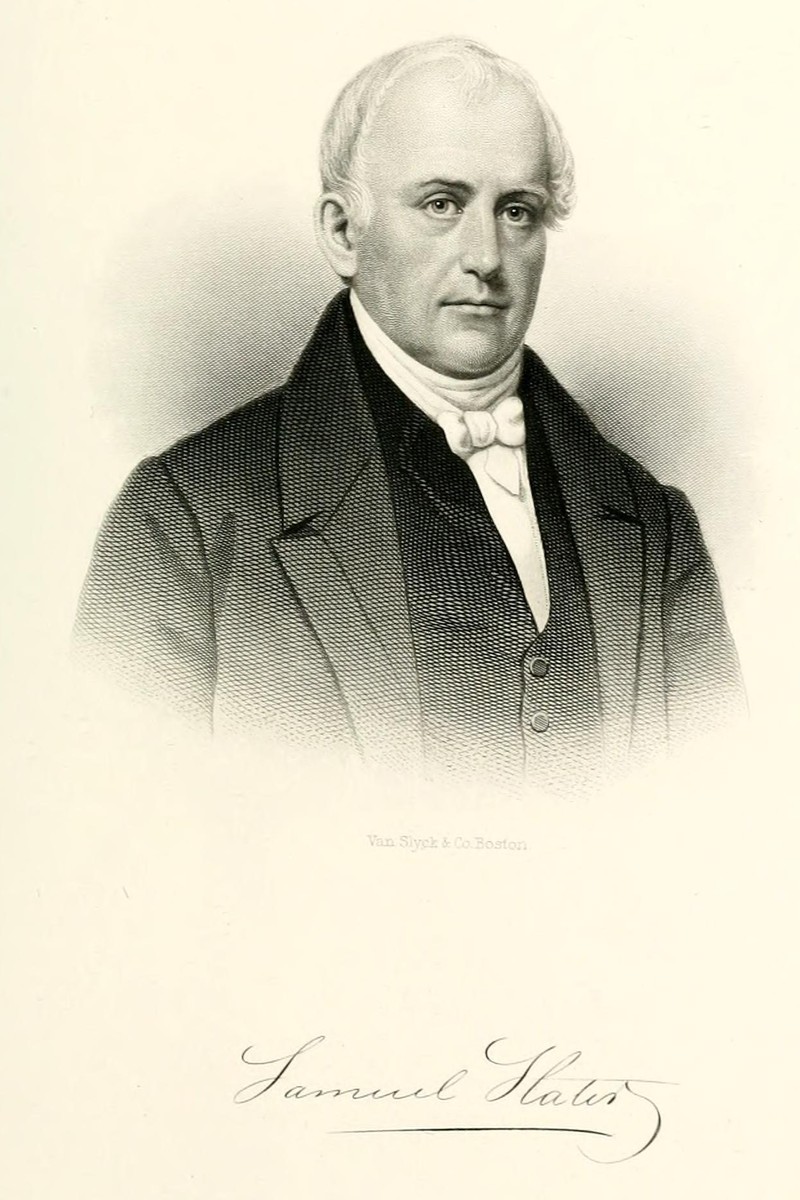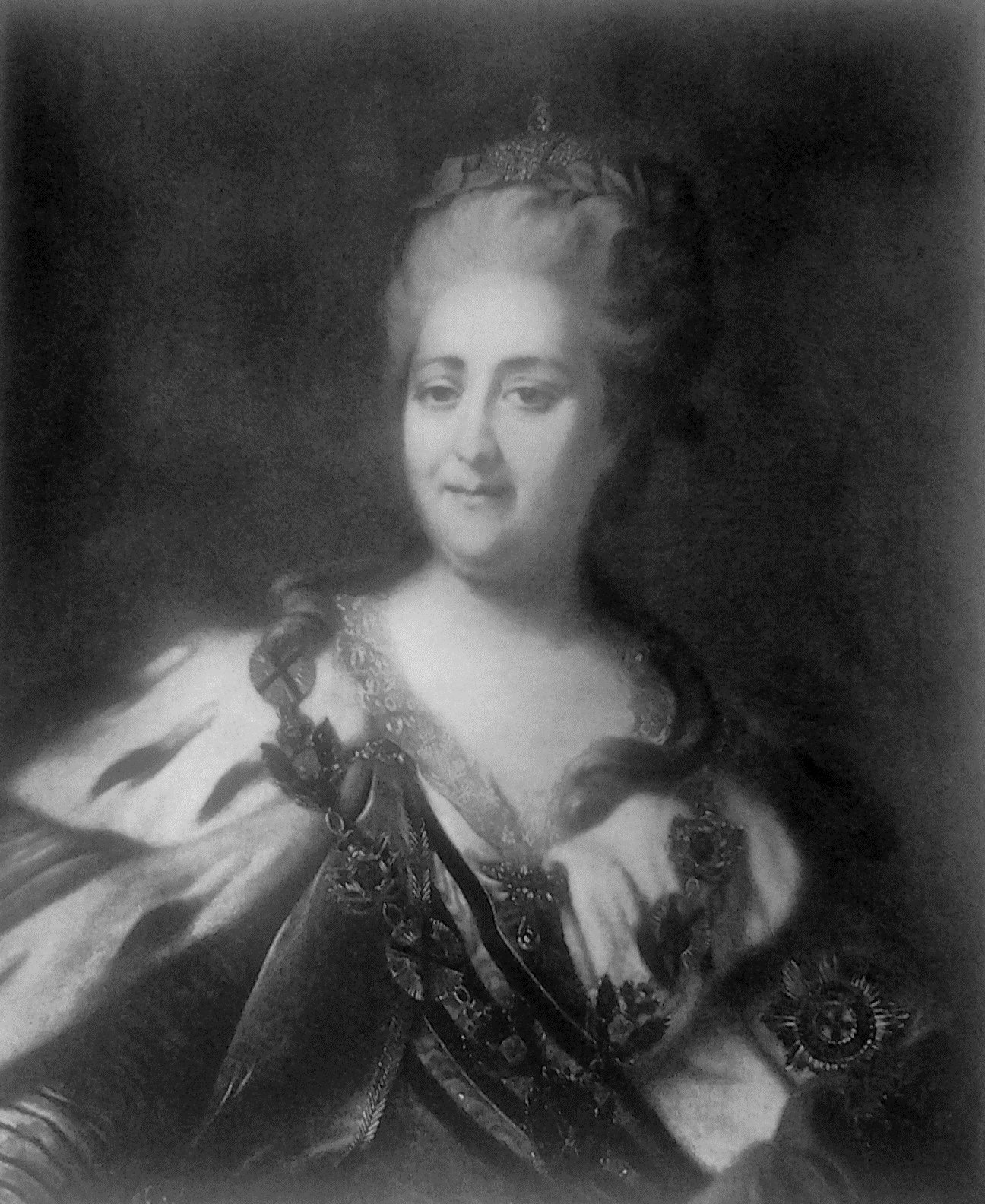

Van Slyck & Co., Boston, steel engraving in The Biographical Cyclopedia of Representative Men of Rhode Island, 1881, via the Internet Archive · Steel-plate portrait engraving of Samuel Slater, imprinted 'Van Slyck & Co. Boston' with a facsimile signature 'Samuel Slater', published as a plate in The Biographical Cyclopedia of Representative Men of Rhode Island (Providence: National Biographical Publishing Co., 1881); scan from the Internet Archive copy (Brigham Young University, Harold B. Lee Library), plate leaf 46. The page scan (2200 x 2979) was cropped to the oval portrait with its imprint and signature (1240 x 1860) and downscaled to 800 x 1200 with no upscaling. The Rhode Island Historical Society's 1986 article reproduces the same plate with the caption 'Samuel Slater, 1768-1835' from the same book (RIHS Collection). · Public domain: a US book published in Providence in 1881 (Internet Archive metadata: date 1881); a pre-1931 US publication, and the engraving was made about 46 years after the sitter's death
entrepreneur · 19th Century
Samuel Slater
1768–1835
Known For
Not yet included in personality matching — the documented evidence doesn't yet cover enough of the personality model. Everything else on this page is fully available.
Trait Constellation
Key Achievements
In December 1790, working for Moses Brown with local mechanics, he started up the first permanent American cotton-spinning mill in Pawtucket, Rhode Island, bringing British Arkwright-system technology to the United States.
He ran the 'Rhode Island System' of small rural spinning mills staffed by whole families, with children aged 7 to 12 among the first workers, a model that spread across New England and set the tone of early industrialization for about two decades.
A generation of millwrights and textile workers trained under him, and he built and financed mill villages such as Slatersville across southern New England until his death in 1835.
Moments That Reveal Them
On 2 December 1789, having heard that Moses Brown wanted a manager of cotton spinning, he wrote to offer his services, and then travelled to Pawtucket and judged Brown's existing machines would not work.
This is consistent with approaching an opening on his own initiative rather than waiting to be recruited. Proactive Agency
In 1789 he left England disguised as a farmer and told no one he was going, despite British restrictions on skilled textile workers emigrating.
This is consistent with accepting a legal and personal risk for a chance to build something new. Risk Tolerance
Turning Points
In 1797 he split from Almy and Brown and built a separate mill, the White Mill, with the Wilkinson family, which turned out thread continuously rather than filling custom orders.
This is consistent with pursuing his own model of continuous production over staying inside the existing partnership. Systems Thinking
Similar People
People whose overall profiles resemble theirs.

Akio Morita

Wu Zetian

T. E. Lawrence

Niels Bohr

Catherine the Great
Opposite Profile
Not a rival — a different profile shape worth a look.

Warren Buffett
Sources
- Samuel Slater (Q442104), verified live via the Wikidata API (2026-11-06): label 'Samuel Slater', description 'English-American industrialist', Korean label 새뮤얼 슬레이터, born 9 June 1768, died 21 April 1835 (a second value of 20 April is also recorded), citizenship United States and United Kingdom. Orientation only; not used as support for any row.
- National Park Service, Lowell National Historical Park, 'Early American Manufacturing' (read in full). CANONICAL SIGNIFICANCE SOURCE: Slater rose from apprentice to overseer in an English factory using the Arkwright system, left England disguised as a farmer, and in December 1790, working for mill owner Moses Brown, started up the first permanent American cotton-spinning mill in Pawtucket, mechanizing carding and spinning with a workforce of nine children aged 7 to 12; a generation of millwrights and workers trained under him spread mills across New England, and the 'Rhode Island System' of small rural spinning mills set the tone of early industrialization for two decades; the mill had over 100 workers by 1800. Federal park-service history, favourable but notes the child workforce.
- National Park Service, Blackstone River Valley National Historical Park, 'Samuel Slater' (read in full). Fifth son of a Belper farmer, trained in Jedediah Strutt's water-powered mill, left England secretly at 21, reached Pawtucket where Almy and Brown's attempts to run a mill had failed and had the first working water-powered textile mill a year later; created the 'Rhode Island System' using the whole family as workers, most noted for child labour (children 7 to 12 were the first employees); with his brother John built Slatersville, described as America's first planned industrial community; kept building and financing mill villages across southern New England until his death in April 1835. Park-service biography.
- National Park Service, Blackstone River Valley National Historical Park, 'Slater Mill' (read in full). Brown hired Slater in December 1789; Slater judged Brown's machines would not work and for several years worked with local mechanics such as the Wilkinson family to make new ones, getting them running in December 1790; he hired children who were paid for hours under his supervision, and in mill villages child workers aged 8 to 14 earned steady wages but lived 'under the constant control and manipulation of their employers'; the 1793 Almy, Brown and Slater mill is the Slater Mill. CRITICAL-CONTEXT passage on labour. Park-service site page.
- Talya Housman, 'Slater Mill and Rhode Island System', Rhode Island Historical Society EnCompass essay (read in full): quotes Slater's letter of 2 December 1789 to Moses Brown ('a few days ago I was informed that you wanted a manager of cotton spinning'), Brown's reply that 'we are destitute of a person acquainted with water-frame spinning', the first batch of yarn on 20 December 1790, Slater's division of the process into steps by age and gender, hiring whole families and building a town with a company store (Slatersville completed 1807, over 300 people by 1810) and the spread of the system. Educational essay by a Brown University doctoral candidate; the letter quotations are from White's 1836 Memoir.
- Rhode Island Historical Society manuscripts finding aid, 'Almy & Brown Records' (MSS 029; chronology read). Gives the dated business record: letters in December 1789, Slater's arrival in January 1790, the firm 'Almy, Brown & Slater' organized 5 April 1790 with Slater in control of manufacturing and Almy & Brown as marketing and purchasing agents, the sources' disagreement on whether he altered old machinery or built new, the 1793 mill, his brother John joining in 1806 to build the Smithfield mills that became Slatersville, and the 1832 dissolution. Archival finding-aid chronology compiled by the archive.
- Nell Porter Brown, 'Tracing America's Industrial Roots in the Blackstone River Valley', Harvard Magazine, May-June 2020 (read in full; interview with the Old Slater Mill Association director). Slater, after seven years in a state-of-the-art English mill from age 14, brought a sense of the machinery's systematic coordination; he told no one, not even his mother, that he was leaving, so he is 'Slater the traitor' in England and 'the father of American manufactures' here; with Moses Brown, the machinist David Wilkinson and woodworker Sylvanus Brown the group built the first successful water-powered cotton-spinning machine; the 1793 mill opened with nine employees under 12, a practice described as common in English factories; and in 1797 he built the White Mill across the river with Wilkinson, pumping out thread continuously, 'the system Slater envisioned', splitting from Almy and Brown. Magazine feature quoting a museum director.
- PBS, 'Who Made America? Innovators: Samuel Slater' (read in full). Slater divided factory work into steps so simple that children could do it; left England in 1789 covertly and, backed by Moses Brown, built the first water-powered cotton-spinning mill in America; Slatersville in 1803 with tenement houses and a company store; the 'Rhode Island System'; the page defends child labour as normal for its time. Popular-history broadcaster page, favourable.
- James L. Conrad Jr., 'The Making of a Hero: Samuel Slater and the Arkwright Frames', Rhode Island History 45(1), February 1986, article beginning on p. 3 (scholarly article; the opening argument read from the Rhode Island Historical Society's scan, pages 3-12). COUNTER-VOICE: argues that the traditional story that Slater built the Arkwright machinery alone and from memory is a heroic construction traced to Moses Brown's 1791 letter and George S. White's 1836 Memoir; the firm's business records show local artisans (Oziel Wilkinson, Sylvanus Brown and others) worked on the old frames and that yarn was spun on Arkwright frames two months after his arrival, so Slater received more help and needed less time than believed; it also notes intense hostility between Almy and Slater from 1829 and that White omitted Almy's initial reluctance to endorse the story. Scan OCR was noisy; the argument is clear but quotations are not reproduced.
- 'Slater, Samuel', in The Biographical Cyclopedia of Representative Men of Rhode Island (Providence: National Biographical Publishing Co., 1881; Internet Archive scan, entry read). SELF-REPORT-DERIVED AND EULOGISTIC: narrates his emigration, the December 1789 letter exchange, the 1790 partnership, his second partnership with his father-in-law's family and the mill across the river, his move to the Webster area (Slater & Tiffany), his 1822 inspection of Amoskeag Falls and his 1829 financial losses; follows White's 1836 Memoir (the heroic account Conrad questions), so it is not an independent check and is used only for dated business moves.