Benjamin Franklin
93% Profile Match
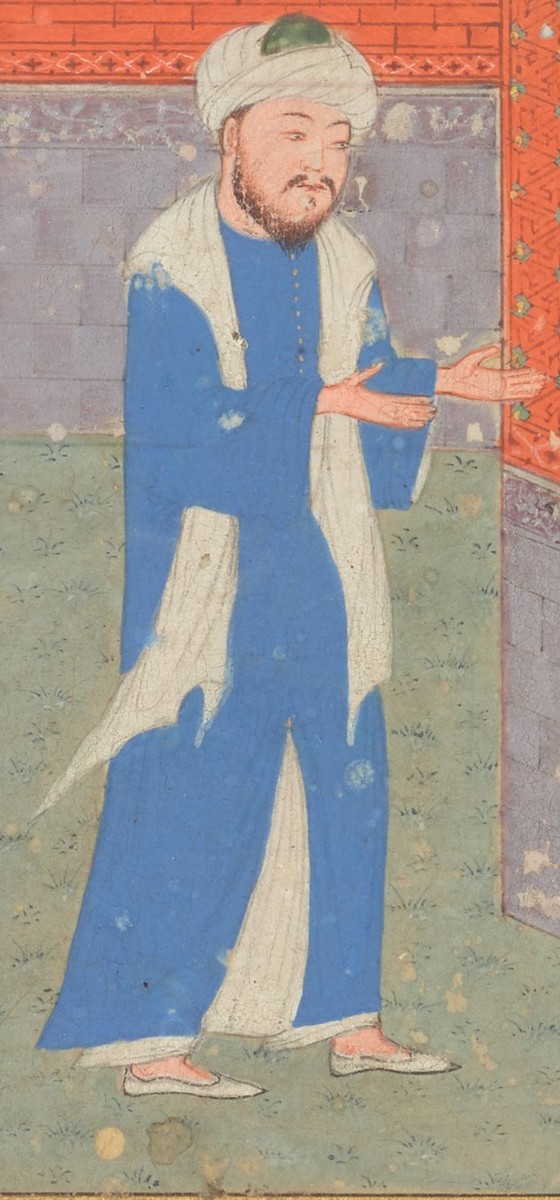
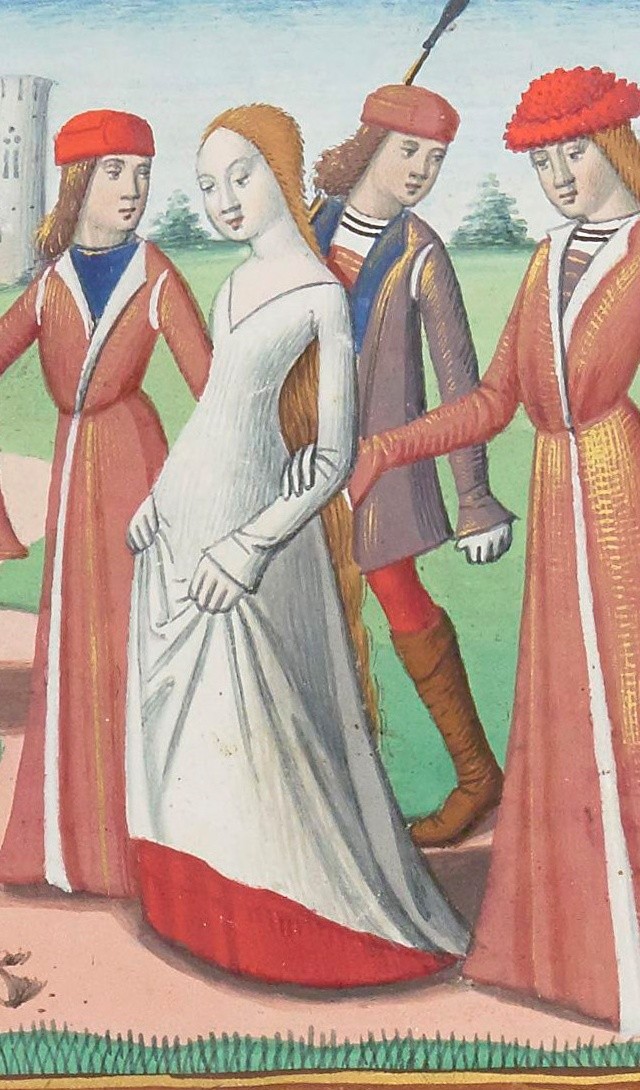
Court painters of Herat, 1427, 'A lady offers a cool drink to the poet Sa'di' (detail), Prince Baysunghur's Rose Garden (Gulistan) by Sa`di, Chester Beatty Library, Dublin, Per 119.36, CC BY 4.0 · Detail of the poet Saadi from the painting 'A lady offers a cool drink to the poet Sa'di', a full-page miniature in Prince Baysunghur's copy of the Gulistan (Rose Garden), made at the Timurid court in Herat and dated 830 AH / 1427, about 135 years after his death; Chester Beatty Library, Dublin, Per 119.36 (verso). The library's own record titles the scene 'A lady offers a cool drink to the poet Sa'di' and describes the poet of the anecdote; the individual painters of the manuscript (Amir Khalil, Khwaja Ghiyathuddin, Khwaja Ata and Mawlana Shihab) are not matched to specific paintings by the library. This is a later, imagined depiction of a figure within a narrative scene, not a likeness from life, and it is shown as a detail of that scene (the lady in the doorway is cropped away). It was taken from the library's public IIIF image at full resolution: the original painting-folio image is 4,773 x 7,749 pixels, the cropped region used is 700 x 1,500 pixels, and it was downscaled once to 560 x 1,200 pixels; nothing was upscaled. Rights basis: the painting is a 2D work from 1427 and is in the public domain by age everywhere; the Chester Beatty Library's live Copyright page states that digital images of its collection objects are released under CC BY 4.0 unless otherwise listed, and the Per 119.36 record lists only the library as owner with no separate restriction. Caveats recorded honestly: the library's item pages are behind an anti-bot challenge, so the record was read through its public IIIF manifest; an older library strategy document mentioned a non-commercial licence, which the current Copyright page supersedes; the credit to the library is given as the CC BY 4.0 licence asks. · Public domain (1427 painting; reproduction released by the Chester Beatty Library under CC BY 4.0)
poet · Medieval
1210–1291
Not yet included in personality matching — the documented evidence doesn't yet cover enough of the personality model. Everything else on this page is fully available.
One of the greatest figures in classical Persian literature, he completed the Bustan (The Orchard, 1257), a verse collection of ethical tales, and the Gulistan (The Rose Garden, 1258), mainly prose with inserted poems, the two works for which he is best known.
He was also a celebrated lyric poet and writer of odes, whose ghazals and qasidas, a mirror-for-princes treatise, prose pieces and Arabic poems are gathered in his collected works, making him, in Britannica's words, the most widely admired writer in the world of Iranian culture.
His poetry spread across the Persian-speaking world within decades of his death: it impressed the Delhi poets Amir Khosrow and Hasan Sijzi, the Gulistan was translated into Turkish in Anatolia, and his works were taken up by European Romantic readers in the nineteenth century.
After some thirty years away from Shiraz he completed the Bustan in late 1257 and the Gulistan a year later, the two dates the Encyclopaedia Iranica calls the most reliable in his biography; one is mostly verse, the other mainly prose with inserted poems.
This is consistent with a writer working comfortably across forms, though the surviving record says little about how he chose between them. Cross-Domain Range
Back in Shiraz he wrote poems for successive Salghurid and Il-khanid officials, giving counsel as well as praise, while apparently never joining the court in a formal post, and reportedly living in a Sufi hospice.
This is consistent with a poet who adjusted to changing circumstances while keeping some independence of position, though the sources do not document his reasons. Adaptability
As an adolescent, probably around 1223-24, he left Shiraz to continue his studies at the Nizamiyya college in Baghdad, the start of a long period of study and travel that ended with his return to Shiraz about 1257 as an already famous poet.
This is consistent with a commitment to formal learning early in life, though the account rests partly on his own works, which scholars treat cautiously. Mastery Orientation
People whose overall profiles resemble theirs.