
Benjamin Franklin
93% Profile Match
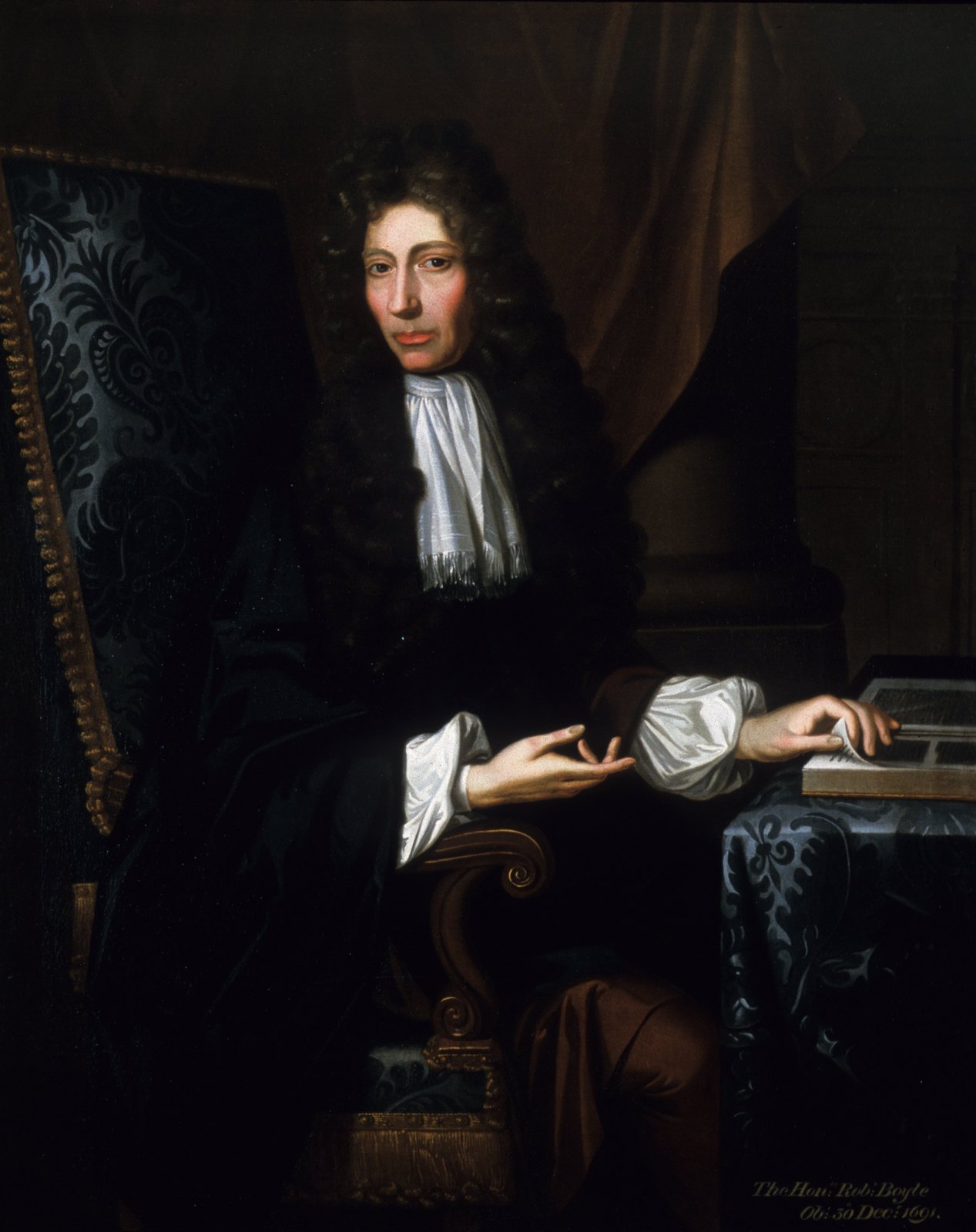
Johann Kerseboom, The Shannon Portrait of the Hon. Robert Boyle F. R. S., oil on canvas, 1689; courtesy of Science History Institute, Philadelphia (Rights: Public Domain Mark 1.0) · Science History Institute (Philadelphia) Digital Collections, "The Shannon Portrait of the Hon. Robert Boyle F. R. S. (1627-1691)", oil on canvas, 127.0 x 101.6 cm, institutional location Museum; via Wikimedia Commons "The Shannon Portrait of the Hon Robert Boyle.jpg" · Public domain (Public Domain Mark 1.0)
Around 1658-59 Boyle had an air pump built at Oxford with the help of Robert Hooke, and in December 1659 he wrote up the results as New Experiments Physico-Mechanical, Touching the Spring of the Air (published 1660). The book reported trials on flame, sound, living creatures and liquids in an evacuated glass, and argued that effects once credited to nature's horror of a vacuum come from the air's own spring. Thomas Hobbes and Francis Linus attacked it, and Boyle replied in the second edition of 1662.
In the 1662 edition of the same book, Boyle added a reply to Linus together with trials in which air trapped in a bent glass tube was compressed and expanded using mercury. He reported that the pressures and expansions stood in reciprocal proportion. Richard Townley had suggested such a relation, and Peter Anstey notes that Boyle did not claim it held without limit. The relation is now known as Boyle's law.
In The Sceptical Chymist (1661) Boyle used a dialogue, in which Carneades speaks for him, to challenge both the Aristotelian four elements and the chemists' three principles of salt, sulphur and mercury, asking what the words 'element' and 'principle' actually mean and what experiments show. Michael Hunter adds that the experimental essays of these years led him to advance corpuscularianism, his version of the mechanical philosophy, against scholastic explanations in terms of forms and qualities.
Boyle attended the Royal Society's inaugural meeting on 28 November 1660, and Michael Hunter calls him the prime exemplar of the experimental philosophy it espoused; his books gave detailed accounts of his trials so that others could follow the procedure. A codicil of 1691 to his will charged a London house with funding the Boyle Lectures, a series of sermons defending the Christian religion, first given by Richard Bentley in 1692.
To test whether the air's pressure changes with height when no mountain was at hand, Boyle and a helper lowered a water-filled weather-glass on a string from the leads of Westminster Abbey to the ground and marked how far the water fell, about an inch. Two or three days later the wind made the result less regular; a repeat inside the church was hampered when the top of the pipe broke, and he wrote that the experiment might need further examination.
Improvising a test when the ideal one was out of reach, and printing the wind-spoiled and hampered trials as well as the clean one, is consistent with a habit of devising experiments and recording their limits. Experimentation
Within months of publishing Memoirs for the Natural History of Human Blood in 1684, Boyle began preparing a revised edition. According to the editors Michael Hunter and Harriet Knight, a draft preface credits the Italian physician Marcello Malpighi's response as a stimulus, and the list of topics for investigation grew from 30 to 45 titles. The revised edition was never printed.
Reworking a printed book in response to another physician's reaction is consistent with revising his own position on outside evidence; the editors also record that critics found the printed book unsystematic and that the revision never reached print. Belief Updating
In 1645-46 Boyle's first writing project was a moral treatise, Aretology, and for several years his writing was pious and moralistic rather than scientific. In 1649 he set up a laboratory at his house in Stalbridge, Dorset, and, according to Michael Hunter, writings from that summer on show an enthusiasm for experimental knowledge that stayed with him for the rest of his life.
A change of direction from moral writing to laboratory work, kept up for four decades, is consistent with curiosity pulling him toward a new line of inquiry. Curiosity
People whose overall profiles resemble theirs.


Not a rival — a different profile shape worth a look.
