Maimonides
80% Profile Match
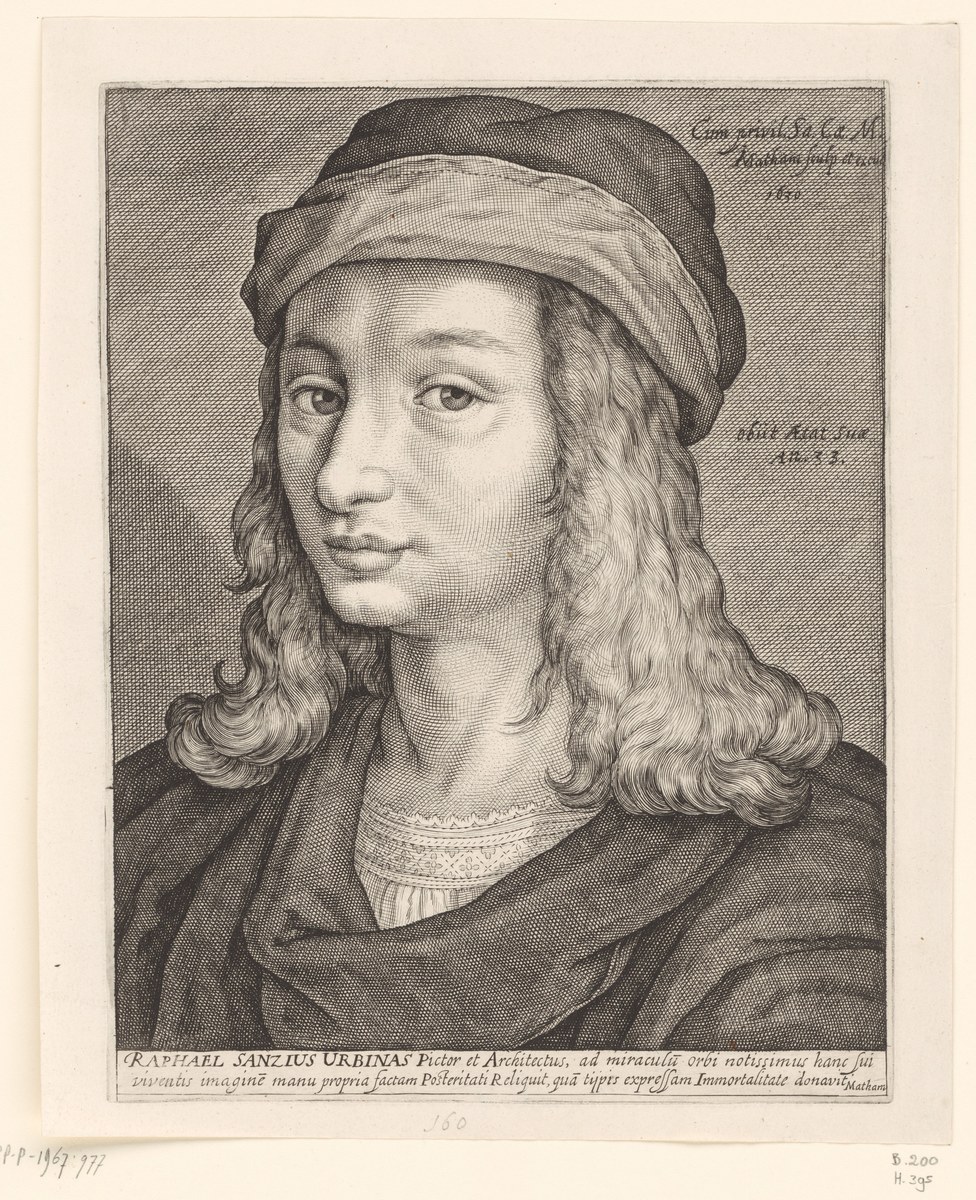
Jacob Matham, 1630, engraving after Raphael; Rijksmuseum, Amsterdam (RP-P-1967-977), Public Domain · Wikimedia Commons, 'Portret van Rafael, RP-P-1967-977.jpg' -- Jacob Matham, engraving, Haarlem, 1630, after a painting by Raphael (Rijksmuseum, Amsterdam, RP-P-1967-977); original Commons file 4816 x 5920 pixels, downscaled once to 976 x 1200 (never upscaled). Includes the plate border and caption. A later copy after Raphael's self-portrait, not a likeness drawn from life; its caption wrongly gives his age at death as 33. · Public Domain (CC0 Rijksmuseum digital file; engraving of 1630)
painter · Early Modern
1483–1520
Not yet included in personality matching — the documented evidence doesn't yet cover enough of the personality model. Everything else on this page is fully available.
Called to Rome in 1508 to decorate Julius II's apartments, he and his school painted the Vatican Stanze between 1508 and 1524, beginning with the Segnatura frescoes that include The School of Athens.
His portraits of Julius II, Leo X and Baldassare Castiglione, and his Madonnas, rank among his most admired works; the National Gallery says the popes' faces still define how we see them.
From 1514 he was chief architect of St Peter's and was commissioned by Leo X to survey the buildings of ancient Rome, while directing a large workshop that Giulio Romano and Gianfrancesco Penni inherited.
Vasari reports that when Raphael fell ill he made his will and left his possessions to his disciples Giulio Romano and Il Fattore (Gianfrancesco Penni), the two who then carried his workshop forward.
This is consistent with a master who tied his closest assistants to the continuation of the workshop, though Vasari is a later and admiring biographer. Collaboration
On Bramante's death in 1514 he was made chief architect of St Peter's, and he was later put in charge of antiquities and asked by Leo X to survey the buildings of ancient Rome.
This is consistent with a painter whose work spread across architecture and the study of antiquity. Cross-Domain Range
Around 1504 he moved to Florence to learn from the artists there, above all Leonardo and Michelangelo, making sketches after their works before the call to Rome in 1508.
This is consistent with an already independent master who went on studying the leading artists of his day. Mastery Orientation
People whose overall profiles resemble theirs.