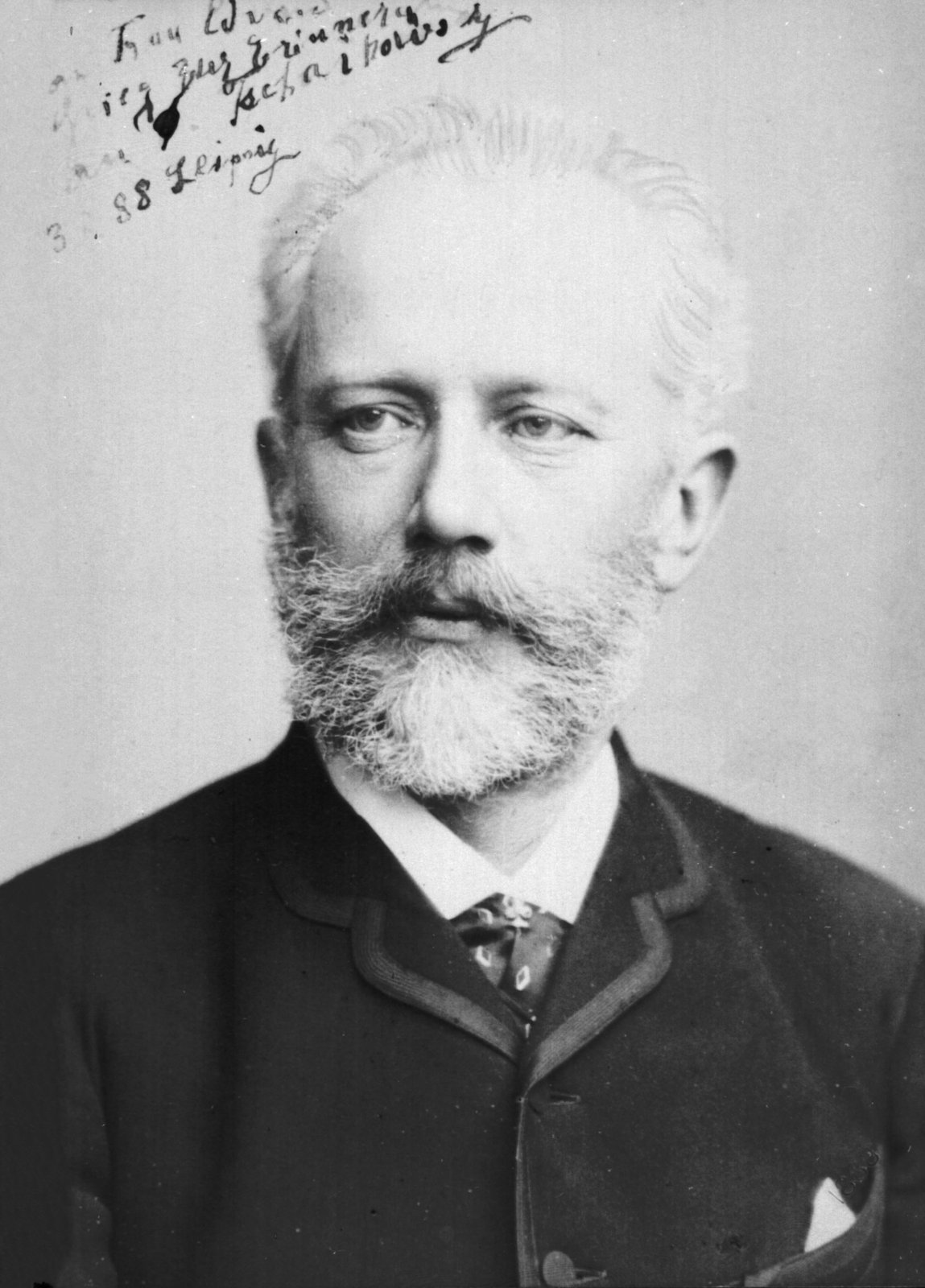

Atelier E. Bieber, Hamburg (probably Leonard Berlin, 1841-1931), studio photograph of Pyotr Ilyich Tchaikovsky, 1888, an inscribed print; the Tchaikovsky Research letters pages date the Hamburg sitting to 6/18 January 1888 · Wikimedia Commons file 'Tschaikowsky EBieber 1888.jpg' (photograph by Atelier E. Bieber, Hamburg, probably Leonard Berlin; Commons credit line gives a Bergen Public Library Flickr item) · Public domain
Trait Constellation
Key Achievements
Tchaikovsky composed the scores of three ballets: Swan Lake, first staged at the Bolshoi Theatre in Moscow in 1877, and The Sleeping Beauty (1890) and The Nutcracker (1892), both written for the Imperial Theatres in St Petersburg. The Swan Lake score was heavily cut and rearranged in later productions, and the version widely known in the twentieth century derives from one prepared after his death; all three ballets remain staples of the repertoire.
In 1874 Nikolay Rubinstein criticised the First Piano Concerto harshly, and Leopold Auer, to whom the Violin Concerto had been offered, declined to play it as too difficult; after its 1881 Vienna performance the critic Eduard Hanslick wrote a hostile review. Both concertos are now among the best-loved works in the repertoire, alongside the Fourth, Fifth and Sixth ('Pathetique') symphonies, the last premiered under his own baton in 1893, and the 1812 Overture.
Two of Tchaikovsky's operas are settings of Pushkin. Eugene Onegin, which he called 'lyrical scenes', was composed in 1877-78 and first staged in full by Moscow Conservatory students in March 1879, with its first professional production at the Bolshoi in January 1881. The Queen of Spades premiered at the Mariinsky Theatre in St Petersburg in December 1890, after he had written it in Florence in 44 days.
Moments That Reveal Them
On Christmas Eve 1874 Tchaikovsky played his new piano concerto for Nikolay Rubinstein and Nikolay Hubert, hoping for technical advice. By Tchaikovsky's own account, written three years later to Nadezhda von Meck, Rubinstein condemned the work harshly and said he would perform it if it were revised; Tchaikovsky answered that he would not alter a single note. He published it as it stood and dedicated it to Hans von Bulow, who gave its first performance in Boston in October 1875; Tchaikovsky later made revisions of his own, in 1879 and around 1889.
The episode is consistent with the profile's independent thinking: he held to his own judgement against the most authoritative pianist in Moscow, although his later revisions show he did not treat the concerto as beyond change. Independent Thinking
Tchaikovsky destroyed the scores of several early works. He cut bars from the symphonic fantasia Fatum before its 1869 premiere and later destroyed the full score; he reused parts of the opera Undina in other works and then destroyed that score; and he destroyed most of the score of his first opera, The Voyevoda. In 1891 he tore up the score of a later symphonic ballad, also called The Voyevoda, after hearing it performed. Fatum, the ballad and most of the opera were reconstructed after his death, largely from surviving orchestral parts; of Undina only extracts survive.
This pattern is consistent with the profile's perfectionism, with the loss of the originals as its visible cost. Tchaikovsky Research notes that for Fatum it is unclear whether Balakirev's criticism or a changed view of the piece lay behind the destruction. Perfectionism
Turning Points
Tchaikovsky had repeatedly said he could not conduct, and in October 1886 he wrote to von Meck that the very thought of the podium made him tremble. In December 1886 he took his first orchestral rehearsal, and on 19/31 January 1887 he conducted the premiere of his revised opera Cherevichki at the Bolshoi Theatre in Moscow. By the end of 1887 he had set out on a first European tour as a conductor, and over the next six years he conducted his own music in Prague, Paris, London and, in 1891, at the opening week of the new Music Hall in New York, later called Carnegie Hall.
The change illustrates the profile's adaptability: a self-described reluctance gave way to a sustained new public role. The difficulty is self-reported, and Walter Damrosch, who hosted him in 1891, wrote that he found the work tiring but that the players followed his intentions eagerly. Adaptability
Similar People
People whose overall profiles resemble theirs.


Fyodor Dostoevsky

Octavia Butler

Duke Ellington

Wilbur Wright

Yayoi Kusama
Sources
- Pyotr Ilyich Tchaikovsky (Q7315) -- Wikidata entry verified live on 2026-10-04: English label 'Pyotr Ilyich Tchaikovsky', description 'Russian composer (1840-1893)', two recorded birth dates (25 April and 7 May 1840) and two death dates (25 October and 6 November 1893, i.e. Old and New Style), citizenship Russian Empire, Korean label. Orientation only; not used as support for any scored row.
- Wikipedia, 'Pyotr Ilyich Tchaikovsky' (English) -- summary paragraph read for orientation only (lists the works for which he is best known). Not used as support for any scored row; cited only for uncontested high-level facts in the achievements text.
- Alexander Poznansky, 'Tchaikovsky: A Life', biographical essay written for Tchaikovsky Research (en.tchaikovsky-research.net) -- SCHOLAR's account (non-self; drawn on the Russian archives opened since the 1990s). Read locally from the opening through the 1893 narrative (about three quarters of the essay: childhood and the Ministry of Justice years, the St Petersburg and Moscow Conservatory years, the 1866-1877 operas, symphonies and ballet, the 1877-1886 years in Switzerland, Italy and Maydanovo, the 1887-1892 conducting tours, Sleeping Beauty, Queen of Spades and the 1891 American tour, and 1893 including Cambridge and the Sixth Symphony). The sections on his private life, the 1877 marriage, sexuality, and the circumstances of his death were read for context but are NOT used as evidence for any trait. The final epilogue and the notes were not read.
- Modest Tchaikovsky (the composer's brother), The Life and Letters of Peter Ilich Tchaikovsky, abridged and edited by Rosa Newmarch (London: John Lane, 1906), Project Gutenberg eBook #45259 -- INSIDER biography (family member and sometime collaborator, admiring, quotes many of the composer's own letters, which are self perspective). Read locally, targeted: the Christmas Eve 1874 Rubinstein scene (his own account of it to von Meck, 21 January/2 February 1878) and Bulow's reply; the 1881 Violin Concerto Vienna reception with the full Hanslick review; the 1886-87 letters and narrative on his first conducting; the description of the Maydanovo/Klin working day; the passage on his financial support of others; and the January 1892 Brussels charity concert. Not read in full.
- Nikolay Rimsky-Korsakov, My Musical Life (New York: Knopf, English translation 1923; Internet Archive full text mymusicallife0000rims_p2v1) -- PEER composer's memoir (non-self; a member of the rival nationalist circle). Read locally, targeted: the account of the first meeting in 1866-67 and how Balakireff's circle first regarded him as a conservatory product; the 1876 visits; the 1879 note that Tchaikovsky as a Moscow critic had written a sympathetic review of Rimsky's Third Symphony; the 1891 St Petersburg visit; and Rimsky's frank dislike of Iolanta (used only to show the memoir is not uniformly admiring, never as trait evidence). The text spells the name 'Chaykovski'.
- Rosa Newmarch, Tchaikovsky: His Life and Works, with Extracts from His Writings and the Diary of His Tour Abroad in 1888 (London: John Lane, 1900), Internet Archive full text (cu31924022415891) -- early English-language biography built on the reminiscences of his friend and colleague Nikolay Kashkin; includes extracts of the composer's own 1888 tour diary (self). Read locally only in part: the preface, the passage on the composition and fortunes of Swan Lake, and the 1888 diary entry on Auer, Brodsky and Hanslick. Used for the canonical shortlist, not for scoring.
- Tchaikovsky Research (en.tchaikovsky-research.net), scholarly reference site with source-cited work and people pages -- pages 'Piano Concerto No. 1', 'Violin Concerto', 'Nikolay Rubinstein', 'Leopold Auer', 'Adolph Brodsky' and 'Cesar Cui', each read in full. Documentary compilation (non-self editors, quoting letters, manuscripts and eyewitnesses) covering the 1874 Rubinstein criticism, the three versions of the Piano Concerto, Auer's and Davydov's refusal of the Violin Concerto, Brodsky's 1881 Vienna performance with Hanslick's hostile review, and Cui's hostile criticism of Tchaikovsky's music.
- Tchaikovsky Research (en.tchaikovsky-research.net) -- pages 'Romeo and Juliet', 'Mily Balakirev', 'Fatum', 'Undina' and 'The Voyevoda (opera)' (the last two read for their composition, rejection and score-destruction sections). Documentary compilation (non-self editors, quoting Tchaikovsky's and Balakirev's letters): Balakirev's 1869 critique of Romeo and Juliet and the revisions of 1870 and 1880, the deletion of bars from Fatum before its premiere and the later destruction of its score, and the destruction of the scores of Undina and most of The Voyevoda.
- Tchaikovsky Research (en.tchaikovsky-research.net) -- pages 'Swan Lake', 'The Sleeping Beauty' and 'The Nutcracker', composition, performance and reception sections read in full. Documentary compilation (non-self editors) built on the composer's diary entries, sketchbook dates and letters, Petipa's and Vsevolozhsky's correspondence, and posters: commissions, the detailed plans supplied by the balletmaster, the dated composition of Sleeping Beauty in January 1889, Vsevolozhsky's 1891 letter about The Nutcracker, and the first productions of each ballet.
- Tchaikovsky Research (en.tchaikovsky-research.net) -- pages 'The Queen of Spades' (composition section), 'Yevgeny Onegin' (performances section), 'Symphony No. 6' (performances section) and 'The Year 1812' (composition and performances sections). Documentary compilation (non-self editors) with dated diary and sketch notes: the January-March 1890 composition of The Queen of Spades, the first performances of Onegin (Conservatory students 1879, Bolshoi 1881) and of The Queen of Spades (7/19 December 1890), the Sixth Symphony's premiere under the composer on 16/28 October 1893, and the commission and first performances of the 1812 overture.
- Tchaikovsky Research (en.tchaikovsky-research.net), page 'New York', read in full -- documentary day-by-day itinerary of his 1891 visit (non-self editors quoting his tour diary): arrival 14/26 April, almost daily rehearsals, the opening-week concerts of the new Music Hall (now Carnegie Hall) on 23 April/5 May and 25 April/7 May, and the Baltimore and Philadelphia concerts.
- Walter Damrosch (conductor who invited him to open Carnegie Hall in 1891), My Musical Life (1923), as quoted and annotated on the Tchaikovsky Research page 'Walter Damrosch' -- EYEWITNESS HOST account (non-self; admiring): his 1891 rehearsals and concerts at the opening of the Music Hall, that he was 'not a conductor by profession' and found rehearsals and concerts fatiguing, and the June 1893 dinner at Cambridge where honorary doctorates went to five composers. Read in full on the TR page, not in the original book.
- Ethel Smyth, Impressions That Remained (1919), as quoted on the Tchaikovsky Research page 'Ethel Smyth', read in full -- EYEWITNESS account by a younger composer (non-self) of meeting him in Leipzig in January 1888: his courtesy, the hours-long argument with her about Brahms, and his advice to attend closely to orchestral colour. Read through the TR page, not the original book.