Alan Turing
94% Profile Match
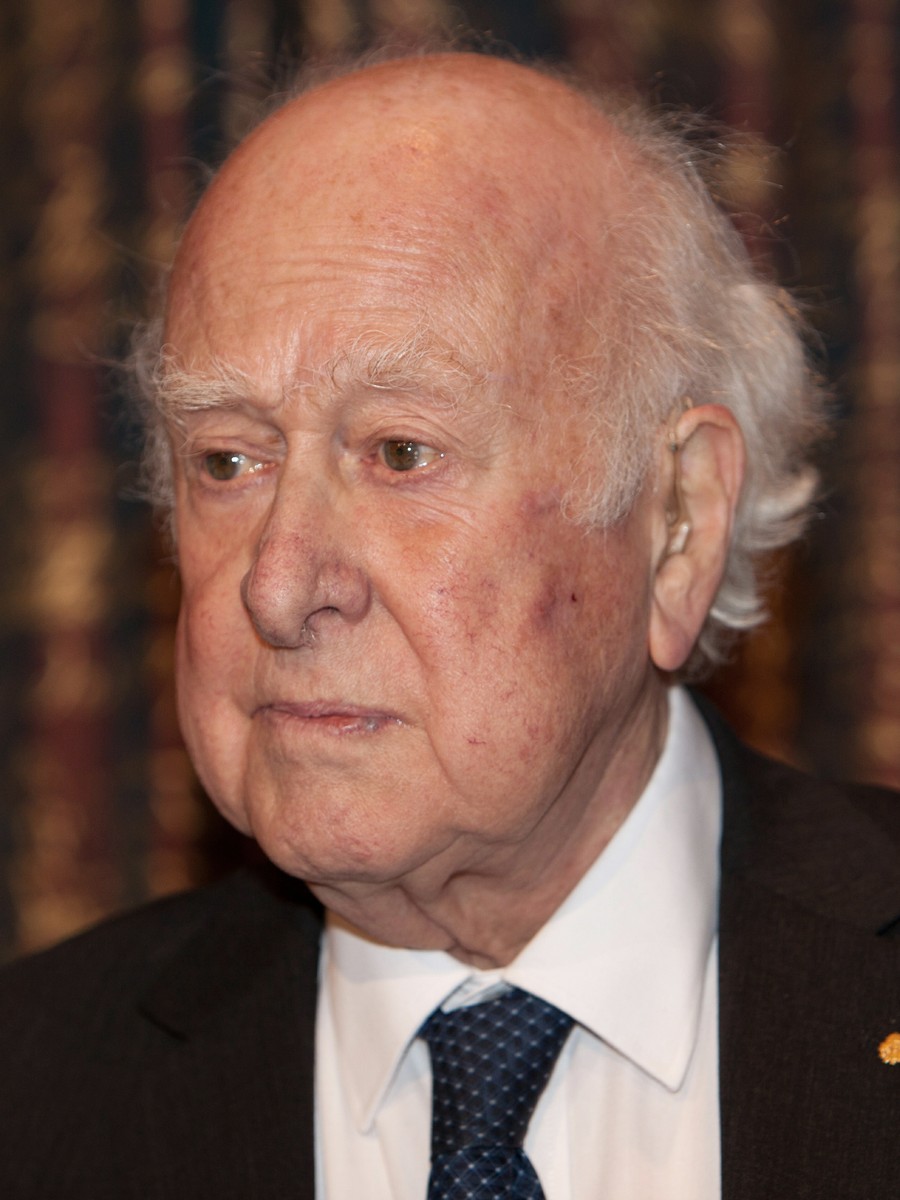
Photo: Bengt Nyman, 2013, licensed under CC BY 2.0; cropped and downscaled from the original · Wikimedia Commons, 'DIMG 7469 (11253401126).jpg' -- photograph of Peter Higgs by Bengt Nyman (Vaxholm, Sweden), taken 7 December 2013 at the Nobel laureates' press conference at the Royal Swedish Academy of Sciences (Canon EOS 5D Mark II); published on Flickr by the photographer, transferred to Commons by Bengt Nyman himself on 8 July 2016 and confirmed by FlickreviewR as CC BY 2.0; original JPEG 3393 x 3393 pixels (6.78 MB). A 3:4 region (2545 x 3393 pixels) around his head and shoulders was cropped from the original and downscaled once to 900 x 1200 (never upscaled). Identity: other frames of the same session (DIMG 7484, 7505, 7516) show the place card 'PETER W. HIGGS, Kungl. Vetenskapsakademien'. · CC BY 2.0
physicist · 20th Century
1929–2024
Not yet included in personality matching — the documented evidence doesn't yet cover enough of the personality model. Everything else on this page is fully available.
In two short papers written at the University of Edinburgh in 1964, Higgs showed how a spontaneously broken gauge symmetry can give mass to vector bosons without leaving the massless Goldstone particles that had seemed to block the idea, and his second paper stated explicitly that the model implies a massive scalar particle, later called the Higgs boson. François Englert and Robert Brout, and separately Gerald Guralnik, Carl Hagen and Tom Kibble, reached the mechanism independently the same year.
The mechanism became a central part of the Standard Model of particle physics. On 4 July 2012 the ATLAS and CMS experiments at CERN's Large Hadron Collider announced the discovery of a new particle with the properties expected of the Higgs boson, and in 2013 Higgs and Englert shared the Nobel Prize in Physics for the theoretical discovery of the mechanism.
A longer paper published in 1966, developed during a sabbatical at the University of North Carolina, worked out scattering processes and showed that the scalar particle's coupling to the massive vector bosons is proportional to their squared mass. The 1964 and 1966 papers drew little attention for several years; Steven Weinberg and Abdus Salam incorporated the mechanism into the electroweak theory in 1967 and 1968.
In July 1964 Higgs read Walter Gilbert's argument that the Anderson-Nambu route to massive vector bosons could not work in a relativistic theory. According to Science News, reporting a 2001 talk by Higgs, his first reaction was 'Oh yes you could', and the Nobel Academy's history records that in the paper he submitted shortly afterwards he pointed out that Gilbert's criticism does not apply in a gauge theory.
This is consistent with reaching his own conclusion against a published argument. Independent Thinking
On 8 October 2013, the day the Nobel Prize in Physics was announced, Higgs left home before the expected announcement and had lunch at a bar in Leith, so the Swedish Academy could not reach him for over an hour and announced the prize without speaking to him. According to Frank Close and his colleague Alan Walker, a woman who stopped her car to congratulate him on his walk home told him of the award; in February 2013 he had said he might 'maybe not be around, or be around, but elsewhere' that day.
This is consistent with avoiding publicity rather than seeking it. Social Assertiveness
Physics Letters accepted Higgs's first 1964 paper but rejected his second, a model in which a vector boson gains mass; King's College London quotes the verdict as 'of no obvious relevance to physics'. According to Science News, which reported his own account, he revised the paper to say that an essential feature of the theory was the prediction of incomplete multiplets of scalar and vector bosons and sent it to Physical Review Letters, where it was published on 19 October 1964; Higgs told the journalist that without the rejection he 'might never have mentioned it'.
This is consistent with continuing after a setback and revising the work to show its testable consequence. Persistence
People whose overall profiles resemble theirs.



Not a rival — a different profile shape worth a look.