Ada Lovelace
93% Profile Match
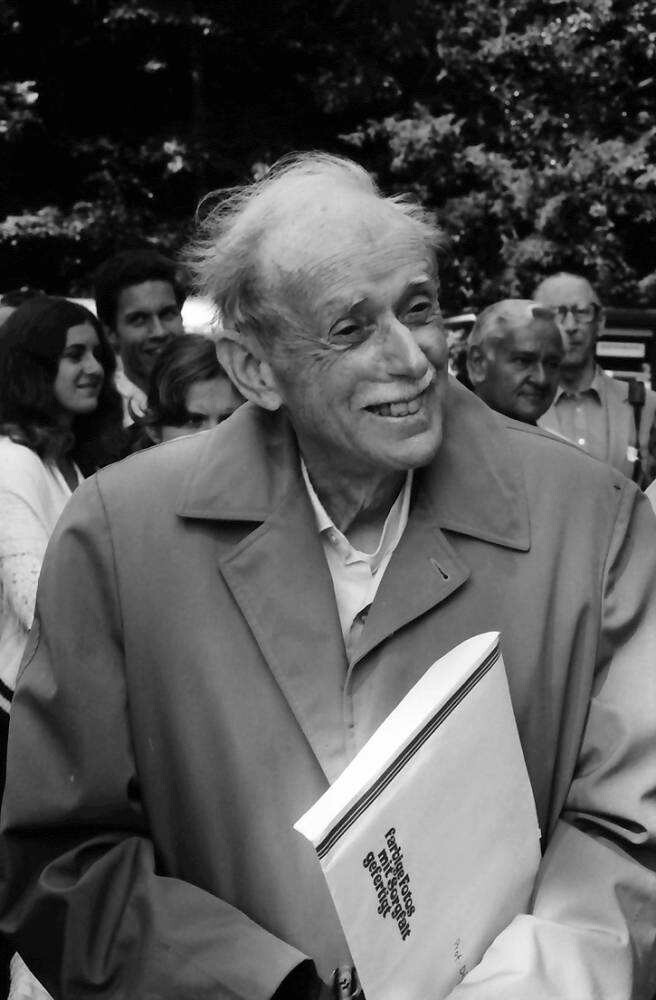
Willy Pragher, Landesarchiv Baden-Wuerttemberg, Staatsarchiv Freiburg, W 134 Nr. 119172a, CC BY 3.0 DE · Wikimedia Commons, '32. Tagung 1982 Physiker; Mainau Paul Dirac - W134Nr.119172a - Willy Pragher.jpg' -- photograph by Willy Pragher (1908-1992) at the 1982 Mainau/Lindau Nobel laureates' meeting, held by the Landesarchiv Baden-Wuerttemberg, Staatsarchiv Freiburg (signature W 134 Nr. 119172a); original file 656 x 1000 pixels, saved unchanged (no scaling). · CC BY 3.0 DE
physicist · 20th Century
1902–1984
Not yet included in personality matching — the documented evidence doesn't yet cover enough of the personality model. Everything else on this page is fully available.
In 1925 he independently produced a formulation of quantum mechanics based on a noncommutative algebra, and in 1930 he set out the whole theory in The Principles of Quantum Mechanics.
His 1928 wave equation for the electron joined quantum theory with special relativity, two frameworks that had been mathematically opposed.
His hole theory required a positively charged particle with the electron's mass, and the positron was found experimentally in 1932 and 1933; he shared the 1933 Nobel Prize in Physics.
After the war he kept explaining why he was not satisfied with renormalization, even though it was a big success, and urged physicists to look for the correct Hamiltonian.
This is consistent with holding to his own standard for a good theory even when most of the field had moved on. Independent Thinking
In his 1963 Scientific American article he argued that it is more important to have beauty in one's equations than to have them fit experiment, using Schroedinger's discovery as his example.
This is consistent with a theorist who treated mathematical beauty as a guide to progress, a stance Dyson judges did not lead to major later discoveries. Aesthetic Sensitivity
After the early 1930s his output fell, and Schweber's review describes him becoming a loner once again after the war, in contrast to his years of close ties with Cambridge circles and European correspondents.
This is consistent with a researcher whose strongest work came while he was closely connected to colleagues and who later worked mostly on his own terms. Need for Autonomy
People whose overall profiles resemble theirs.



Not a rival — a different profile shape worth a look.