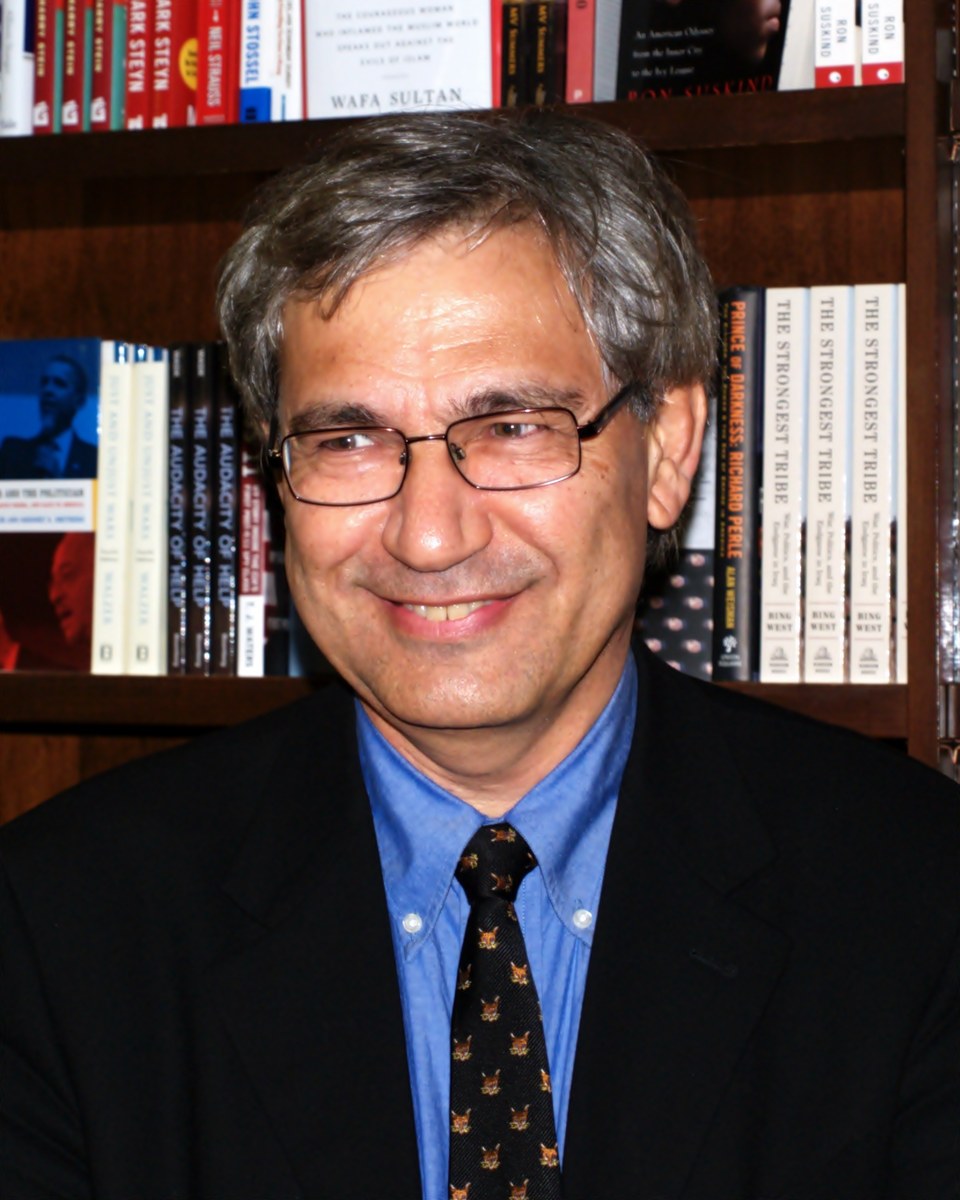
David Shankbone, CC BY 3.0, via Wikimedia Commons · Photograph of Orhan Pamuk by David Shankbone at a Barnes & Noble reading in New York on 18 November 2009, uploaded to Wikimedia Commons by the photographer himself under the Creative Commons Attribution 3.0 licence (file page: author David Shankbone, date 2009-11-18). The current Commons revision (1401 x 1955) is a 2019 retouched version by another editor, so the photographer's original 2011 upload (1658 x 2072) was used instead, downscaled to 960 x 1200; no upscaling. The file page carries a personality-rights notice and requires attribution; the photographer's blog source page could not be reached to double-check the licence statement. · CC BY 3.0
writer · Contemporary
Orhan Pamuk
b. 1952
Known For
Not yet included in personality matching — the documented evidence doesn't yet cover enough of the personality model. Everything else on this page is fully available.
Trait Constellation
Key Achievements
Turkish novelist awarded the 2006 Nobel Prize in Literature for having, 'in the quest for the melancholic soul of his native city', discovered 'new symbols for the clash and interlacing of cultures'.
His novels The Black Book, My Name is Red and Snow turn Istanbul, Ottoman miniaturists and a border town into labyrinths of stories; the Swedish Academy compared his Istanbul to Dostoyevsky's St. Petersburg and Joyce's Dublin.
He developed the 2008 novel The Museum of Innocence together with a real museum in Istanbul, opened in 2012 with 83 cabinets he designed, which won the 2014 European Museum of the Year Award.
Moments That Reveal Them
From the 1990s he collected everyday objects while writing The Museum of Innocence, and in 2012, four years after the novel, opened a museum whose 83 cabinets he designed himself, some still empty and waiting for the right object.
This is consistent with sustaining a long project across many years. Persistence
In a 2005 interview he said he did not want to follow the previous generation of Turkish authors who, in his words, wasted their talent serving their nation through flat social-realist writing, preferring Faulkner, Woolf and Proust.
This is consistent, by his own account, with choosing his own literary direction over an expected social role. Independent Thinking
Turning Points
He says he found his own voice in The Black Book, begun in 1985 while he was a visiting scholar at Columbia University in New York; the Swedish Academy later named it among his major works.
This is consistent, by his own account, with a shift toward a more distinctive creative voice. Creative Originality
Similar People
People whose overall profiles resemble theirs.

Louis Pasteur

Yayoi Kusama

Sequoyah

Leonardo da Vinci

Franz Kafka
Opposite Profile
Not a rival — a different profile shape worth a look.

Otto von Bismarck
Sources
- Orhan Pamuk (Q241248), verified live via the Wikidata API (2026-10-26): label 'Orhan Pamuk', description 'Turkish novelist, academic and Nobel laureate (born 1952)', born 1952-06-07, no death date, citizenship Turkey, Korean label present. Orientation only; not used as support for any row.
- Swedish Academy presentation speech for the 2006 Nobel Prize in Literature, with the Nobel Foundation press release of 12 October 2006, both read in full. CANONICAL SIGNIFICANCE SOURCE: the prize citation says he 'in the quest for the melancholic soul of his native city, has discovered new symbols for the clash and interlacing of cultures'; the speech discusses The Black Book, My Name is Red and Snow and compares his Istanbul to Dostoyevsky's St. Petersburg, Joyce's Dublin and Proust's Paris. Admiring and evaluative by nature (a prize-giving speech), but an independent institutional view of what the work is.
- Orhan Pamuk, 'Biographical', Nobel Foundation (autobiographical statement written for the 2006 prize), read in full. SELF-REPORT: his account of leaving architecture for writing, giving up painting at 22, four years to find a Turkish publisher for his first novel, and the books' titles and aims. Used only as corroborating self-report, never as sole support; its passages on marriage, divorce, family and his daughter were read and are not used.
- 'Orhan Pamuk, The Art of Fiction No. 187', The Paris Review, issue 175 (Fall/Winter 2005), read in part (the first portion of the interview and the editor's introduction are public; the rest is behind a subscription wall). SELF-REPORT (interview): ten-hour working days at a separate office overlooking the Bosphorus, his rejection of the social-realist model of the previous Turkish generation, and his remark that he was attacked more for interviews than for his books. The introduction records the 2005 charge under Article 301/1, which is context and not scored.
- Handan Kazanci, 'Museum of Innocence: Hub for lovers in heart of Istanbul', Anadolu Agency, 13 February 2020, read in full: Pamuk began collecting objects in the 1990s while developing the novel, the museum opened in 2012 in a 19th-century house, he designed each of its 83 glass-fronted cabinets, it won the 2014 European Museum of the Year Award, and some cabinets are still empty and numbered for objects not yet found; the article includes Pamuk's own statements, museum staff and a visitor. State-run news agency feature; partly self-report.
- James Ley, 'Erosion of the Will: A Strangeness in My Mind by Orhan Pamuk', Sydney Review of Books, 25 February 2016, read in full: a critical essay on his work that traces his East-West double vision, his early formal gamesmanship and later turn toward broad-canvas social realism in The Museum of Innocence and A Strangeness in My Mind, his stated wish to keep 'childlike innocence' as a novelist, the difficulty of balancing that with political material in Snow, and the judgement that the latest novel lacks the exuberance and detail of the Joycean city novel he once aspired to write. Independent critical review; the critic's reading of Pamuk's stance is interpretation.
- Lee Monks, review of 'A Strangeness in My Mind', The Mookse and the Gripes (literary blog), 21 April 2016, read in the opening section: describes Pamuk as a writer who obsesses over detail in order to contain a world, comparing him with classical realists. Single reviewer's impression of one novel; used only for the detail row.
- Wikimedia Commons file page 'Orhan Pamuk 2009 Shankbone.jpg' (photographer David Shankbone, 18 November 2009, Creative Commons Attribution 3.0), with its file history and the earlier full-size version, checked for the portrait only.