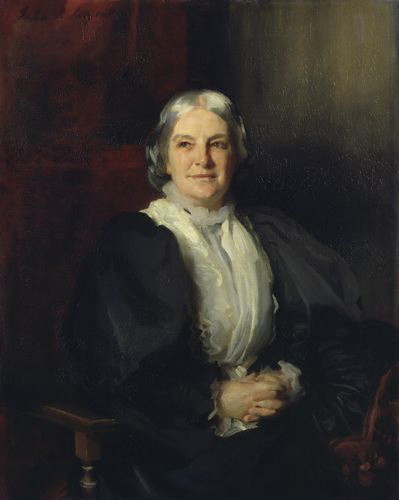
John Singer Sargent, Octavia Hill, 1898, National Portrait Gallery, London (NPG 1746) · Portrait of Octavia Hill by John Singer Sargent, dated 1898, oil on canvas, National Portrait Gallery London NPG 1746, commissioned by her friends and given to her on her sixtieth birthday (Victorian Web quoting the gallery; Britannica dates the painting 1899). Sargent died in 1925, so the painting is in the public domain in the UK and US; Commons tags it public domain as a faithful reproduction of a two-dimensional work. The gallery's own item page could not be opened (HTTP 403 bot protection), so any gallery terms on its own digital images were not read. Original 399 x 500; used as is, no resizing. · Public domain (artwork by John Singer Sargent, died 1925)
activist · 19th Century
Octavia Hill
1838–1912
Known For
Not yet included in personality matching — the documented evidence doesn't yet cover enough of the personality model. Everything else on this page is fully available.
Trait Constellation
Key Achievements
From 1864 managed London slum houses bought with Ruskin's money, combining repairs, regular personal visits and a commercial return, and trained women volunteers as managers; from 1884 she ran the Ecclesiastical Commissioners' Southwark property, and her methods were imitated in Britain, on the Continent and in the United States.
Led campaigns to keep London's open spaces from building, founding the Kyrle Society in 1875 to bring beauty and green space to the poor and raising funds to save sites such as Parliament Hill and Hilly Fields.
Co-founded the National Trust in 1895 with Robert Hunter and Hardwicke Rawnsley to hold land and buildings for the public, and helped found the Charity Organisation Society in 1869 with Edward Denison.
Moments That Reveal Them
Her 1876 letters show Ruskin writing of a growing sense of separation from her 'in essential principles' and asking whether such amelioration only encouraged great evil-doers; the break was never fully mended, though she wrote of him with reverence at his death.
This is consistent with a willingness to hold to her own approach against a mentor's objections, though the sources outline the dispute only briefly. Conflict Tolerance
Her system rested on regular personal visits, with rent collection as a social occasion, but tenants who fell behind after grace periods were evicted, and later observers have called the approach patronising.
This is consistent with a hands-on, detail-focused management style that also carried a strict, rule-based edge. Detail Orientation
Turning Points
In 1864 Ruskin bought three houses in Paradise Place, Marylebone, and handed them to her to manage, turning her from art copyist and teacher into a housing manager.
This is consistent with a person who turned a mentor's backing into a lifelong practical vocation. Proactive Agency
Similar People
People whose overall profiles resemble theirs.

Wangari Maathai

Nelson Mandela

Elizabeth Cady Stanton

Martin Luther King Jr.

Malala Yousafzai
Opposite Profile
Not a rival — a different profile shape worth a look.

Wolfgang Amadeus Mozart
Sources
- Octavia Hill (Q437462) -- verified live via the Wikidata API (2026-10-26): English label 'Octavia Hill', description 'English social reformer (1838-1912)', born 1838-12-03, died 1912-08-13, citizenship United Kingdom, P18 image 'Sargent - Octavia Hill.jpg'; no Korean label on the item. Orientation only; not used as support for any row.
- Encyclopaedia Britannica, 'Octavia Hill' (britannica.com/biography/Octavia-Hill), read in full: leader of the British open-space movement that led to the 1895 foundation of the National Trust; housing reformer whose management methods were imitated in Britain, on the Continent and in the United States; influenced by Ruskin, whom she met in 1853; first housing project in St Marylebone from 1864 with money lent by Ruskin; 1884 Ecclesiastical Commissioners put her in charge of their Southwark property where she trained other women as managers; 1869 co-founded the Charity Organisation Society with Edward Denison; assisted by her sisters, especially Miranda. CANONICAL SIGNIFICANCE SOURCE. Concise, neutral reference entry.
- Helen Bosanquet, 'Hill, Octavia', Dictionary of National Biography, 1927 supplement (Wikisource transcription), read in full: training under Ruskin and F. D. Maurice's Christian Socialist circle, the 1864-65 purchase of the first houses with Ruskin's money, his advice to put the work on a 5 per cent business footing, the 1884 Ecclesiastical Commissioners appointment, her insistence on developing responsibility in her assistants, the spread of her system to America and Berlin, her support of the Charity Organization Society, the Kyrle Society, the Commons Preservation Society and the National Trust (1895), her preference for voluntary work and reluctance to take part in political measures (she refused the 1889 housing commission), and the quoted description of her management duties. Written by a Charity Organisation Society colleague, so sympathetic; its sections on her health and family are not used.
- John Ranlett, 'Octavia Hill' (EBSCO Research Starters, History, 2024), read in full: leadership in an all-female household, her management system of personal contact and rent collection as social occasions, eviction of tenants who fell behind after grace periods, preference for rehabilitating small existing dwellings over large new projects, the Kyrle Society (1875), the Swiss Cottage Fields defeat, open-space campaigns, the 1881-82 Smoke Abatement Exhibition, the National Trust (1895), her seats on the Royal Commissions on the Aged Poor and Poor Laws where she supported private initiative against state involvement and clashed with Beatrice Webb, and a Significance section saying later observers find her approach 'distastefully patronizing', that her system housed only a small fraction of London's poor, that it is argued her publicity delayed an effective overall attack on housing, and that Wohl finds her contribution important but not altogether admirable. A modern encyclopaedic overview that names the criticism; the engagement and breakdown passages are deliberately not used.
- C. Edmund Maurice (ed.), 'Life of Octavia Hill as told in her letters' (Macmillan, 1913; Internet Archive full text), read selectively: her letters about her work for and visits to Ruskin, Ruskin's 1876 letters to her expressing a growing sense of separation 'in essential principles' and asking whether amelioration only encourages the 'great Evil Doers', and the editor's account of the 'misunderstanding with Ruskin', saying Ruskin regretted his hasty words, later made the houses over to her, and that her admiration never wavered. The authorised biography by her brother-in-law, based on her own letters, therefore friendly and partly self-testimony; used for the documented Ruskin episode and the letters quoted, not for character praise. Her health and private matters are not used.
- Octavia Hill Birthplace House (octaviahill.org), pages 'Social Housing', 'Co-Founder of the National Trust' and 'John Ruskin', read in full: the 1864 purchase of three houses in Paradise Place ('Little Hell') that she managed, the volunteer 'Fellow Workers' as the foundation of housing management, articles later published as 'Homes of the London Poor' that attracted patrons including Princess Alice, spread of her methods abroad, the 1885-95 collaboration with Robert Hunter and Hardwicke Rawnsley that led to the National Trust, and the statement that Ruskin and she had 'a bitter quarrel in the 1870s' and did not meet again. The memorial museum's self-description of its subject: admiring, used for chronology only.
- Jonathan G. Ouvry, review of Gillian Darley's 'Octavia Hill: A Life' (Constable, 1989), George Eliot Fellowship Review no. 21, 1990, pp. 50-51, read in full via the George Eliot Review Online PDF: calls the book the definitive life; summarises Hill's method of regular personal contact with tenants and a commercial return to owners, notes that non-payers were evicted 'with a rapidity' that now seems almost brutal and that those at the very bottom were not her concern, and that her methods spread to Europe and America. The reviewer discloses he is Hill's great-great-nephew and has been involved with the housing association bearing her name, so this is a family-affiliated review of the biography, not a reading of the biography itself.
- Wikimedia Commons file page 'Sargent - Octavia Hill.jpg' (wikitext and image record), checked for the portrait: artist John Singer Sargent, dated 1898, National Portrait Gallery London accession NPG 1746, tagged public domain (reproduction of a work whose author died in 1925); original 399 x 500. Not used for any scoring.