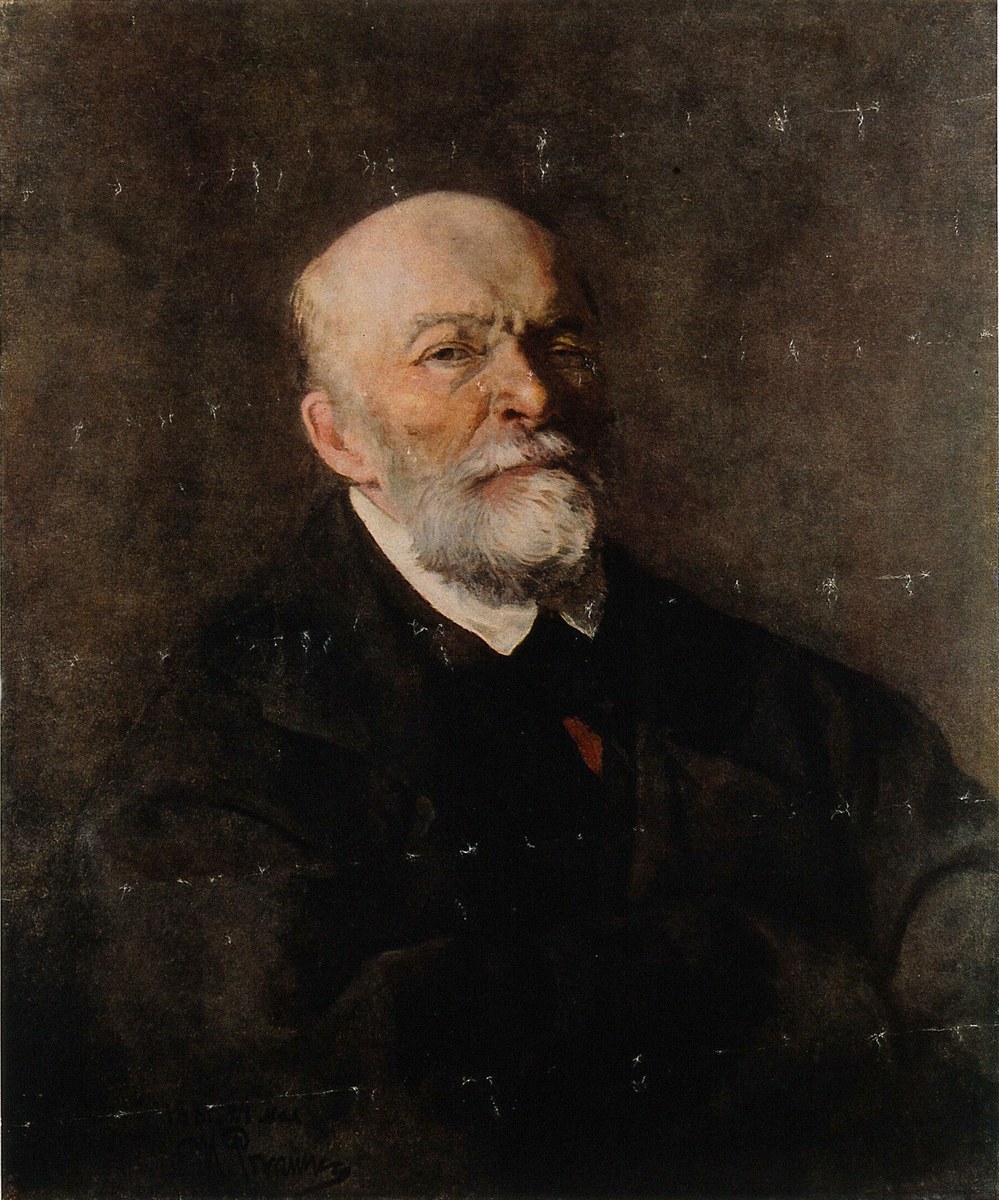
Ilya Repin, Portrait of the Surgeon Nikolai Pirogov, 1881 (Tretyakov Gallery), reproduced in a 1953 colour print (Iskusstvo, Moscow); Wellcome Collection, public domain · Ilya Repin's 1881 portrait of the surgeon Nikolai Pirogov, painted from life in four sittings and dated 24 May 1881 (Tretyakov Gallery, Moscow, inventory 731, bought from the artist in 1882), shown here through a 1953 colour print published by Iskusstvo, Moscow, which is held by the Wellcome Collection in London and marked Public Domain Mark. The sheet is captioned in Russian with Repin's name and dates, the Tretyakov Gallery and 'Nikolai Ivanovich Pirogov (1810-1881)'. The file used is the Wellcome 2,359 x 3,109 pixel image, cropped to the picture area and downscaled once to 999 x 1,200 pixels; nothing was upscaled. Caveats: the picture is a printed reproduction with some white scratches; the Tretyakov Gallery's own site terms claim rights in its images, so the museum's images were not used, and the legal basis rests on the painter's death in 1930 and on the reproduction being a photomechanical copy of a 2D painting. · Public domain (painting by Ilya Repin, d. 1930; 1953 print marked Public Domain Mark by the Wellcome Collection)
physician · 19th Century
Nikolay Pirogov
1810–1881
Known For
Not yet included in personality matching — the documented evidence doesn't yet cover enough of the personality model. Everything else on this page is fully available.
Trait Constellation
Key Achievements
As chief surgeon of besieged Sevastopol in 1854-55 he used anaesthesia on a mass scale, trained nursing sisters with Grand Duchess Elena Pavlovna, and later wrote the 1864 field-surgery text; historians say he may be considered the founder of field surgery.
From January 1847 he tested ether on animals, himself and his assistants and then developed its widespread use in Russia, including on the battlefield in the Caucasus, with an inhaler and mask of his own design; Berenson and Inozemtsev had used ether in Russia a few weeks earlier.
He published the eight-part Topographic Anatomy atlas (1852-1859), with 220 plates of sections through the frozen body in three directions, and introduced applied topographical anatomy teaching in Russia; the frozen-section idea had been carried out earlier by de Riemer, so his contribution was its scale and application.
Moments That Reveal Them
Doubtful at first about the safety of ether, Pirogov began experiments in January 1847, studied its course on himself and his assistants before using it on patients, and performed his first two operations under ether on 14 February 1847.
The sequence is consistent with a habit of testing a new method on himself and in controlled trials before applying it widely. Experimentation
At the field hospital in Oglakh in the Caucasus in 1847 the wounded lay in tents with no separate operating room, so Pirogov operated in front of the other wounded men to show them the effect of ether, and they afterwards came for surgery without fear.
The episode is consistent with a readiness to adapt a procedure to primitive conditions and take the initiative in persuading patients. Proactive Agency
Turning Points
After years of what Hendriks and colleagues call a ceaseless struggle with the administration in St. Petersburg, he resigned his surgical post in April 1856 and moved first to Odessa and then to Kiev, where he worked on school administration instead of surgery.
The move is consistent with a willingness to redirect his career into another field when his existing post became untenable. Cross-Domain Range
Similar People
People whose overall profiles resemble theirs.


Yayoi Kusama

Maya Angelou

Gertrude Bell

Marie Curie

Benjamin Franklin
Opposite Profile
Not a rival — a different profile shape worth a look.

Otto von Bismarck
Sources
- Nikolai Pirogov (Q315266), verified live via the Wikidata API (2026-11-05): label 'Nikolai Pirogov', description 'Russian medical scientist (1810-1881)', born 1810 (13 and 25 November and a year-only value recorded), died 1881 (23 November, 5 December and a month-only value), citizen of the Russian Empire, Russian label Николай Иванович Пирогов, no Korean label. Orientation only; not used as support for any row.
- Complete Dictionary of Scientific Biography (S. R. Mikulinsky) and Encyclopedia of Russian History (Alexander Vucinich), entries on Nikolai Ivanovich Pirogov, as reprinted on Encyclopedia.com (read in a summarised fetch, not word for word). CANONICAL SIGNIFICANCE SOURCE: surgeon and anatomist born in Moscow in 1810, doctorate at Dorpat 1832, Dorpat surgery chair 1836, head of surgery at the St. Petersburg Medical-Surgical Academy 1841-56; credited with using ether under battle conditions in 1847, founding topographic anatomy with his four-volume atlas (frozen-cadaver sections), the plaster cast idea (1851), organising care in the Crimean War and writing the 1864 field-surgery text; resigned in 1856 'tired of petty academic quarrels and intrigues', then worked as a school-district administrator in Odessa and Kiev until dismissed in 1861. Both entries are short, admiring and give no source citations; they disagree on some dates.
- I. F. Hendriks, J. G. Bovill, F. Boer, E. S. Houwaart and P. C. W. Hogendoorn, 'Nikolay Ivanovich Pirogov: a surgeon's contribution to military and civilian anaesthesia', Anaesthesia 70 (2015), pp. 219-227 (open-access publisher's version read in full). Scholarly historical article: his medical training (no dissection in four university years, then Dorpat, Berlin and Gottingen), his initial reluctance and then January 1847 experiments with ether on animals, himself and his assistants, his first operations under ether on 14 February 1847, his own inhaler and mask, the 1847 Caucasus mission (30 inhalers, 32 kg of ether, operations done before other wounded men, about 100 anaesthetised), his meticulous records of side effects, chloroform from December 1847, and the Sevastopol period (nursing sisters trained with Grand Duchess Elena Pavlovna, 5,000 amputations in nine months, typhoid); says Berenson in Riga and Inozemtsev in Moscow were the first in Russia to use ether, and that he 'may be considered the founder of field surgery'. The author team writes as admirers of Pirogov.
- I. F. Hendriks, 'Nikolay Ivanovich Pirogov and his contribution to medicine in 19th Century Imperial Russia', doctoral thesis, Leiden University (2022), Chapter 9 'Summary and concluding remarks' (English summary read in full; the other chapters were not opened). Summarises his empirical method (literature, animal experiments, self-experiment, careful analysis before wide use), the move of surgery from craft to science, his atlases and the osteoplastic foot amputation, his role as organiser in the Crimean War (triage, training of female nurses with Elena Pavlovna), his resignation after constant opposition (the summary says 1860; the 1856 date used elsewhere is followed here), and the Red Cross inspector-general reports. Same author as the 2015 article, so not independent of it.
- Jeremy Norman's History of Medicine, bibliographic entry for Pirogov's 'Anatome topographica sectionibus per corpus humanum congelatum triplici directione ductis illustrata' (page read in full, short). Gives St. Petersburg, J. Trey, 1852-1859, eight parts, 220 plates; calls it 'the first use on a grand scale of frozen sections in anatomical illustration'; says the frozen-section idea was first carried out by de Riemer, so Pirogov's contribution was the scale and application, and that he introduced the teaching of applied topographical anatomy in Russia. Bibliographer's note; the critical priority caveat comes from here.
- I. Hendriks, D. Zhuravlev, J. Boville, E. Huvart, F. Boer and P. Hogendoorn, 'Nikolay Ivanovich Pirogov: Forerunner, co-founder and Inspector-General of the Red Cross', Vestnik of St. Petersburg University. Medicine 15(1), 2020, pp. 56-78 (abstract only read; the English PDF was not opened). Abstract: Pirogov and Grand Duchess Elena Pavlovna organised and trained women as nurses for the Crimean front, he proposed an international treaty on medical aid to war victims and later acted as inspector-general reporting on care in two later wars. Partly read.
- Tretyakov Gallery (My Tretyakov), collection record 'Portrait of the Surgeon N. I. Pirogov' by Ilya Repin, 1881, oil on canvas 64.5 x 53.4, inventory 731 (record read in full). States that Repin finished the portrait in four sittings, signed and dated the canvas 24 May 1881, and that Pavel Tretyakov acquired it from the artist in 1882; the page carries no rights statement and links to site terms. Used for the portrait only, not for any trait row.
- Wellcome Collection, 'Nikolai Ivanovitch Pirogov. Colour process print, 1953, after I. E. Repin' (catalogue record opened live through the Wellcome catalogue API: licence Public Domain Mark, credit Wellcome Collection, digital image 2,359 x 3,109 pixels). Used for the portrait only, not for any trait row.