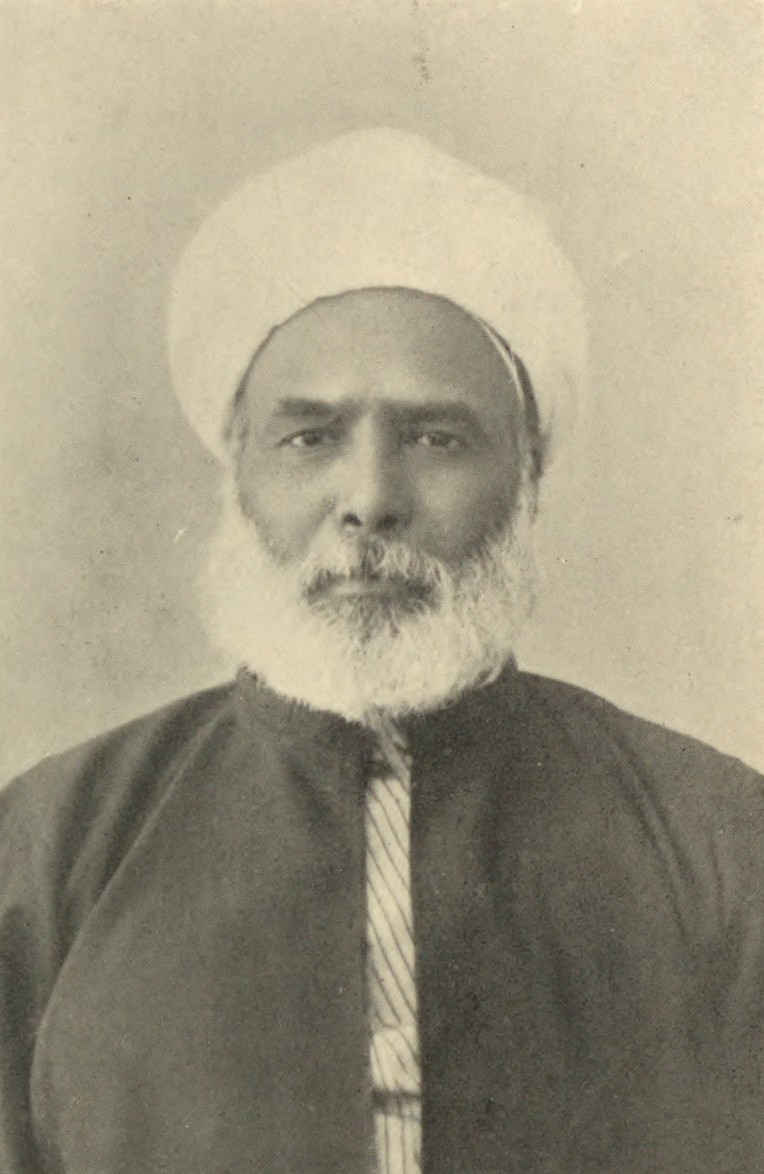
Photograph credited Fasani, in A. B. de Guerville, New Egypt, 1906, via Wikimedia Commons (public domain) · Photograph captioned 'The late Grand Moufti, Sheik Mohamed Abdou', reproduced in A. B. de Guerville, New Egypt (William Heinemann, London, 1906 edition; first published 1905 according to the Internet Archive record, with a Dutton edition in New York in 1906), facing page 159, with the credit 'Fasani' printed beside the plate in the Internet Archive text. Photographer not otherwise identified. The photograph was published in a book in 1905-1906, before 1931, so it is in the public domain in the United States on the basis of publication date; the Wikimedia Commons file 'The late Grand Moufti.png' carries the tag for works whose US copyright has expired and was uploaded from the Internet Archive scan. The Wikidata image 'Muhammad Abduh.jpg' was not used because its Commons page gives only an uploader's 'PD-old' with no publication source. Original file 764 x 1174 pixels, converted from PNG to JPEG with no resizing, cropping or upscaling. · Public domain (published before 1931)
theologian · 19th Century
Muhammad Abduh
1849–1905
Known For
Not yet included in personality matching — the documented evidence doesn't yet cover enough of the personality model. Everything else on this page is fully available.
Trait Constellation
Key Achievements
He led the late-19th-century Islamic modernist movement in Egypt, arguing that religion should be understood by freeing thought from taqlid and that Islam is consistent with reason and modern science.
In 1899 he became Mufti of Egypt and worked to reform the religious courts and the administration of endowments; from 1895 he was a leading member of the Al-Azhar administrative council, through which he carried out some reforms.
He wrote the Risalat al-tawhid, a systematic treatise on theology from his Beirut lectures, and his Qur'an lectures were expanded with his approval by Rashid Rida into the commentary known as al-Manar.
Moments That Reveal Them
As a boy at the Tanta mosque school he ran away because he was bewildered by learning commentaries by rote, and returned only when his uncle persuaded him.
This is consistent with an early impatience with rote learning that later became his argument against taqlid. Independent Thinking
In 1895 he persuaded the khedive to set up an administrative council for Al-Azhar and for ten years was its most prominent member, carrying out some reforms in its organisation.
This is consistent with a reformer who worked through institutions he could reach rather than only through writing. Proactive Agency
Turning Points
After meeting al-Afghani he left his phase of extreme asceticism, began studying philosophy (copying Ibn Sina's Isharat by hand) and started writing on social subjects.
This is consistent with a shift from inward mystical study toward a broader engagement with philosophy and public questions. Cross-Domain Range
Similar People
People whose overall profiles resemble theirs.


Ada Lovelace

Carl Jung

Gertrude Bell

Benjamin Franklin

Rabindranath Tagore
Opposite Profile
Not a rival — a different profile shape worth a look.

Otto von Bismarck
Sources
- Muhammad Abduh (Q311826), verified live via the Wikidata API (2026-10-31): label 'Muhammad Abduh', description 'Egyptian Islamic jurist, religious scholar and liberal reformer (1849-1905)', died 1905-07-11, citizenship Egypt, Korean label 무함마드 압두. Orientation only; not used as support for any row.
- Encyclopaedia Britannica, 'Muhammad Abduh' (biography page including its summary and question-and-answer sections; the full article body is subscriber-only and was not opened). CANONICAL SIGNIFICANCE SOURCE: an Egyptian religious scholar, jurist and liberal reformer who sought to revitalise Islamic teaching; studied at the Tanta mosque school and Al-Azhar (graduating 1877); joined al-Afghani in Paris in 1884 and later taught in Beirut; returned in 1888; as mufti of Egypt implemented reforms in Islamic law, administration and higher education against conservative resistance; works include Risalat al-tawhid and a Qur'an commentary.
- Albert Hourani, 'Arabic Thought in the Liberal Age 1798-1939' (Oxford University Press, 1962), chapter VI 'Muhammad Abduh', read as the Internet Archive full-text scan (about 25 pages of the chapter: early life, Azhar years, career, thought, critiques). Scholarly intellectual history by a historian who is neither a disciple nor a hostile critic; it draws on Rida's biography but also on Cromer, Blunt and Broadley, reports the doubts of Cromer, Blunt and Azhar critics, and describes Abduh's 'eclecticism' and avoidance of hard questions (for example a statement on the created Qur'an quietly removed from later editions of the Risalat al-tawhid). Quotes his own fragment of autobiography stating his purposes (self-report, as relayed).
- 'Muhammad Abduh: A Profile from the Archives', Jadaliyya (series with the newspaper As-Safir, translated by Mazen Hakeem; read in full, about 6,800 characters): chronology of his career from the Tanta mosque and Al-Azhar to the 1895 Azhar administrative council and the 1899 appointment as mufti with reform of religious courts and endowments; says he rejected the dominant rote method and 'transcribers', corresponded with Le Bon, Spencer, Tolstoy and Blunt, and warns that researchers urge caution against relying wholly on Rashid Rida's reading of Abduh. Short journalistic profile; not footnoted.
- Muzaffar Iqbal, 'Muhammad Abduh (1849-1905)', Center for Islam and Science biographical archive (read in full, about 19,000 characters). Partly follows the standard encyclopedia outline but adds a critical assessment: says his limited knowledge of science and modern philosophy led him to reconcile Qur'anic statements with scientific theories (jinn as microbes, evolution), describes his 1900-01 Qur'an lectures taken down and expanded by Rida with his approval, and quotes the Risalat al-tawhid. Evaluative and partly sceptical; used as the counter-voice.
- A. B. de Guerville, 'New Egypt' (William Heinemann, London, 1906 edition; Internet Archive full-text scan), the chapter 'The Political Testament of the Late Grand Moufti' and the surrounding passages (read: the author's own account of conversations with the Grand Moufti on religious and educational questions and a note Abduh sent him shortly before his death, with Abduh's statements on free education and the content of Egyptian schooling; a letter from his physician calling him 'the greatest man in modern Mussulman Egypt' is the correspondent's admiring testimony). A contemporary European journalist's witness, written within weeks of his death; admiring; the rows use only what the book reports Abduh as saying and doing about teaching. The book is also the publication source of the portrait.