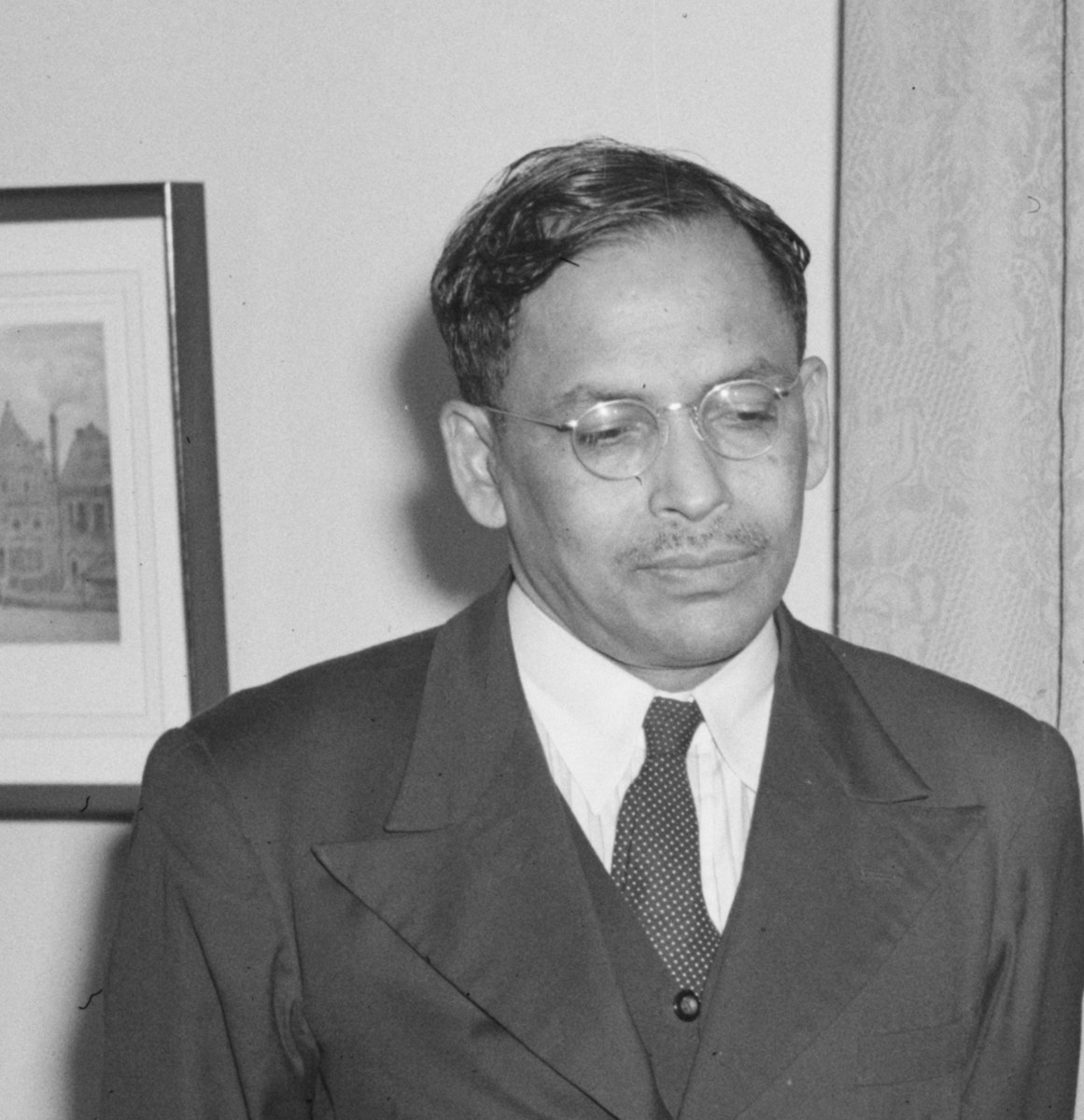
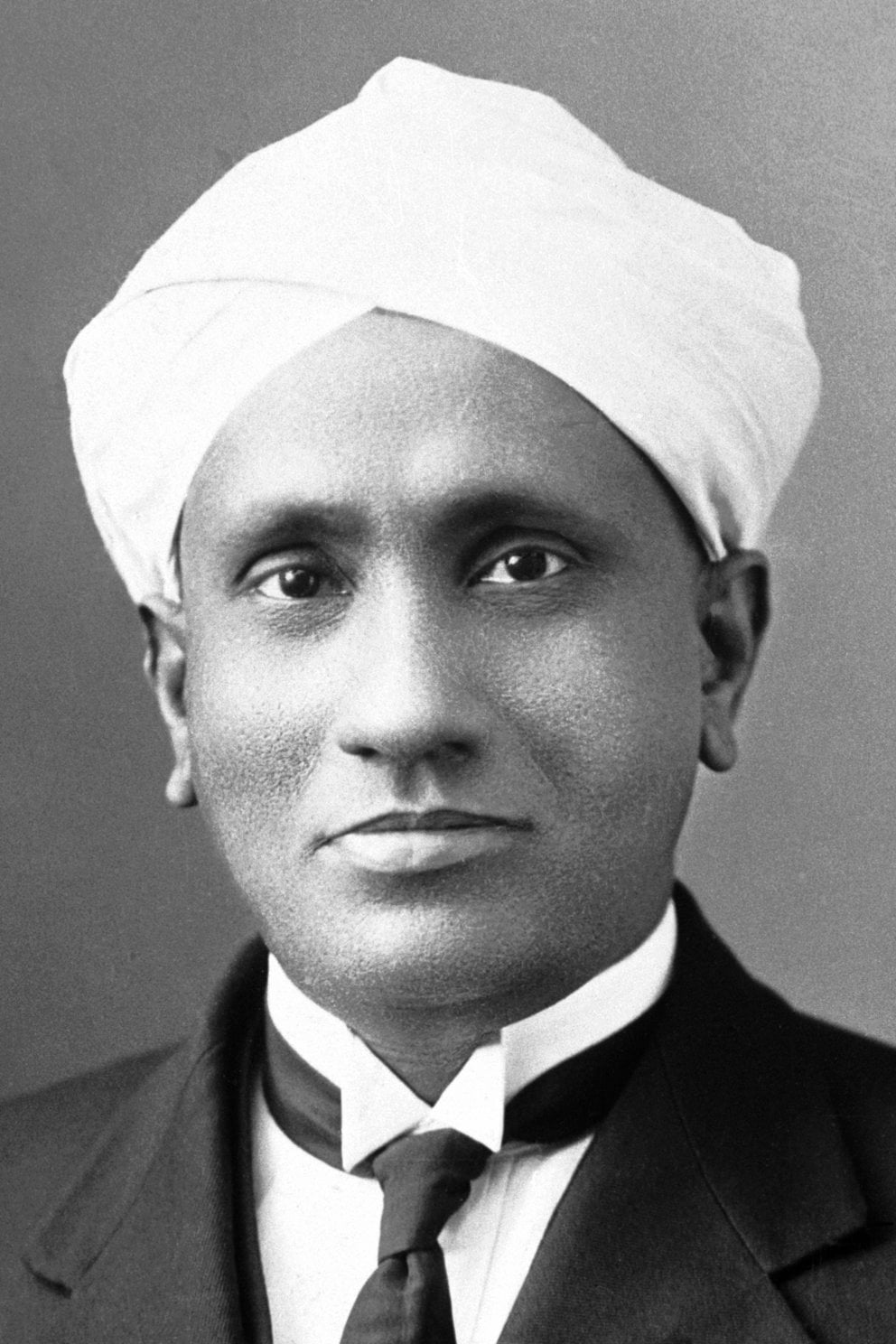
J. Sherrel Lakey, Office of War Information photographer, December 1944; Library of Congress · Library of Congress, Farm Security Administration - Office of War Information Photograph Collection (item LC-DIG-fsa-8d37165), via Wikimedia Commons; cropped from a group photograph of visiting Indian scientists · Public domain (work of a United States federal government photographer)
astrophysicist · 20th Century
Meghnad Saha
1893–1956
Known For
Not yet included in personality matching — the documented evidence doesn't yet cover enough of the personality model. Everything else on this page is fully available.
Trait Constellation
Key Achievements
Derived the thermal ionization equation in a 1920 paper, which Britannica says became fundamental to all work on stellar atmospheres: it links a star's spectrum to its temperature and the abundance of its elements.
Used the theory to explain why rubidium and caesium lines are missing from the Sun's spectrum and to predict that they should appear in cooler sunspots, where H. N. Russell then found the rubidium lines.
Helped build Indian science institutions: first president of the Allahabad academy, driving force behind the Institute of Nuclear Physics in Calcutta (later named for him), and founder of the journal Science and Culture.
Moments That Reveal Them
After writing a paper on the Harvard classification of stellar spectra, he withdrew it in London and spent about four months rewriting it with A. Fowler's criticism, publishing it in 1921 as 'On a physical theory of stellar spectra'.
This is consistent with openness to expert criticism when improving his own theory. Analytical Rigour
After independence he opposed setting up the Atomic Energy Commission at that time, arguing that India lacked the industrial base and trained people, and disagreed with Bhabha and Nehru on the approach.
This is consistent with willingness to hold a public position against more powerful figures. Conflict Tolerance
Turning Points
Awarded the Premchand Roychand Scholarship in 1919, he spent about two years in London and Berlin, where he worked in Fowler's and Nernst's laboratories and published his stellar-spectra theory in 1921.
This is consistent with a shift from isolated work in Calcutta to an international research network. Cross-Domain Range
Similar People
People whose overall profiles resemble theirs.

Wole Soyinka

Hildegard of Bingen

Bertrand Russell

Maya Angelou

Rachel Carson
Sources
- Meghnad Saha (Q377898) -- verified live via the Wikidata API (2026-10-26): English label 'Meghnad Saha', description 'Bengali astrophysicist (1893-1956)', born 6 October 1893, died 16 February 1956. Orientation only; not used as support for any row.
- Encyclopaedia Britannica, 'Meghnad N. Saha' -- reference biography: Indian astrophysicist noted for the 1920 thermal ionization equation, in the form perfected by Edward A. Milne fundamental to work on stellar atmospheres; professor at Allahabad in 1923, Fellow of the Royal Society in 1927, Calcutta from 1938 where he was instrumental in creating the Institute of Nuclear Physics; founded the journal Science and Culture in 1935; elected to Parliament as an independent in 1951 (politics not scored). CANONICAL SIGNIFICANCE SOURCE. Read in full.
- D. S. Kothari, 'Meghnad Saha' (Biographical Memoirs of Fellows of the Royal Society, vol. 5, February 1960; reprinted by the Indian National Science Academy) -- detailed memoir by one of his former students: the 1920 thermal ionization paper, the Milne and Fowler refinements and criticism of his method, his Allahabad and Calcutta years, the Institute of Nuclear Physics (founded 1948, opened 1950), the Indian Association for the Cultivation of Science, the academies and Science and Culture, flood control, and also his limits (little aptitude for practical work, a 'quaint' solar-corona hypothesis, not recognising the 21-cm hydrogen line). Colleague and admiring, but specific and with dated detail. Read in full except the bibliography.
- V. V. Raman, 'Saha, Meghnad', Complete Dictionary of Scientific Biography (reprinted on Encyclopedia.com) -- independent scholarly reference entry: his application of thermodynamics and quantum theory to stellar matter, the dispute over where the 1920 paper was written, the note that early enthusiasts applied the equation 'rather rashly' with significant errors, his institutional work and his avoidance of party politics. Read in full.
- Amitabha Bhattacharya, 'What India owes to Meghnad Saha', The Statesman, 1 March 2019 -- retrospective opinion by a retired civil servant, drawing on Robert Anderson's and G. Venkataraman's studies: his teaching and institution-building, his disagreement with Homi Bhabha and Nehru over setting up the Atomic Energy Commission, his difficulties with bureaucrats, the 'sometimes acrimonious' disagreements between Raman and Saha with personal ego and rivalry, and the point that his 1920 paper was published in a local journal. Admiring overall but with the critical points above. Read in full.