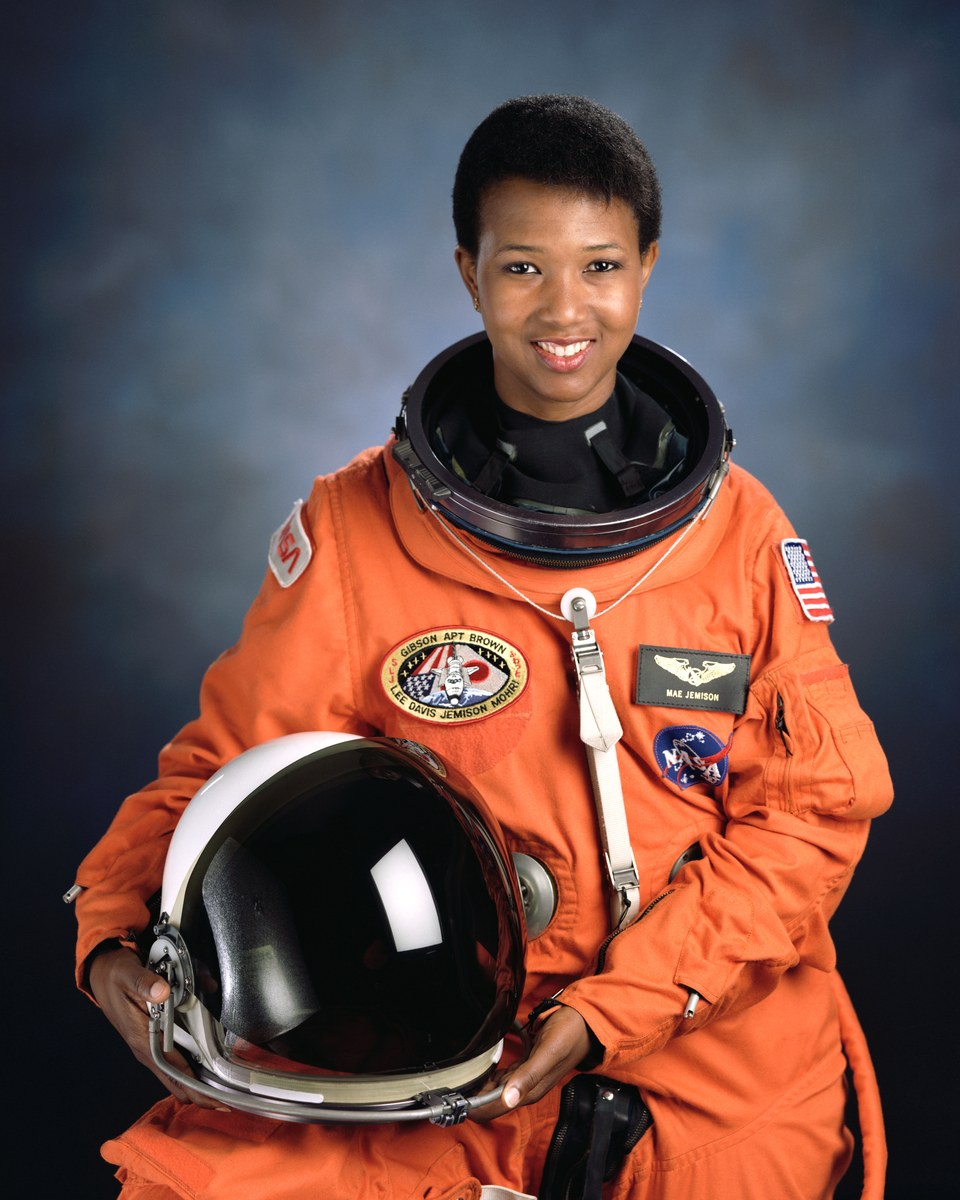
NASA / Johnson Space Center, photo S92-40463, official STS-47 portrait, 1 July 1992, downscaled from the original · NASA Johnson Space Center photograph S92-40463, 'Official portrait of STS-47 Mission Specialist Mae C. Jemison in LES' (NASA record date 1 July 1992; Commons 'Taken on 1 July 1992'), downloaded from the NASA Image and Video Library original (6204 x 7755 pixels, 5,122,051 bytes), the same size as the Wikimedia Commons file 'Mae Carol Jemison.jpg' (author NASA, tagged public domain as a work solely created by NASA; the Commons file's embedded metadata names Adobe Photoshop CS3, but this file was taken from NASA's own asset server, not from Commons). NASA's Media Usage Guidelines say NASA content is generally not subject to copyright in the United States and that third-party copyrighted material is marked with the holder's name; this record carries only a NASA credit, no third-party credit, and the mission patch visible on the suit is part of the official crew portrait. The guidelines also warn that commercial use of an astronaut's likeness must not imply NASA endorsement and that an identifiable person may have publicity rights; this record is for editorial identification of the subject and the lead should decide whether the product counts as commercial use (the same caveat already applies to other living astronauts in the roster). Downscaled once to 960 x 1200 (never upscaled). · Public Domain (NASA work)
astronaut · Contemporary
Mae Jemison
b. 1956
Known For
Not yet included in personality matching — the documented evidence doesn't yet cover enough of the personality model. Everything else on this page is fully available.
Trait Constellation
Key Achievements
On 12 September 1992 Jemison flew on Space Shuttle Endeavour's STS-47 mission as the Spacelab-J science mission specialist, a joint NASA-Japan flight of about eight days and 127 orbits that carried 44 life-science and materials-processing experiments; she was co-investigator on a bone cell research experiment. NASA's press kit identifies her as the first African American woman to fly in space.
She trained as both an engineer and a physician, with a chemical engineering degree from Stanford (1977) and a medical degree from Cornell (1981). From January 1983 to June 1985 she was Area Peace Corps Medical Officer for Sierra Leone and Liberia, managing health care for Peace Corps and embassy personnel, writing self-care manuals and taking part in hepatitis B vaccine, schistosomiasis and rabies research with the National Institutes of Health and the CDC.
She left NASA in March 1993 and later founded the technology consulting company the Jemison Group and an international science camp, The Earth We Share.
Moments That Reveal Them
Early in the Spacelab-J mission Jemison spent most of a Blue Team shift on the Frog Embryology Experiment. She moved fertilized eggs into the sealed workstation and watched them under a video microscope, and the experiment's principal investigator, Kenneth Souza, speaking from Marshall Space Flight Center's operations area, said he and his team agreed with her choice of the two best egg-donor frogs of the four aboard. When the workstation door stuck, she spoke with the experiment's payload manager, who approved a plan from Jemison and Jan Davis to free it, and it worked.
This is consistent with working a problem in step with ground investigators and a crewmate rather than alone, though the report records the outcome in a single sentence. Collaboration
In NASA's status reports for the first days of the mission (12 to 17 September 1992), Jemison appears in both of Spacelab-J's research areas. In materials science she ran the Gas Evaporation Facility, which vaporized metal filaments in glass bulbs, and the Liquid Drop Facility, levitating a drop of mineral oil with sound waves (a Japanese co-investigator thanked her for her hard work although the results were not completely successful). In life science she injected frogs to induce ovulation, fertilized and later fixed the eggs, and rotated chicken eggs each shift.
This is consistent with a background spanning engineering and medicine being put to work across the mission's two research areas, though the assignments were also set by the shift plan. Cross-Domain Range
Turning Points
Jemison, a physician, applied to NASA's astronaut program in 1985. When selection was paused after the Challenger accident in 1986 she reapplied, and in June 1987 she was chosen as one of 15 candidates from over 2,000 applicants. NASA's biography says she was working as a general practitioner and attending graduate engineering classes when she was selected.
This is consistent with someone who went after a new career path herself and tried again when the first attempt was overtaken by events, though the account of the application rests mainly on a museum biography. Proactive Agency
Similar People
People whose overall profiles resemble theirs.


Aristotle

Theodore Roosevelt

Wu Zetian

Leonardo da Vinci

Rabindranath Tagore
Sources
- Mae Jemison (Q34091) -- verified live via the Wikidata API (2026-10-16): English label 'Mae Jemison', description 'American doctor and NASA astronaut', born 17 October 1956, no date of death recorded, citizenship United States, Korean label present. Orientation only; not used as support for any row.
- NASA Johnson Space Center, 'Biographical Data: Mae C. Jemison (M.D.), NASA Astronaut (Former)', March 1993 -- the agency's official biography: a background in both engineering and medical research, with work in computer programming, printed wiring board materials, nuclear magnetic resonance spectroscopy, computer magnetic disc production and reproductive biology; internship and general practice in Los Angeles; Area Peace Corps Medical Officer for Sierra Leone and Liberia from January 1983 to June 1985, managing the health care delivery system for Peace Corps and embassy personnel, developing curriculum and teaching volunteer personal health training, writing self-care manuals, setting public health and safety guidelines for placement and training sites, and taking part in hepatitis B vaccine, schistosomiasis and rabies research with the National Institutes of Health and the CDC; general practice with CIGNA while attending graduate engineering classes until her selection as an astronaut in June 1987; technical assignments in launch support, Shuttle software verification and the Science Support Group; science mission specialist on STS-47 Spacelab-J (12-20 September 1992, 127 orbits, 44 experiments, 190 hours 30 minutes in space) and co-investigator on a bone cell research experiment; left NASA in March 1993; and a list of student-era activities (a health study grant for rural Kenya in 1979, a health and law fair she organised in 1979, work in a Thai refugee camp in 1980). CANONICAL SIGNIFICANCE SOURCE (honouring in tone and compiled from information the astronaut supplied, so used for the achievement cards and for dates and roles only; its personal data, family, hobbies and honours entries were not used). Read in full.
- NASA, 'STS-47 Press Kit' (Space Shuttle Endeavour, Spacelab-J, September 1992; HTML/PDF edition prepared by Richard W. Orloff in 2001) -- the pre-flight press kit: the first NASA mission devoted primarily to Japan, a crew of seven working paired 12-hour Red and Blue Team shifts (Jemison as Mission Specialist 4 on the Blue Team with Jay Apt and Jan Davis), the description of Jemison alongside Jan Davis as first-time space travellers with Jemison identified as the first African American woman to fly in space, the Spacelab-J experiment programme (materials processing and life sciences including frog and chicken-embryo development and bone cell research) and short crew biographies. Official NASA publication, promotional in tone; its notes on other crew members' private lives were not used. Read the mission overview, crew assignments, life-sciences and experiment lists and the Jemison biography; the engineering sections were skimmed.
- NASA Johnson Space Center and Marshall Space Flight Center, 'STS-47 Mission Control Status Reports' and Spacelab-J payload operations summaries, 12-17 September 1992 (NASA Spacelink daily file collections, preserved on a CD-ROM image on discmaster.textfiles.com) -- contemporaneous public-affairs reports of the Blue Team's shifts: Jemison conducting the Gas Evaporation Facility experiment and the first check of the Space Acceleration Measurement System, injecting four female frogs with a hormone for the Frog Embryology Experiment, selecting with the ground team's agreement the two best egg-donor frogs of the four aboard, moving fertilized eggs into the General Purpose Workstation and observing them under a video microscope, agreeing with the payload manager a plan with Jan Davis to free a stuck workstation door, fixing frog-egg specimens with formaldehyde at set stages and showing the team the tadpoles, running the Liquid Drop Facility experiment (a Japanese co-investigator thanked her for her hard work although the experiments were not completely successful), and rotating chicken eggs each shift. NASA's own operational reporting by public-affairs staff, independent of Jemison's accounts, factual and not hostile; the copies read are third-party archival mirrors of the NASA releases, not NASA-hosted pages. Her participation as an experiment subject in the biofeedback and lower-body-negative-pressure studies, and the physiological-measurement and health-monitoring entries that go with it, were not used. Read the Jemison passages across the 12-17 September files.
- Marisa Mathias, 'Mae Jemison', National Women's History Museum biography, 2024 -- an independent museum biography: the chemical engineering and medical degrees, her summer with a medical-aid organisation in Kenya, the study she led for the American Medical Student Association, her presidency of a Student National Medical Association chapter and work on health fairs, the Thai refugee camp, the Peace Corps medical post (managing a medical office, laboratory, pharmacy and volunteer health training), her 1985 NASA application, the pause in selection after the Challenger accident, her reapplication and 1987 selection as one of 15 from over 2,000 applicants, STS-47, her departure in 1993, and her later science camp, professorship at Dartmouth, consulting company and 100 Year Starship. An educational museum biography built substantially on Jemison's own memoir and Ebony articles (quoted in it), so honouring and partly self-derived; its childhood, family, dance, personal-effects and quoted-memoir passages were not used. Read in full.
- Ben Evans, 'Of Marriage, Medaka Fish and Multiculturalism: The Legacy of STS-47', AmericaSpace, 28 October 2012 -- a spaceflight-history feature on the mission: Spacelab-J as a NASA-Japan life and materials science flight on which 'astronauts do the science', Jemison designated NASA's 'science mission specialist' (performing payload-specialist duties, with a university biochemist as her backup, a role the article says was never seen again in the Shuttle era), the Blue and Red Team shift structure, her earlier Peace Corps medical work (care, self-care manuals, help with vaccine research), and the mission's close. Independent space-history journalism drawing on NASA documents and Jemison's recollections; its material on other crew members' marriage, family and divorce, on Jemison's childhood, schooling and experiences of discrimination, and an unsourced Peace Corps medical-evacuation anecdote told without attribution (apparently from her memoir) were not used. Read in full.
- Alan Boyle, 'Skipper chosen for starship effort', NBC News Cosmic Log, 7 January 2012 -- news report on DARPA's 100 Year Starship project: sources saying the team to manage it would be led by Mae Jemison, who had founded several ventures including the Jemison Group (a technology design and consulting company) and the Dorothy Jemison Foundation for Excellence (educational projects) and had played a prominent role in the 2011 100 Year Starship symposium; the $500,000 DARPA seed contract; the BBC's reading of an unreleased DARPA letter; the Tau Zero Foundation, a bidder that did not win, saying the contract was going to a team led by an ex-astronaut and its founder suggesting it would lower its profile; and a partner organisation's director describing the three-way team's different emphases. Independent news reporting that includes a losing bidder's reaction; DARPA had not yet confirmed the selection when it was written. Read in full.
- Ian O'Neill (Discovery News), 'Uniting the planet for a journey to another star', carried by NBC News, 30 May 2012 -- follow-up confirming that the Dorothy Jemison Foundation for Excellence, headed by Jemison, would head the multi-partner 100 Year Starship project (with Icarus Interstellar, the Foundation for Enterprise Development and the SETI Institute), that DARPA had awarded $500,000 as seed money, and describing the planned research institute and the project's stated inclusive aims in her words. Independent science journalism with substantial direct quotation of Jemison, so partly her own account; used only to confirm the foundation's role and the award. Read in full.
- Brid-Aine Parnell, 'Former coder, NASA 'naut to lead DARPA starship dream', The Register, 9 January 2012 -- short technology-news item reporting, from a letter seen by the BBC, that Jemison would head the 100 Year Starship project, describing the plan in a sceptical and irreverent tone as wildly aspirational against an eventual cost of billions and a $500,000 seed contract, and noting her programming work before NASA and her science mission specialist role on STS-47. Independent, lightly sceptical trade-press voice on the later venture; its Star Trek aside was not used. Read in full.
- NASA Image and Video Library record S92-40463 (Johnson Space Center), 'Official portrait of STS-47 Mission Specialist Mae C. Jemison in LES' (record date 1 July 1992; description 'Astronaut Mae C. Jemison, M.D., mission specialist'), with NASA's Media Usage Guidelines and the Wikimedia Commons original-file page 'Mae Carol Jemison.jpg' -- checked for the portrait's basis. Not used for any scoring.