Yayoi Kusama
93% Profile Match
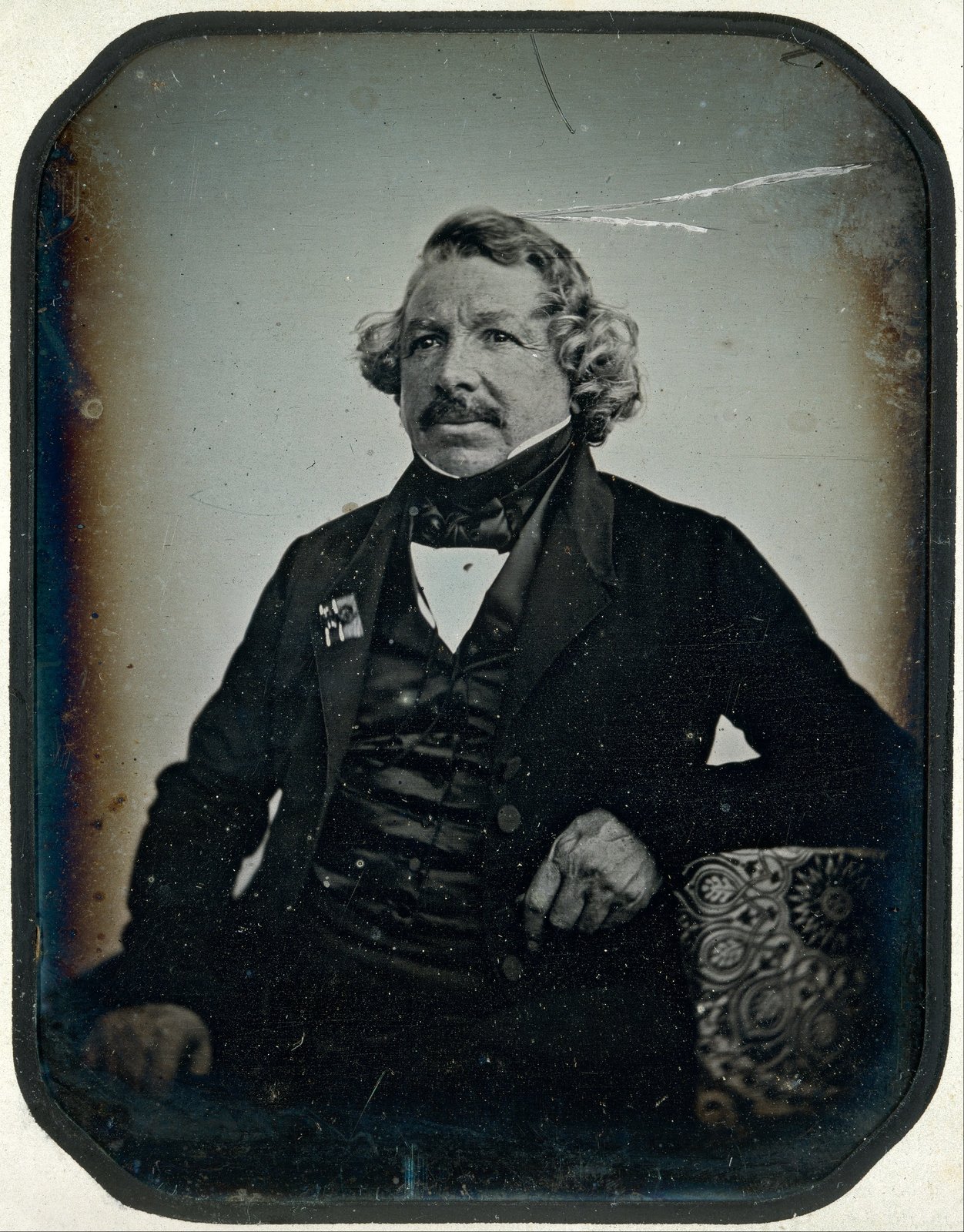
Jean-Baptiste Sabatier-Blot (1801-1881), 'Louis Jacques Mande Daguerre', daguerreotype, 1844; George Eastman Museum. Basis: an 1844 original by a creator who died in 1881 (public domain by term, Commons PD-Art/PD-old-100), and the museum's own partner listing on Google Arts & Culture shows 'Rights: Public Domain'. The museum's own collection site (collections.eastman.org) is behind a Cloudflare wall and could not be consulted, so no museum-site rights notice was read, and none conflicting was observed. The original verso inscription confirms the sitter, the maker (his friend Sabatier-Blot) and the year 1844. · George Eastman Museum (Rochester, NY), daguerreotype of Louis-Jacques-Mandé Daguerre by Jean-Baptiste Sabatier-Blot, 1844 (gift of Eastman Kodak Company; ex-collection Gabriel Cromer), via Google Arts & Culture partner page asset kAGH5aEML9GTQQ and the Wikimedia Commons Google Art Project copy (original 2349x3001, downsized to 1252x1600 at q85) · Public domain
In the process Daguerre made public in 1839, a silver-plated copper plate was exposed to iodine vapour, exposed in a camera, developed over heated mercury vapour and then made insensitive to light. The state's exposé said it needed four or five minutes, where Nicéphore Niepce's bitumen process had needed many hours. Daguerre's own 1839 note argues the daguerreotype owed nothing to Niepce, while Davanne, speaking for Niepce's memory, still credits Daguerre with the latent image developed by mercury vapour.
In 1822 Daguerre and the painter Charles-Marie Bouton opened the Diorama in Paris: large translucent canvases painted on both sides and lit from the front or from behind, so that one scene changed from day to night or into another effect. A programme had two pictures; Daguerre's Midnight Mass at Saint-Étienne-du-Mont was among the first. The 1839 agreement with the state also required him to make the Diorama's painting and lighting methods public.
Because the process could not be protected by a French patent, the Minister of the Interior agreed with Daguerre and Isidore Niepce on 14 June 1839 that the state would buy it for life pensions of 6,000 francs to Daguerre and 4,000 to Niepce; the Deputies passed the law on 3 July and the Peers on 30 July. François Arago described the process to the Academy of Sciences on 19 August to a crowd that overflowed the hall, and Daguerre's manual appeared from the maker Alphonse Giroux, who sold the apparatus under Daguerre's signature. Eder adds that Daguerre also took an English patent on 14 August 1839.
On 3 September 1827 Daguerre spent about three hours in Paris with Nicéphore Niepce, whom he had approached since 1826. Niepce's letter of the next day, quoted by Ernouf, says Daguerre showed him the Diorama, described a fast process of his own and his struggle to hold several colours, and believed Niepce was further ahead; Daguerre pressed the need to shorten the fixing of the image. The two signed their partnership in December 1829.
Seeking out an older, more advanced researcher after repeated evasive replies, and using the meeting to push the next problem, is consistent with proactive agency; the account comes from Niepce's side of the correspondence as printed by Ernouf. Proactive Agency
On 8 March 1839 a fire destroyed the Diorama and Daguerre's home while he was visiting Samuel Morse to see the telegraph; Morse wrote to his brothers the next day. On 20 May Morse offered to arrange an exhibition of Daguerre's results in America, and on 26 July Daguerre replied that the transaction with the French government was nearly at an end, so he could not take it up.
Staying on the course of the state sale in the months after the loss, rather than taking a foreign offer, is consistent with persistence; Morse is a friendly witness and his son edited the letters. Persistence
In 1837 and 1838 Daguerre and Isidore Niepce looked for capitalists and, on 15 May 1838, tried to sell the process by subscription. Ernouf says buyers admired the plates but doubted the images would last and feared copying, and Eder reports the attempt failed. Daguerre then took the secret to François Arago, who announced the invention to the Academy of Sciences on 7 January 1839 and helped bring the matter to the Minister of the Interior.
Changing route to the state when the market would not pay for something no patent could protect is consistent with resourcefulness; the buyers' reasons come from Ernouf alone. Resourcefulness
People whose overall profiles resemble theirs.




Not a rival — a different profile shape worth a look.