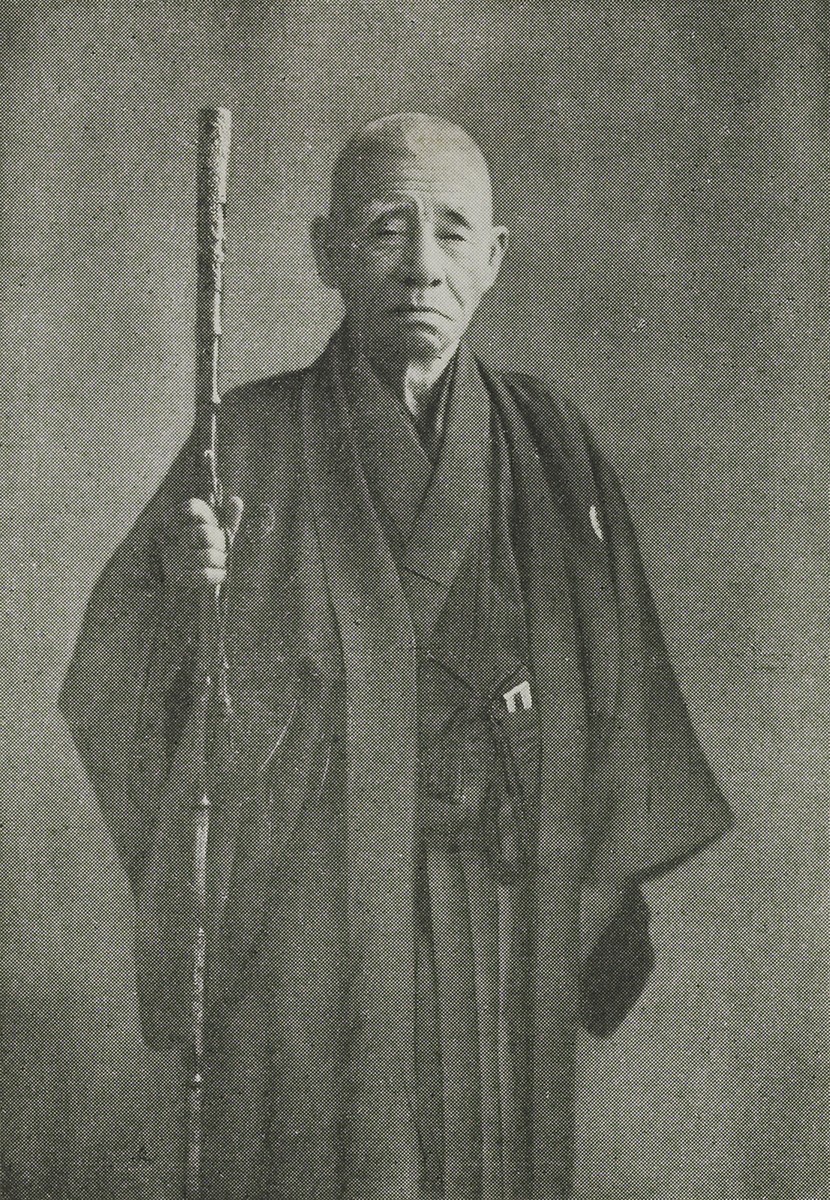
Photographer unknown, published 1953 in Otodake Iwazo, Mikimoto Kokichi; reproduced by the National Diet Library, Japan, Portraits of Modern Japanese Historical Figures. · Photographic portrait of Mikimoto Kokichi as an old man, photographer unknown, reproduced as the first image on the National Diet Library's online exhibition 'Portraits of Modern Japanese Historical Figures' (entry 396). The exhibition's data identifies the image as taken from the digitised NDL book with persistent ID 2974878, Otodake Iwazo, 'Mikimoto Kokichi' (Seinen Series no. 4, Shakai Kyoiku Kyokai, Tokyo, 1953), which the NDL catalogue lists as published in 1953 with plates; so the photograph was published in Japan in 1953, before 1956. The Library's usage notice says every portrait image in the exhibition is one whose copyright term has expired and may be reused without application, including commercially. The photograph's own date and photographer are not stated. Original 1024 x 1480 pixels, downscaled to 830 x 1200 with no cropping and no upscaling. · Public domain (copyright term expired; National Diet Library usage notice)
entrepreneur · 19th Century
Mikimoto Kokichi
1858–1954
Known For
Not yet included in personality matching — the documented evidence doesn't yet cover enough of the personality model. Everything else on this page is fully available.
Trait Constellation
Key Achievements
He founded Japan's cultured pearl industry: after losing his first oysters in 1892 he succeeded with hemispherical cultured pearls in 1893, began selling cultured-pearl jewellery in 1899 and sold spherical cultured pearls in London from 1919.
The round-pearl technique itself is credited to Nishikawa Tokichi and Mise Tatsuhei, who filed patents in 1907; Mikimoto patented his own implantation process in 1908, then from 1916 used the Mise-Nishikawa method and commercialised it.
When his cultured pearls reached Europe they were attacked as fakes, and a French court ruled in 1924 that they do not differ from natural pearls; his production made pearls affordable.
Moments That Reveal Them
According to PBS, he tested nucleus materials from glass, lead and clay to wood and found round shell nuclei cut from US mussel shells gave the best success rates.
This is consistent with a trial-and-error approach to solving a technical problem. Experimentation
In November 1892 a red tide killed all his experimental oysters in Ago Bay, yet in 1893 he obtained hemispherical pearls at another experimental site in Toba Bay.
This is consistent with persistence after a major setback. Persistence
Turning Points
After his 1893 success he set up a full-scale programme for a pearl-culture business and in 1899 began selling cultured-pearl ornaments, opening a Tokyo shop, which turned an experiment into a market.
This is consistent with a tendency to turn a technical result into a business without waiting to be asked. Proactive Agency
Similar People
People whose overall profiles resemble theirs.


Abraham Lincoln

Mahatma Gandhi

Marie Curie

Elizabeth Blackwell

Jane Goodall
Sources
- Mikimoto Kokichi (Q956283), verified live via the Wikidata API (2026-10-30): label 'Mikimoto Kokichi', description 'Japanese businessman (1858-1954)', born 1858 (two birth dates are recorded, 25 January and 10 March, the second being the Gregorian conversion), died 21 September 1954, citizenship Japan, Korean label present, P18 image 'MIKIMOTO Kokichi.jpg'. Orientation only; not used as support for any row.
- Kiyohito Nagai, 'A History of the Cultured Pearl Industry', Zoological Science (Zoological Society of Japan, 2013), hosted by the Japan Pearl Promotion Society, read in full (about 20 pages, via pdftotext): CANONICAL SIGNIFICANCE SOURCE. Mikimoto's 1892 red-tide loss and 1893 hemispherical-pearl success, his meeting with Professor Mitsukuri, the start of sales in 1899, the 1907 Nishikawa and Mise patent applications, Mikimoto's agreement with Nishikawa, the sale of spherical pearls in London from 1919, the 'Paris trial' and the 1924 French ruling, and the 1978 claim by C. Denis George that Saville-Kent anticipated the technique. A peer-reviewed historical review by a Japanese pearl scientist; it is sympathetic to the Japanese industry and gives Mikimoto a central place, while crediting Nishikawa and Mise with the piece and injection methods.
- PBS NOVA, 'The History of Pearls' (pbs.org), read in the cultured-pearl section: Mikimoto as the noodle maker's son with a hard-working wife Ume, his 1896 and 1908 patents, the independent discoveries by Nishikawa and Mise, the 1916 patent altered so that he could use their method, his purchase of rights to it, the claim that his expansion eclipsed the originators, and his trial-and-error tests of nucleus materials. A popular science article of uncertain authorship; it states that he 'single-handedly launched' the industry in one place and credits others in another, so it is used with that tension noted.
- Gemological Institute of America, 'History of Cultured Pearls - Part 1' (4cs.gia.edu, 30 June 2014), read in full: the three Japanese men credited with the cultured pearl (Nishikawa, Mise and Mikimoto), Mise's 1902 trials and 1907 patent, Mikimoto's January 1908 patent for his own implantation process, his 1912 South Sea experiments, his 1916 adoption of the Mise-Nishikawa method and the 1921 market arrival of round cultured pearls. Gemological institute blog; dates differ slightly from Nagai (1919 versus 1921 for the first sales).
- Museum of Archaeology and Anthropology, University of Cambridge, photograph record N.121258.HNL (collections.maa.cam.ac.uk), read in full: James Hornell's glass-negative photograph of Mikimoto and Nishikawa on Tatoku Island on 16 July 1907, Hornell's diary comment on the farm's order and prosperity, and curators' notes on Mikimoto (often cited as founder of the first cultured pearl industry), Nishikawa's 1907 piece-method patent (granted 1917), his marriage to Mikimoto's second daughter and his death in 1909. Museum catalogue entry by archive staff; it quotes Eunson's 1956 biography, which was not opened.
- National Diet Library, Japan, 'Portraits of Modern Japanese Historical Figures': entry for Mikimoto Kokichi (ndl.go.jp/portrait/datas/396), read in full: a short biographical note by Library staff (born 1858, died 1954; started pearl-oyster culture in 1890, succeeded with hemispherical pearls in 1893 under Mitsukuri's circle, opened his Tokyo shop in 1899, the round-pearl method invented by Nishikawa and others with his patent in 1908, overseas shops, member of the House of Peers from 1938). Also the source of the portrait file. Not used for scoring beyond corroboration.