Yi Sun-sin
88% Profile Match
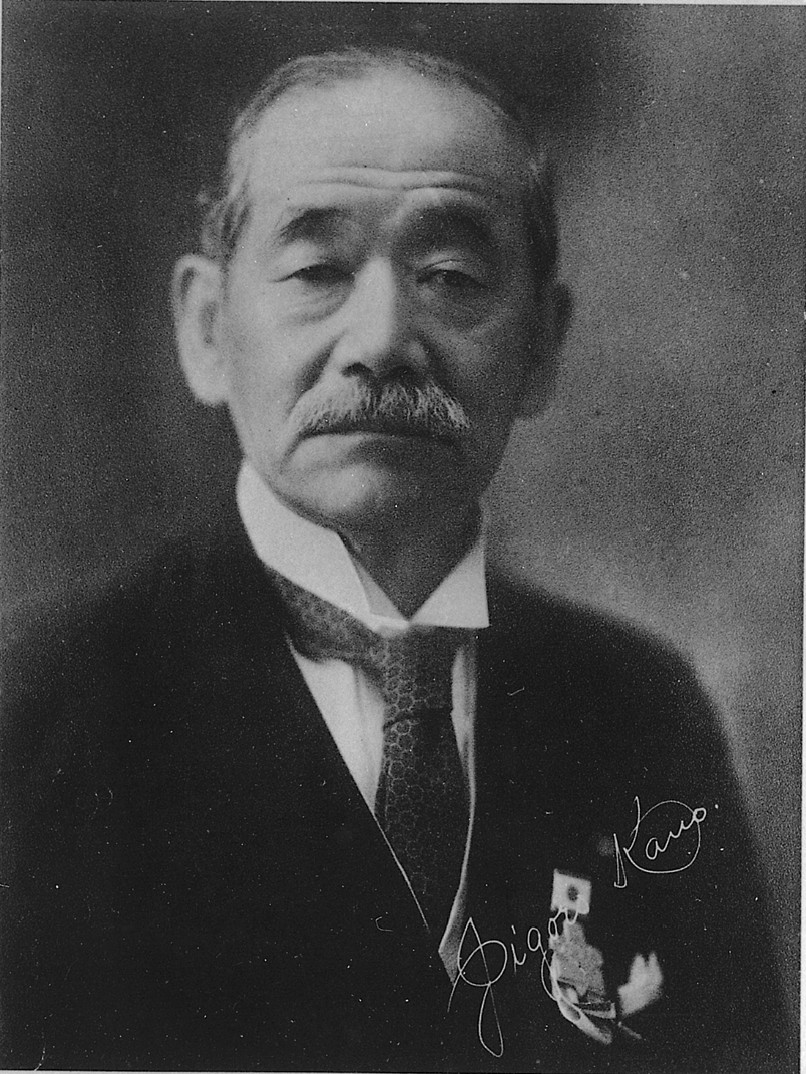
Photographer unknown, published 1941 in Kendo Yokoyama, Kano Sensei Den (Kodokan). Source: Portraits of Modern Japanese Historical Figures, National Diet Library, Japan (https://www.ndl.go.jp/portrait/) · Signed studio portrait photograph of Jigoro Kano, photographer unknown, taken before his death in 1938 and printed as the frontispiece of the biography 'Kano Sensei Den' (Kano Sensei-den) by Kendo Yokoyama (Kodokan, Tokyo, 1941), as reproduced in the National Diet Library's digital exhibition 'Portraits of Modern Japanese Historical Figures' (entry for KANO Jigoro; source item NDL Digital Collections pid 1043572, page 3). The sitter's English signature 'Jigoro Kano' is written on the print and the Library's entry names the sitter. The file is the library's published image (875 x 1146 pixels) with its white page border trimmed (806 x 1074), with no upscaling; it is a halftone book reproduction, so the grain is that of the print. · Public domain (declared by the National Diet Library for all images in 'Portraits of Modern Japanese Historical Figures'; the source book's NDL Digital Collections record shows access restriction 'PDM'; the photograph was published in Japan in 1941, before 1957)
teacher · 19th Century
1860–1938
Not yet included in personality matching — the documented evidence doesn't yet cover enough of the personality model. Everything else on this page is fully available.
Educator who founded judo: in 1882 he opened the Kodokan, drawing judo from the Tenjin Shin'yo-ryu and Kito-ryu jujutsu schools and building it on the principles of maximum efficient use of energy and mutual prosperity; he later introduced the belt and dan ranking system, and judo joined the Olympic programme in 1964.
Principal of the Tokyo teacher-training school (Tokyo Higher Normal School, now the University of Tsukuba's forerunner) for more than two decades, where he promoted sport and founded a Department of Physical Education in 1915; he also set up a school for Chinese students.
First Asian member of the International Olympic Committee (1909-1938) and head of the Japan Amateur Athletic Association founded around the 1912 Stockholm Games, which sent Japan's first Olympic team; he helped bring the 1940 Games to Tokyo.
After losing to a much heavier rival, Kano, according to a 1971 biographical essay, studied sumo books and developed a new throw, kata guruma, that he then used to win.
This is consistent with someone who responded to a defeat by studying outside sources to improve his technique. Mastery Orientation
When the marathon runner Shizo Kanakuri could not afford the trip to the 1912 Stockholm Games, Kano set up a support association at his school that raised enough money for him to go.
This is consistent with someone who organised practical backing to get a participation project over the line. Leadership Drive
In 1882, at about 22, he opened his own dojo, the Kodokan, with a handful of students, moving from being a jujutsu trainee to being the founder and teacher of a new school.
This is consistent with someone who turned years of study of several schools into an institution of his own. Creative Originality
People whose overall profiles resemble theirs.



Not a rival — a different profile shape worth a look.