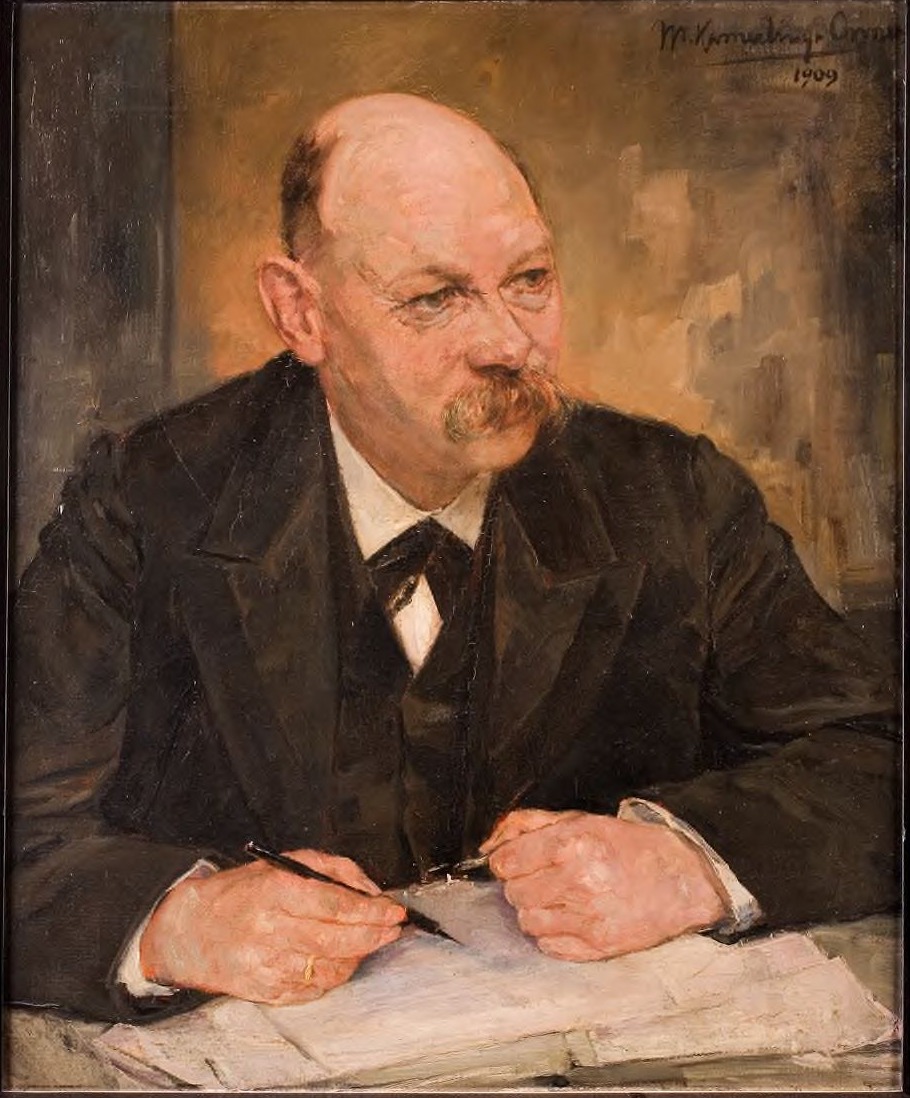
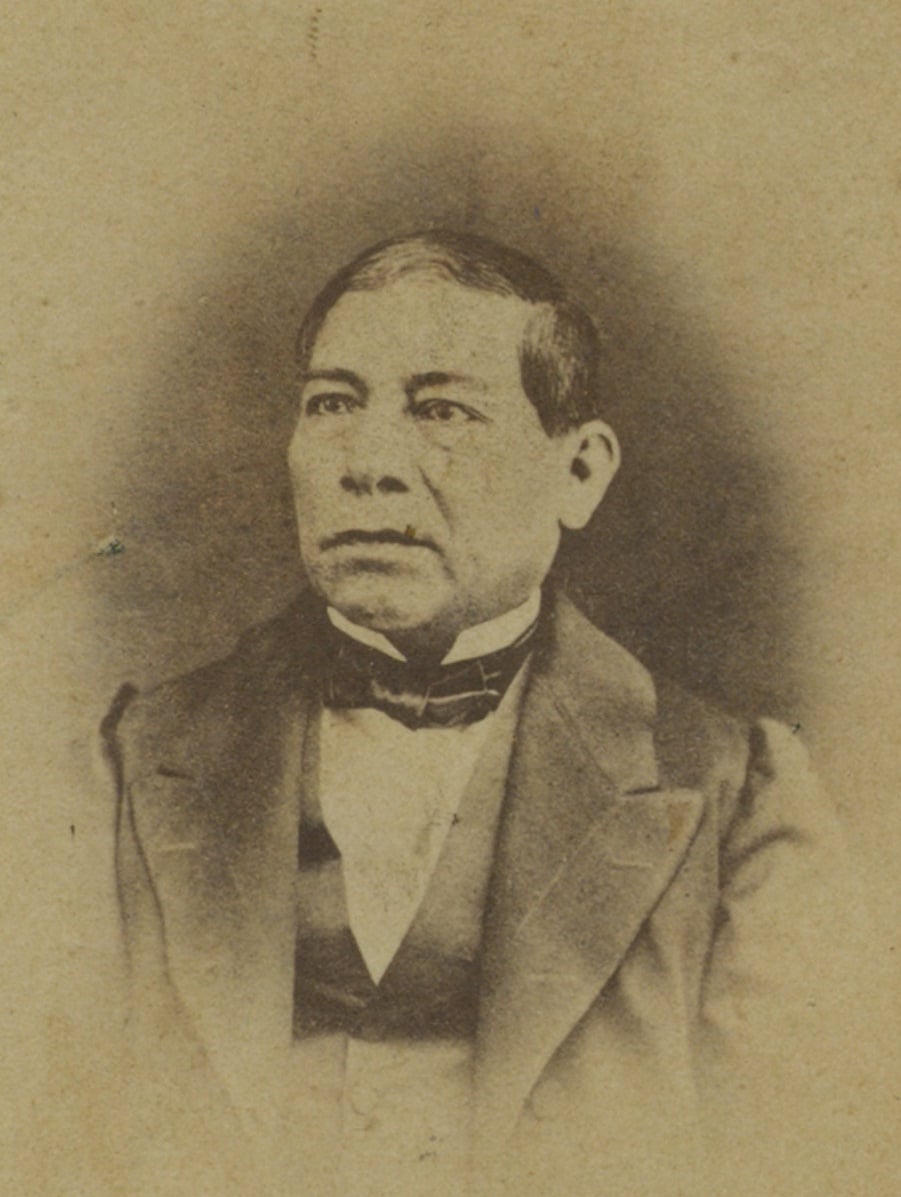
Menso Kamerlingh Onnes, portrait of Heike Kamerlingh Onnes, 1909, oil on canvas, Leiden University Libraries, Icones Leidenses (Icones 311), public domain · Oil portrait of Heike Kamerlingh Onnes by his brother Menso Kamerlingh Onnes (1860-1925), signed and dated 1909, in the Leiden University portrait collection (Icones Leidenses, shelfmark Icones 311; given to the university in 1926 by Mrs Kamerlingh Onnes-Bijleveld). The holder's record, read through its IIIF manifest, states the rights status as public domain with a Public Domain Mark 1.0 link; the painter died in 1925. The file used is the holder's own 1,024 x 1,273 pixel digital image, cropped once to the painted canvas to remove the black frame (910 x 1,098 pixels); nothing was upscaled. The painted frame carries the lettering 'HEIKE KAMERLINGH ONNES. GRONINGENSIS.' and 'NATUS 21 SEPT. 1853 ... PHYS. EXPER. PROF. ORD. AC. L.B. 11 NOV. 1882 ... OBIIT LEIDAE 21 FEBR. 1926.', which match the sitter. A portrait painted in his lifetime by a close relative, signed and dated; the sitting itself is not described in the record. · Public domain (painter died 1925; Leiden University Libraries rights status: public domain, Public Domain Mark 1.0)
physicist · 20th Century
Heike Kamerlingh Onnes
1853–1926
Known For
Not yet included in personality matching — the documented evidence doesn't yet cover enough of the personality model. Everything else on this page is fully available.
Trait Constellation
Key Achievements
On 10 July 1908 he liquefied helium at Leiden, producing about 60 ml at roughly 4.2 kelvin, the last of the so-called permanent gases to be liquefied.
In 1911 he found that the electrical resistance of very pure mercury drops abruptly to zero at liquid-helium temperature, and he named the effect superconductivity.
He built Leiden into the leading low-temperature laboratory, with a liquid-air cascade, a hydrogen liquefier and a school of instrument makers, and received the 1913 Nobel Prize in Physics for his low-temperature research.
Moments That Reveal Them
After Dewar showed liquid hydrogen in 1898, he did not rush a small liquefier but spent until 1906 building one meeting stringent standards that could produce several litres an hour.
This is consistent with holding equipment to a demanding standard even when it cost years. Perfectionism
When his 1911 mercury measurements showed zero resistance, the team repeated them with a W-shaped tube of four segments so that a short circuit could be excluded.
This is consistent with testing a surprising result against alternative explanations before accepting it. Experimentation
Turning Points
On becoming professor at Leiden in 1882 he reorganised the physics laboratory from a teaching institute into a research laboratory to test van der Waals's molecular theory, which led him to build a cryogenic laboratory from scratch.
This is consistent with committing to a long, deliberately sequenced research programme. Planning Orientation
Similar People
People whose overall profiles resemble theirs.

Yi Sun-sin

Ruth Bader Ginsburg

Elizabeth I of England

Martin Luther King Jr.

Benito Juarez
Opposite Profile
Not a rival — a different profile shape worth a look.
Rabindranath Tagore
Sources
- Heike Kamerlingh Onnes (Q62891), verified live via the Wikidata API (2026-11-06): label 'Heike Kamerlingh Onnes', description 'Dutch physicist, Nobel prize winner (1853-1926)', born 21 September 1853, died 21 February 1926, citizen of the Netherlands, occupations include physicist. Orientation only; not used as support for any row.
- Complete Dictionary of Scientific Biography, 'Kamerlingh Onnes, Heike' (entry read in full via Encyclopedia.com). CANONICAL SIGNIFICANCE SOURCE: professor of experimental physics at Leiden for forty-two years from 1882; inaugural address of 1882 and the motto 'Door meten tot weten'; aimed to give experimental support to van der Waals's law of corresponding states; cascade apparatus for liquid air and oxygen in 1892, hydrogen liquefier in February 1906, helium first liquefied on 10 July 1908; discovered in 1911 that the resistance of very pure mercury drops discontinuously to zero and named the effect superconductivity; remained 'absolute monarch' of his field until retiring in 1923. Scholarly and sober: records that his first expectations about resistance were wrong, that his virial-coefficient programme did not give a better law of corresponding states, and that a 1911 density anomaly in liquid helium was attributed to possible methodological faults and not published below 2.2 K.
- Dirk van Delft, 'Little cup of helium, big science', Physics Today 61(3), March 2008 (article read in full, seven pages). The director of the Boerhaave Museum describes the 10 July 1908 liquefaction hour by hour, the 1895-98 city-council shutdown of his hydrogen work, his insistence on stringent standards for the 1906 hydrogen liquefier, the helium gas purification, the school of instrument makers and the 'cold factory' organisation, the 1908 'solid helium' announcement withdrawn six weeks later, and his helium supply chain (Ramsay, a brother's monazite sand, the Welsbach firm, the US Bureau of Mines). Written by a museum historian who is admiring and draws on Onnes's archive; the strongest behavioural source, though it is one author's interpretation.
- Rudolf de Bruyn Ouboter, 'Heike Kamerlingh Onnes's Discovery of Superconductivity', Scientific American, March 1997 (article read in full). A Leiden low-temperature professor describes the cascade, the instrument-makers' society, the 1896 council shutdown, the helium liquefaction, and the 1911 mercury experiments in which the team repeated the measurement with a W-shaped tube to rule out short circuits, plus the later persistent-current experiment and his disappointment that magnetic fields destroyed superconductivity. Flags that the anecdote about a student falling asleep is third-hand. Written from inside the Leiden laboratory tradition.
- Dirk van Delft, 'Heike Kamerlingh Onnes and the Road to Liquid Helium', IEEE/CSC and ESAS European Superconductivity News Forum no. 16, April 2011 (conference paper read in full). Scientific biography from the Leiden centennial symposium: formative years under Bunsen and Kirchhoff, no articles published in the first ten years at Leiden while building the cryogenic installation, the 1901 school of instrument makers, the three-year licence struggle, and Dewar's remark that assistants are a waste. Same author as the Physics Today article, so not an independent perspective; used to corroborate and add dates.
- Encyclopaedia Britannica, 'Heike Kamerlingh Onnes' (page read in full). Orientation on the Nobel Prize in Physics in 1913 for low-temperature work and the production of liquid helium, superconductivity, and the founding in 1894 of the cryogenic laboratory that bears his name; notes that his student Keesom, not he, solidified helium in 1926.
- National High Magnetic Field Laboratory, Magnet Academy, 'Heike Kamerlingh Onnes' (page read in a summarised fetch). Biography of his education, the reorganisation and re-equipping of the Leiden laboratory, hydrogen in 1906, helium in 1908, superconductivity in 1911, the Nobel Prize and his role in the International Institute of Refrigeration. Short, admiring institutional page; used only to corroborate dates.
- Linda Hall Library, Scientist of the Day, 'Heike Kamerlingh Onnes' (21 September 2018; read in full, short post). Frames him as the contemporary and competitor of James Dewar, notes that he reached liquid oxygen and liquid hydrogen later than others and then produced liquid helium in 1908 and found superconductivity in mercury. Used for the competitor framing only.
- Leiden University Libraries, Icones Leidenses, 'Portret van Heike Kamerlingh Onnes, hoogleraar Proefondervindelijke natuurkunde en meteorologie te Leiden' (shelfmark Icones 311; oil painting by Menso Kamerlingh Onnes, 1909); record read through the holder's IIIF manifest, rights 'public domain' with a Public Domain Mark 1.0 link. Used for the portrait only, not for any trait row.