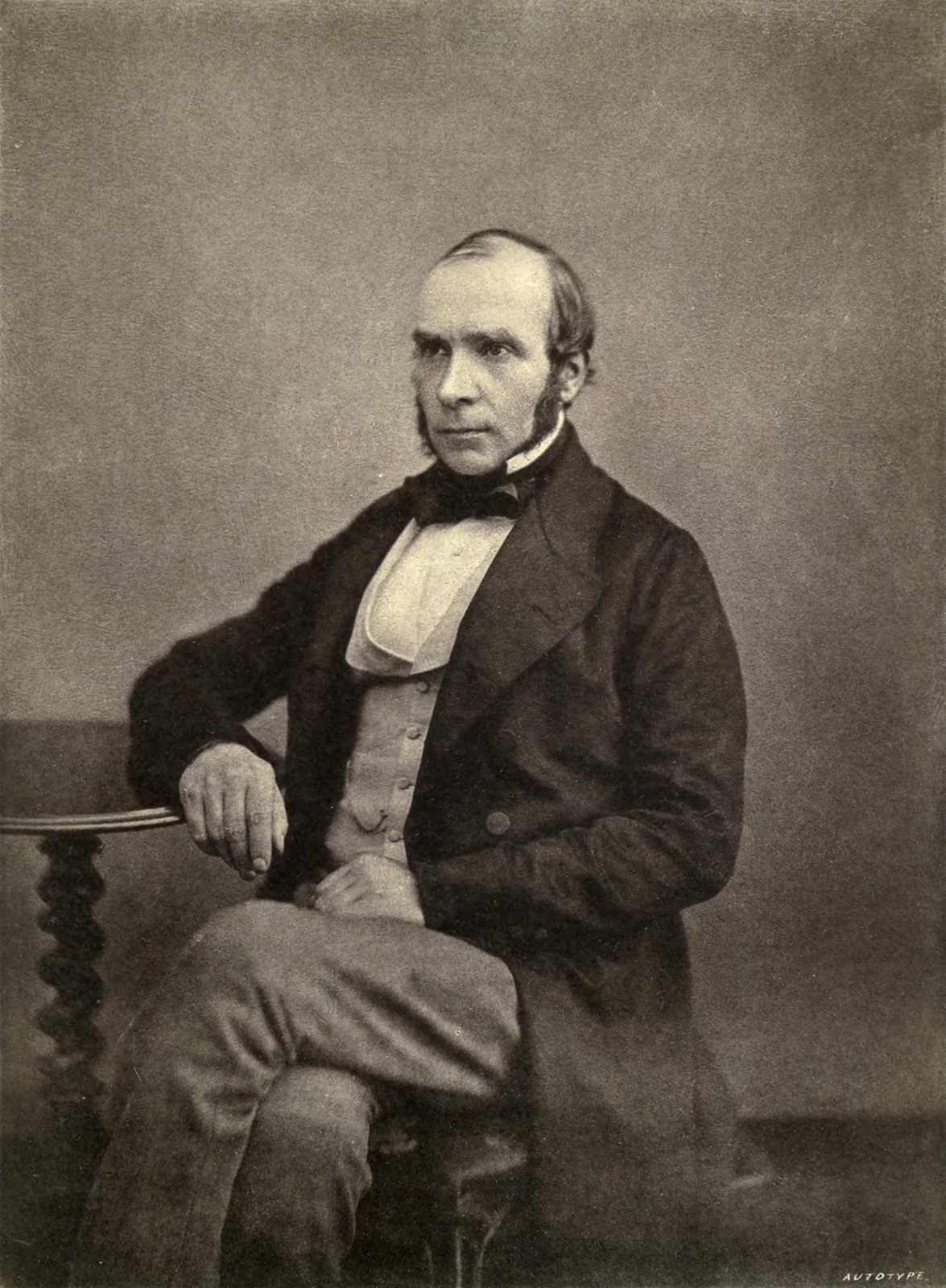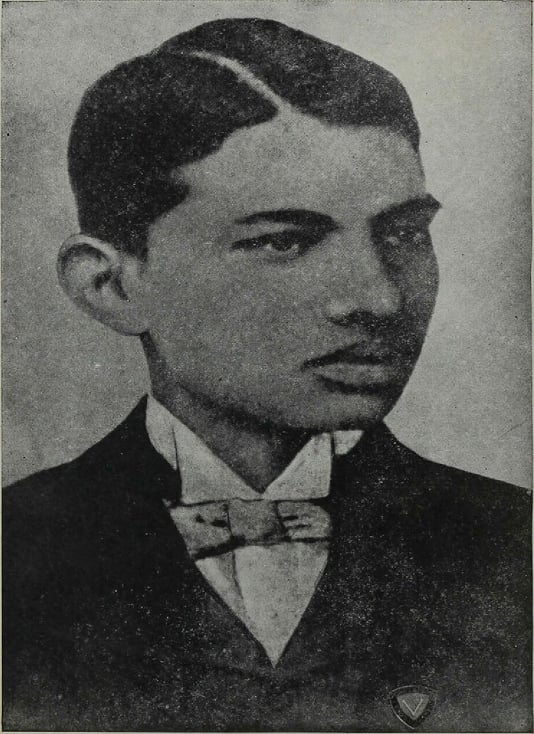

John Snow, photograph of 1856 by an unrecorded photographer, reproduced as an autotype in The Asclepiad, vol. IV (1887); scan: Internet Archive / University of Toronto; cropped to the photograph and downscaled · Autotype plate facing p. 274 in B. W. Richardson (ed.), The Asclepiad, vol. IV (London: Longmans, Green, 1887), captioned 'Autotype from a Presentation Portrait, 1856, and Autograph facsimile.—B. W. R.'; University of Toronto (Gerstein) copy digitized by the Internet Archive · Public domain
Trait Constellation
Key Achievements
In 1849 he argued in print that cholera spreads when people swallow matter from earlier cases, most often through contaminated water, rather than through bad air. The much-enlarged 1855 edition added a house-by-house comparison of cholera deaths among customers of two south London water companies, one drawing its water from the sewage-laden Thames in London and the other from further upstream.
His inquiry into the Broad Street outbreak of 1854 in Soho pointed to the local public pump. A parish committee, which included him and the curate Henry Whitehead, concluded in 1855 that the outbreak was 'in some manner attributable' to the well's water, while the General Board of Health's scientific committee rejected his explanation that same year.
From 1847 he designed inhalers and published practical studies of ether and then chloroform, becoming one of the most sought-after anaesthetists in London. He kept a case record of every anaesthetic he gave, and gave chloroform to Queen Victoria at the births of two of her children, in 1853 and 1857.
Moments That Reveal Them
On the evening of 7 September 1854, a week into the Broad Street outbreak, Snow asked to be heard by the parish Board of Guardians and set out the evidence he had gathered against the pump. The handle was removed the next day. His own figures, like the curate Henry Whitehead's later ones, show that new cases were already falling before then.
Going to the local authorities on his own evidence, with no official role and while few believed his theory, is consistent with the profile's strong reading of taking the initiative. Proactive Agency
In March 1855 Snow told a parliamentary committee, on behalf of manufacturers, that foul-smelling fumes from trades such as bone-boiling did not in themselves cause epidemic disease. Under hostile questioning he admitted he had not studied those trades particularly. The Lancet answered with two scathing editorials, one dismissing his evidence as 'hobbyistic dogmas' rather than science.
Taking a publicly unpopular side and holding it under pressure offers one example of his readiness for controversy; the episode also sits alongside his friend Richardson's view that he sometimes pushed arguments further than his evidence could carry. Conflict Tolerance
Turning Points
In December 1846 news of ether anaesthesia reached London, and early results were uneven. According to his friend B. W. Richardson, Snow traced the problem to the way the vapour was given, built an improved inhaler, and tested it on animals before being allowed to administer it at London hospitals. Within a short time surgeons were calling on him regularly, lifting him out of a struggling general practice.
Meeting a new technique with his own trials and apparatus, rather than simply adopting it, illustrates the hands-on experimentation that runs through his later work on other anaesthetic agents. Experimentation
Similar People
People whose overall profiles resemble theirs.

Marie Curie

Rosalind Franklin

Jane Goodall

Sigmund Freud

George Orwell
Sources
- John Snow (English Wikipedia) -- orientation only; not used as support for any scored row. Korean Wikipedia title '존 스노 (의사)' confirmed via the Wikidata sitelink.
- John Snow (Q356407) -- verified live via wbgetentities (2026-09-26): en label 'John Snow', description 'English epidemiologist and physician (1813–1858)', ko label '존 스노', born 1813-03-15, died 1858-06-16, citizenship Q174193 (United Kingdom of Great Britain and Ireland), P18 'John Snow.jpg', kowiki '존 스노 (의사)'. Orientation only.
- Benjamin Ward Richardson, 'Memoir of the Author', pp. i-xliv prefixed to John Snow, On Chloroform and Other Anaesthetics (London: John Churchill, 1858), archive.org OCR (onchloroformothe00snow) -- INSIDER/FRIEND perspective (Richardson knew Snow for his last eight years and shared experiments with him; admiring, written just after his death), embedding a FIRSTHAND FELLOW-STUDENT letter from Joshua Parsons (co-lodger 1836-37), recorded as a separate perspective. Read the memoir in full (pp. i-xl): early life, Parsons' letter, the 1838 Apothecaries' refusal, Westminster Medical Society, ether 1846-47 and chloroform, the 1851 Lord Campbell/Alfred Taylor dispute, cholera work 1848-55 and the Broad Street representation, the cost of the 1855 book, the 1855 offensive-trades evidence and the 1858 Chadwick exchange, amylene and self-experiment, and the 'personal history' section (order, diary, habits, controversy). Also consulted the book's own amylene chapter (SELF) for his case record of a death under amylene.
- Rev. Henry Whitehead, 'The Broad Street Pump: an Episode in the Cholera Epidemic of 1854', Macmillan's Magazine 13, no. 74 (Dec. 1865): 113-122, archive.org OCR of the Wellcome offprint (b22449231) -- INDEPENDENT, INITIALLY SCEPTICAL LOCAL WITNESS: curate of St Luke's, Berwick Street, who expected his own inquiry to refute Snow and says so. Read in full. Used for: Snow having 'prevailed upon the parish authorities' to remove the handle on 8 Sept. while 'scarcely any one seriously believed in his theory'; Whitehead's own reluctant conversion through house-to-house inquiry; Snow's case findings as Whitehead relays them; Whitehead's follow-up of the earliest Broad Street cases 'in consequence of Dr. Snow's suggestions'.
- Cholera Inquiry Committee, Report on the Cholera Outbreak in the Parish of St. James, Westminster, during the Autumn of 1854, presented to the Vestry July 1855 (London: J. Churchill, 1855), archive.org OCR (b22327460) -- LOCAL INSTITUTIONAL perspective (committee of vestrymen, medical men and clergy; general report drafted by J. Marshall), with Snow's own report (SELF) and Whitehead's report bound in. Read: Introduction (membership; methods: the failed printed return, Snow's report of 12 Dec. 1854 laid before it 'at the desire of the Committee', the house-to-house 'Visitors' Inquiry List' prepared by King, Lankester and Snow); the General Report sections on the well water, the attack table, the committee's conclusion that the outbreak was 'in some manner attributable' to the Broad Street well while refraining from endorsing any hypothesis of its mode of action, and its note that sewage entry into the well was unproved until Whitehead's later findings.
- General Board of Health, Medical Council, Report of the Committee for Scientific Inquiries in relation to the Cholera-Epidemic of 1854 (London: HMSO, 1855), archive.org OCR (b21687043) -- ADVERSARIAL OFFICIAL perspective. Read the contents, the Golden Square section (pp. 51-53) and the water-supply chemistry/microscopy sections. Used for: the committee's explicit rejection of Snow's Broad Street explanation ('After careful inquiry, we see no reason to adopt this belief') and its preferred atmospheric/organic-impurity account.
- John Snow, On the Mode of Communication of Cholera, 2nd ed. (London: J. Churchill, 1855), read in the reprint Snow on Cholera (New York: Commonwealth Fund, 1936), archive.org OCR (b3134818x_0001) -- SELF, one perspective, never sole support for a row. Read: the Broad Street/Golden Square section (the 73-death inquiry, the 7 Sept. interview with the Board of Guardians, the attack table and his own statement that attacks had fallen so far before the handle was removed that its effect could not be decided); the Deptford nitrate-of-silver passage; the 1854 south-London inquiry (the chloride-of-silver test distinguishing the two companies' water, and his engaging Mr J. J. Whiting for districts he could not cover himself).
- John Snow's evidence to the Select Committee on the Public Health and Nuisances Removal Bills, 5 March 1855 (questions 117-172), transcribed on the UCLA Department of Epidemiology John Snow site (R. R. Frerichs), Wayback copy of ph.ucla.edu/epi/snow/snows_testimony.html -- SELF answers under HOSTILE questioning by committee members (a parliamentary record). Read the whole transcription. Used for: his open statement that he appeared at the manufacturers' request, his flat denial that decomposition effluvia cause disease, and his admission that he had not studied those trades particularly and had first been asked to consider the subject 'two or three days ago'.
- The Lancet, editorials 'The Public Health and Nuisances Removal Bill: Dr. Snow's Evidence' (23 June 1855) and 30 June 1855, plus the Lancet editorial of 14 May 1853 on chloroform at the royal birth, as transcribed with commentary on the UCLA John Snow site (pages reactionandcommitteeaction.html and lancet1853reaction.html, Wayback copies) -- ADVERSARIAL CONTEMPORARY PRESS perspective. Read both pages in full. Used for: the Lancet's attack on Snow as 'singular in his opinion' with 'hobbyistic dogmas' and its 'main sewer' jibe, i.e. contemporary evidence that he publicly held a minority position; and its logical objection to his evidence. The 1853 editorial is context only (no row).
- R. R. Frerichs (UCLA Dept. of Epidemiology), John Snow site pages 'Reverend Henry Whitehead' and 'John Snow and the removal of the Broad Street pump handle' (Wayback copies, read in full) -- SCHOLAR/COMPILER perspective quoting primary texts: Edwin Lankester's 1866 recollection (local physician and member of the St James committee: Snow 'demanded an audience' and 'was not believed'), Whitehead's 1867 table showing fatal attacks already falling before 8 Sept., and Whitehead's farewell speech of 16 Jan. 1874 (via H. D. Rawnsley's 1898 memorial sketch) recalling Snow's conversations and a medical friend's 1855 remark that Snow's views were 'generally regarded in the profession as very unsound'.
- Michael A. E. Ramsay, 'John Snow, MD: anaesthetist to the Queen of England and pioneer epidemiologist', Proceedings (Baylor University Medical Center) 19(1) (2006): 24-28 (PMC1325279), read in full -- MODERN CLINICIAN-HISTORIAN overview, secondary and not error-free (it misdates the first cholera essay to 1848 and places the Golden Square outbreak in 1853), so used only as light corroboration: his casebooks logging some 5,000 anaesthetics over twelve years, and his continuing to argue the waterborne theory for the rest of his life without convincing most peers. Never sole support.