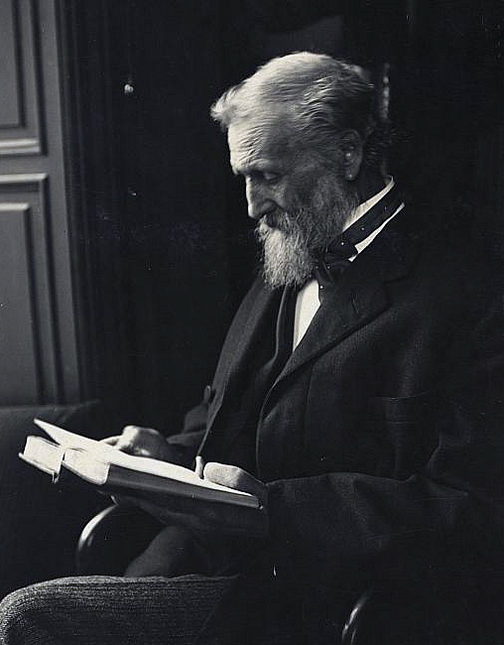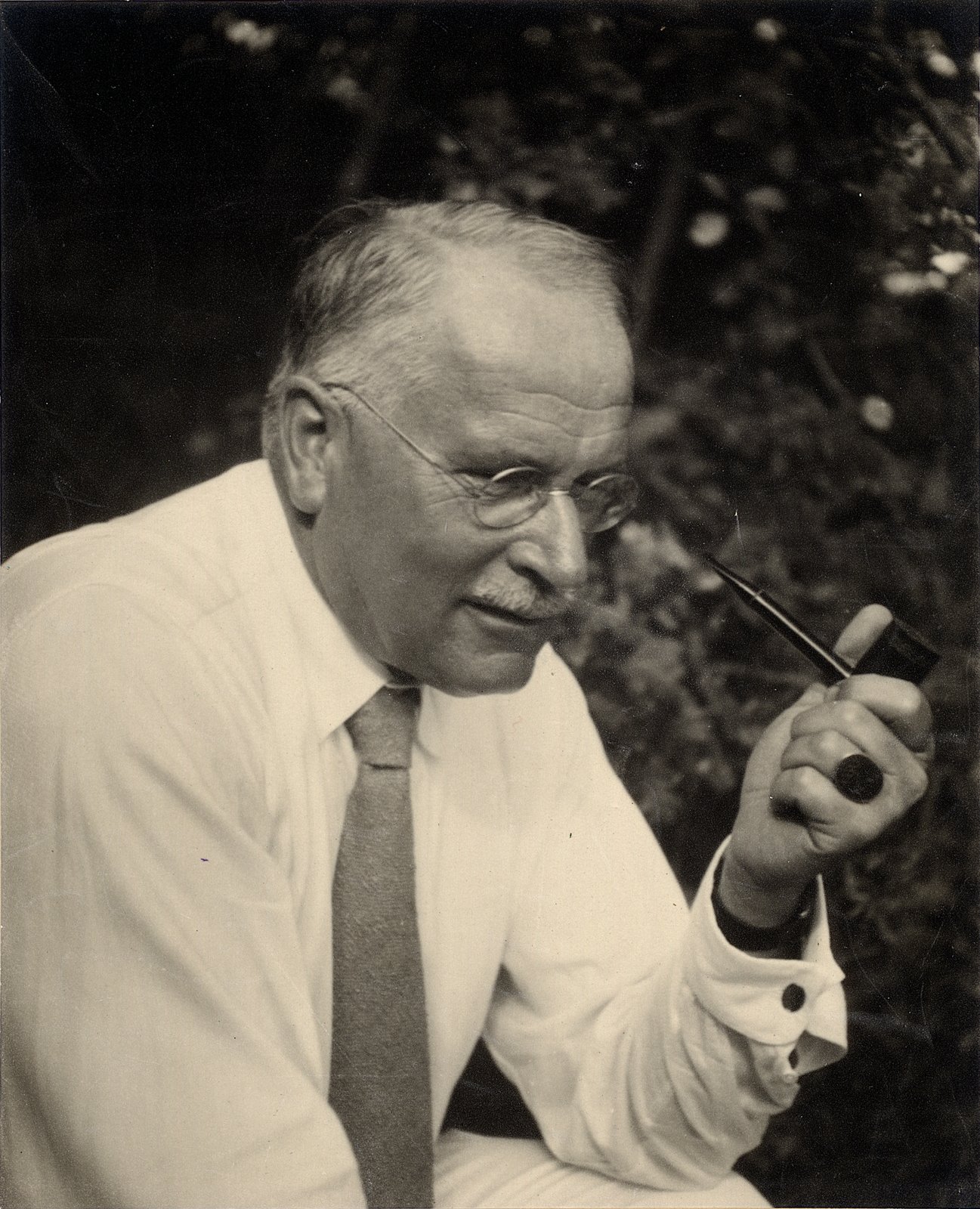

Underwood & Underwood, c. 1912; Library of Congress (public domain) · Library of Congress Prints and Photographs Division, '[John Muir, seated, reading a book]', photographer Underwood & Underwood, dated c1912 May 29 on the record, with the note 'J169749 U.S. Copyright Office' (a 1912 U.S. copyright entry), call number BIOG FILE - Muir, John, reproduction number LC-DIG-ppmsca-18943. The Library's rights statement is 'No known restrictions on publication', but the basis relied on here is item-level: a professional studio photograph published and registered in the United States in 1912, so its U.S. protection has expired by age (works published before 1931). Muir was about 74 and the sitting was a documented photograph of him, so it is a likeness. Saved from the Wikimedia Commons file 'John Muir 1912.jpg' at its original 504 x 645 pixels with no resizing or upscaling; a larger Library of Congress scan could not be fetched. · Public domain
naturalist · 19th Century
John Muir
1838–1914
Known For
Not yet included in personality matching — the documented evidence doesn't yet cover enough of the personality model. Everything else on this page is fully available.
Trait Constellation
Key Achievements
Naturalist and writer whose magazine articles led Britannica to call him largely responsible for the 1890 creation of Sequoia and Yosemite national parks; he founded the Sierra Club in 1892 and was its first president.
Wrote books that remain important in American nature literature, including The Mountains of California (1894), Our National Parks (1901) and The Yosemite (1912), plus posthumous journals such as A Thousand-Mile Walk.
In 1874-75 attributed Yosemite's formation to glacial erosion, against the then common cataclysm view; Britannica says he was the first to present this theory and that it is now generally accepted.
Moments That Reveal Them
In the early 1870s he spent his Sunday excursions from a Yosemite sawmill making detailed studies of the valley's geology, plants and animals, including the water ouzel, and worked out the idea that glaciers had shaped the valley.
This is consistent with self-directed curiosity, though the detail comes largely from Muir's own journals as retold. Curiosity
Without formal geological training he argued that glaciers, not a sudden earthquake collapse, had carved Yosemite; Joseph LeConte was impressed enough to encourage his first article, while a later geographers' review says he overstated the glaciers' extent.
This is consistent with independent thinking against the prevailing view, with some overreach. Independent Thinking
Turning Points
In 1867 an industrial accident nearly cost him an eye; he abandoned mechanical inventing and set out on a thousand-mile walk, then went to Yosemite in 1868 to devote his life to nature.
This is consistent with a self-chosen change of direction toward independent work in nature. Need for Autonomy
Similar People
People whose overall profiles resemble theirs.


Leonardo da Vinci

Gertrude Bell

Sor Juana Inés de la Cruz

Ada Lovelace

T. E. Lawrence
Sources
- John Muir (Q379580) -- verified live via the Wikidata API (2026-10-26): English label 'John Muir', description 'Scottish-American naturalist (1838-1914)', born 1838-04-21, died 1914-12-24, Korean label present, P18 images 'John Muir 1912.jpg' and 'Muir portrait 1872.jpg'. Orientation only; not used as support for any row.
- Encyclopaedia Britannica, 'John Muir' (britannica.com, updated October 2026), read in full: Scottish-born American naturalist, writer and advocate of forest conservation; emigration to Wisconsin in 1849; the 1867 industrial accident that turned him from mechanical inventions to nature; the 1,000-mile walk to the Gulf; Yosemite from 1868; the 1874-75 Overland Monthly articles attributing Yosemite's formation to glacial erosion, a theory it says he was the first to present and which is now generally accepted; his magazine writing and the 1890 Yosemite and Sequoia parks; the Sierra Club founded in 1892; his disagreement with Gifford Pinchot; his books (The Mountains of California, Our National Parks, The Yosemite and posthumous journals); and a closing passage on his harmful attitudes toward Black and Indigenous peoples. CANONICAL SIGNIFICANCE SOURCE. Reference work; it treats advocacy as central to his significance, which this profile scores only as context.
- U.S. National Park Service, 'John Muir', Yosemite National Park website (nps.gov/yose), read in full: the 1868 first visit, his work as ranch hand, shepherd and sawmill hand for James Hutchings, the tension that led him to quit in 1871, his first glacier article in the New York Tribune in 1871, his friendships with botanists, artists and editors (Asa Gray, Albert Kellogg and others), his 1876 forest-preservation article, the 1889 Tuolumne Meadows trip with Robert Underwood Johnson, the Hetch Hetchy fight and his death, with quotations from My First Summer in the Sierra and The Yosemite. Admiring government-agency account.
- Tony Perrottet, 'John Muir's Yosemite', Smithsonian magazine, June 2008 issue (smithsonianmag.com), read in full: Muir's first shelter in Yosemite and the cabin he built with Harry Randall over a diverted creek, the 1868-1874 years, his shepherding of 2,000 sheep to Tuolumne Meadows and later disdain for 'hoofed locusts', his ascent of Cathedral Peak with a notebook, studies of the valley's geology, plants and the water ouzel on Sunday excursions, climbing into a glacier and riding an avalanche, Theresa Yelverton's contemporary description of him in a novel, Joseph LeConte's encouragement of his glacial theory and first article, Emerson's visit, the park-boundary and Roosevelt episodes, the Hetch Hetchy defeat, and the criticism of Muir's remarks on Native Americans by a Maidu park ranger. Journalism with quotations from curators and rangers.
- Robert M. Wilson, review of Donald Worster, A Passion for Nature: The Life of John Muir (Oxford University Press, 2008), H-HistGeog, H-Net Reviews, August 2009 (PDF read in full): describes Worster's biography as exhaustive, neither hagiography nor a response to critics; Muir as a manual labourer (farmer, millwright, shepherd) until his early forties; wandering excursions such as the 1867 walk; Worster's argument that Muir extended liberal ideals to the nonhuman world and held a pantheistic religion of nature; Muir's willingness to compromise on tourism at Hetch Hetchy; the criticism by environmental historians of Muir's wilderness ideal as elitist. Worster's book itself was not opened.
- Jeffrey R. Trust, review of Jeffrey P. Schaffer, The Geomorphic Evolution of the Yosemite Valley and Sierra Nevada Landscapes, Yearbook of the Association of Pacific Coast Geographers 59 (1997), 153-157 (Project MUSE; first page excerpt read): an academic geographer's aside that Muir, a broadly educated naturalist rather than a geologist, proclaimed that glaciers rather than earthquakes formed Yosemite Valley, against the state geologist Josiah Whitney, and that the long controversy ended with Whitney recanting his earlier statements and Muir 'turning extremist' and overstating the effects and extent of Yosemite's glaciers. A brief independent note from a book review on another subject; only the opening was readable.
- Dan Styer (Oberlin College physics department), 'Resources for Retracing John Muir's 1869 First Summer in the Sierra' (oberlin.edu, 17 March 2020), read in full: a short academic web page warning, after Steven J. Holmes, that Muir's 1869 journal is lost, that My First Summer in the Sierra (1911) rests on Muir's 1887 rewriting and modification of it, and that this explains how he can present a confident unified glaciation theory by July 11 in the account. Short academic note; Holmes's own work was not opened.
- Library of Congress Prints and Photographs Division, record 2008679854, '[John Muir, seated, reading a book]', Underwood & Underwood, photographer, c1912 May 29, call number BIOG FILE - Muir, John, reproduction number LC-DIG-ppmsca-18943, notes 'J169749 U.S. Copyright Office', rights statement 'No known restrictions on publication' (JSON record read), and the Wikimedia Commons file page 'John Muir 1912.jpg' that reproduces it. Checked for the portrait's rights. Not used for any scoring.