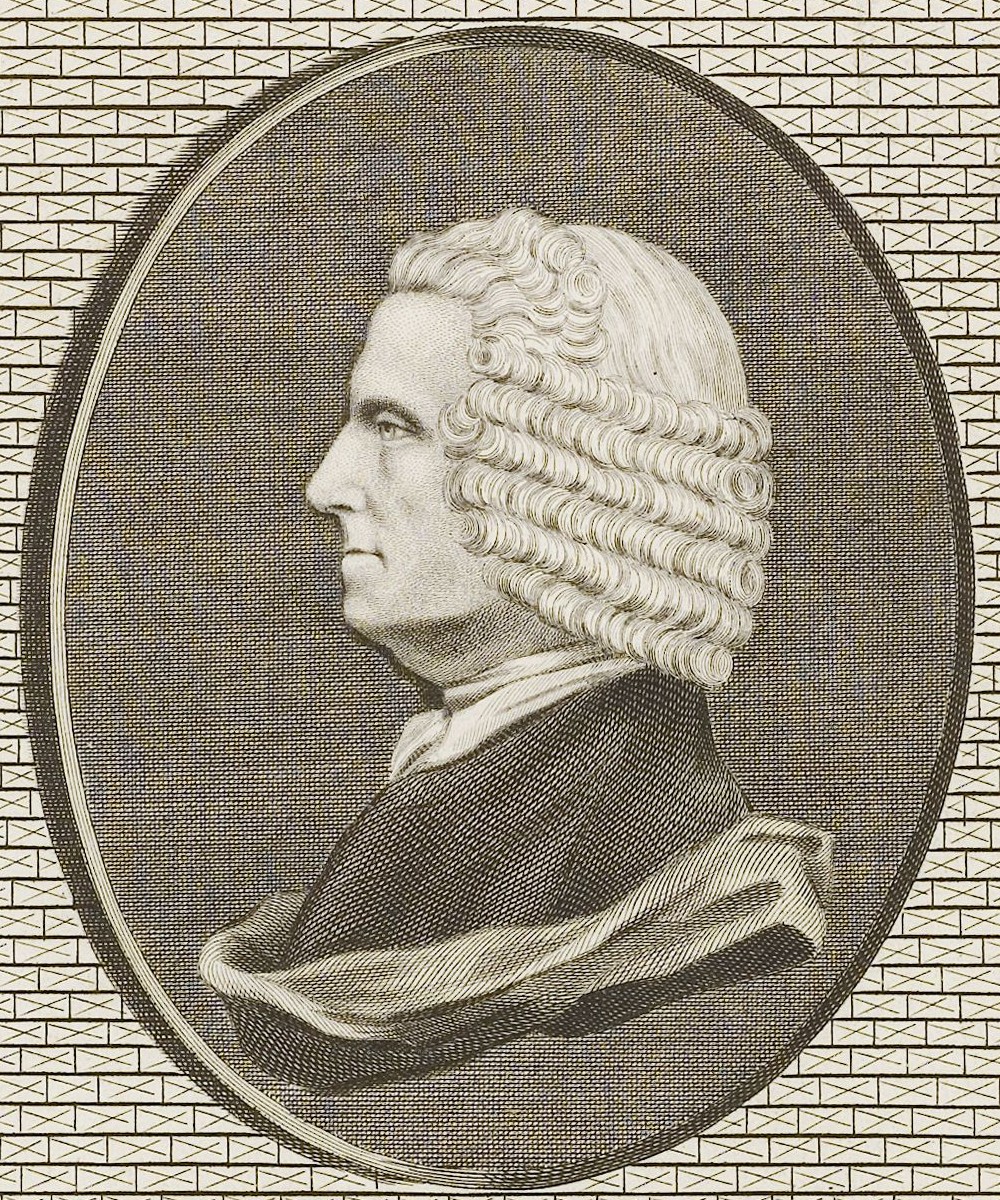

Burnet Reading, etching of John Harrison, 1788 (European Magazine, published by John Sewell); KU Leuven Libraries, Public Domain Mark 1.0, cropped from the original · KU Leuven Libraries (Catholic University of Leuven), print 'John Harrison' (catalogue record 9983674930101488; Europeana item 2024903/photography_ProvidedCHO_KU_Leuven_9983674930101488): etching by Burnet Reading (1749/50-1838), published by John Sewell, Cornhill, on 1 September 1788 for the European Magazine, inscribed 'JOHN HARRISON Esqr. / Inventor of the Time Keeper', image 126 x 97 mm; the record supplied by KU Leuven in Europeana states the Public Domain Mark 1.0, the display fields of KU Leuven's own catalogue record show no copyright or reuse statement, and the Wikimedia Commons file 'John Harrison, PA07931.jpg' (original 1220 x 1931 pixels, uploaded 22 May 2025) is tagged public domain with the same mark. The print does not name the portrait it follows and was made twelve years after Harrison's death. Cropped to the oval portrait (1000 x 1200 pixels), not resized and never upscaled. · Public Domain Mark 1.0 (KU Leuven record via Europeana; 1788 etching by an engraver who died in 1838)
inventor · Early Modern
John Harrison
1693–1776
Known For
Not yet included in personality matching — the documented evidence doesn't yet cover enough of the personality model. Everything else on this page is fully available.
Trait Constellation
Key Achievements
Harrison, a carpenter who taught himself clockmaking, built a series of marine timekeepers to find longitude at sea: H1 between 1730 and 1735, then H2, H3 and, in 1759, the watch-sized H4. In the 1764 Barbados trial H4 kept time within the most stringent limits of the 1714 Longitude Act, and Royal Museums Greenwich says his timekeepers are arguably the most important ever made.
In the mid-1720s he designed precision longcase clocks that Royal Museums Greenwich says kept time to within a second a month, and his H3 introduced the bimetallic strip and the caged roller bearing, which the museum says are still in use in thermostats and in mechanical engineering. The Science Museum Group's timeline records that the Royal Society awarded him its Copley gold medal in 1749 for his experimental work.
After the 1764 trial the Board of Longitude paid only half of the top reward and, according to Cambridge University Library, on condition that he disclose how H4 was made and that copies be built; Harrison appealed to King George III, and most of the remainder was paid in 1773. The first copy of H4, made by Larcum Kendall, sailed with Captain Cook on his second voyage and, the Board's archive says, proved exceptionally accurate, with praise from Cook and his astronomer William Wales.
Moments That Reveal Them
Harrison finished H2 within the two years he had promised after the Lisbon trial, but he discovered a fundamental flaw in it and never allowed it to be tested at sea. He then began H3 in 1740 and worked on it for nearly 19 years, making many changes and adjustments, because he could not persuade its two large balances to keep time well enough.
This is consistent with an inventor who held his own work to a high standard, though both episodes come from one museum and the difficulty of the problem may explain the length of the work. Perfectionism
In 1767 Harrison published 'The Case of Mr. John Harrison' against the Board and a pamphlet attacking Nevil Maskelyne, whom he suspected of jeopardising his reward to promote the lunar method; a Cambridge scholar calls the pamphlet vitriolic. Maskelyne had published the negative results of his Greenwich test of H4 that year, and his own letter to Lord Sandwich shows that the attacks affected him and that he dropped a reply, thinking such abuse needed no refutation.
This is consistent with a man willing to contest the commissioners and a rival in public over a long period, though the sources show both a grievance Harrison plainly felt and a Board and Astronomer Royal with reasons of their own. Conflict Tolerance
Turning Points
By the early 1750s Harrison had spent over a decade on H3 without getting its large balances to keep time well enough. A pocket watch made to his design by John Jefferys, which the museum dates to about 1751-53, went so well that he realised the solution lay in smaller watches; he began H4 in 1755 and completed it in 1759, and it went on trial to Jamaica in 1761.
This is consistent with an inventor who changed the form of his solution after years invested in another, though the account comes from one museum and the Harrisons later held firmly to their own reading of the Board's terms. Belief Updating
Similar People
People whose overall profiles resemble theirs.


Abraham Lincoln

Yayoi Kusama

Sequoyah

Emmy Noether

Miles Davis
Opposite Profile
Not a rival — a different profile shape worth a look.
Theodore Roosevelt
Sources
- John Harrison (Q314335) -- verified live via the Wikidata API (2026-10-16): English label 'John Harrison', description 'British clockworker', born 24 March 1693 at Foulby (Yorkshire), died 24 March 1776 in London, citizenship Kingdom of Great Britain, occupations including clockmaker, watchmaker, inventor and designer, Korean label present. Orientation only; not used as support for any row.
- Royal Museums Greenwich, 'Longitude found: the story of Harrison's timekeepers' (Royal Observatory story page) -- CANONICAL SIGNIFICANCE SOURCE: the museum's account of Harrison as a carpenter self-taught in clockmaking who designed precision longcase clocks in the mid-1720s said to reach an accuracy of a second in a month; his aim of a portable clock within three seconds a day; his approach to Halley and George Graham; H1 (built at Barrow upon Humber, shown in London in 1735, tried on the 1736 Lisbon voyage, with the Commissioners' 1737 award of 500 pounds); H2 (never tested because he found a fundamental flaw) and H3 (19 years of work and many adjustments); the watch with a new balance made by John Jefferys and H4; the 1761 Jamaica trial; the Board's decision that the test was not sufficient and his supporters' campaign of newspaper articles and pamphlets; the 1764 Barbados trial, the 1765 recommendation of 10,000 pounds with the other half conditional on others being able to make similar timekeepers, and the Harrisons' view that the rules had been changed; Maskelyne's ten-month Greenwich test of 1766-67 and Harrison's challenge to its results; the commissioners' wish to publish against Harrison's wish to protect his methods; and the compensation eventually granted by Parliament. Sympathetic museum narrative that nevertheless gives the Board's reasons (rival lunar and Jupiter methods, the need to show the watch was not a one-off); the shop and gallery promotion was not used. Read in full.
- Royal Museums Greenwich, 'John Harrison's marine timekeepers' (Royal Observatory attraction page) -- short promotional statement that the timekeepers are arguably the most important ever made, that they let ships determine longitude at sea, that H1 to H4 were developed over his lifetime and that they compensate for temperature and run without lubrication through anti-friction devices. Promotional museum copy, used only for the card's attributed 'arguably' statement. Read in full.
- Royal Museums Greenwich, collection record 'H3' (marine timekeeper, ZAA0036) -- the museum's statement that H3 was started in 1740, took nearly 19 years to build and adjust, did not win the prize because Harrison could not persuade its two large heavy circular balances to keep time well enough, and nevertheless incorporated the bimetallic strip and the caged roller bearing, both still relevant today. Short admiring catalogue entry. Read in full.
- Royal Museums Greenwich, collection record 'H4' (marine timekeeper, ZAA0037) -- 'Harrison's prize-winning longitude watch, completed in 1759': he had been improving watches as a sideline to H3, a pocket watch made to his design by John Jefferys in 1753 went so well that he realised the longitude solution lay in smaller watches, and work on H4 began in 1755, with a very stable high-frequency balance. Short catalogue entry (the museum's story page dates the Jefferys commission to about 1751-52). Read in full.
- Science Museum Group Collection, people record 'John Harrison 1693-1776' (horologist and clock-maker) -- institutional timeline: 1713 earliest extant clock, 1726 first heard of the 1714 Longitude Act, 1735 H1, 1736 Lisbon voyage, 1739 H2 after the Board's 500 pounds, 1749 awarded the Royal Society's Copley gold medal for his experimental work, 1759 H3, 1760 H4 and the 1761 Jamaica trial. Short timeline whose dates for H3 and H4 differ from the Royal Museums Greenwich records; used only for the 1749 Copley medal. Read in full.
- Worshipful Company of Clockmakers, Museum Collection page, entry 'Marine Timekeeper known as H5 by John Harrison and Son 1770' -- the Company's statement that H5 is mechanically very similar to the prize-winning H4, is the fifth and last timekeeper he produced as part of the Longitude Reward, was completed when he was 77, and was personally tested by King George III at his observatory in Richmond, which helped secure him the last part of his prize money. Short museum-collection text by the livery company whose museum holds H5. Read in full.
- Linda Hall Library, 'Scientist of the Day: John Harrison' (William B. Ashworth Jr., 24 March 2017) -- independent library biography: the 1714 reward of up to 20,000 pounds, a series of clocks that kept time on long voyages, H4's 1761 Jamaica trial (5 seconds slow on arrival) after which the Board claimed a fluke and demanded a second trial, the 1764 Barbados result, a partial payment of 10,000 pounds on top of 4,315 pounds of advances, the demand that he hand over his clocks and the Board's publication of 'The Principles of Mr. Harrison's Timekeeper' (1767), the appeal to King George III and the final payment of 8,750 pounds by Parliament in 1773, and the remark that the official prize was never awarded. Short independent library biography, admiring but factual. Read in full.
- Cambridge University Library, ArchiveSearch, 'Papers of the Board of Longitude, 1605-1830' (RGO 14), scope note and historical background -- archival description of the 1714 Act and the Board, the strict sliding scale of rewards, the Board's first recorded meeting in 1737 with its award of 250 pounds to Harrison after the Lisbon trial, further payments that let him continue, the 1761-62 Jamaica and 1764 Barbados trials of H4 and the Board's refusal to accept either as sufficient, the payment of only half the reward on condition that he disclose the construction and that copies be made, Larcum Kendall's copy K1 taken on Captain Cook's second voyage and praised by Cook and William Wales, Harrison's appeal to King George III before the majority of the rest was agreed in 1773, and the observation that the dispute eclipsed much of the Board's other work while the lunar method developed as the serious rival. Authoritative archival description from a university library, read to the end of the Harrison narrative (the later paragraphs on the Board's post-1774 work were skimmed and not used).
- Cambridge Digital Library, 'National Maritime Museum Manuscripts: Sandwich Papers', commentary by Katy Barrett (University of Cambridge) on letters of the 1770s -- scholarly commentary on how the Board of Longitude's commissioners dealt with Harrison: that by the 1770s H4 had been found to meet the 1714 Act's limits but the commissioners wanted proof it could be replicated, Harrison's 1767 publication 'The Case of Mr. John Harrison' and his 'vitriolic' pamphlet against Maskelyne, his letters to Lord Sandwich saying he was old and unjustly treated, that more watches were unnecessary and that he was denied access to H4, his conviction that Maskelyne was jeopardising his reward to promote the lunar method, Maskelyne's 1767 publications of the watch's principles and of the negative Greenwich results, and Maskelyne's own letter showing he was affected by the attacks and had dropped a reply. Scholarly archival commentary giving both sides; Harrison's own words reach it only as described and quoted by the author, so they count as self. Read in full.
- Simon Schaffer, 'Chronometers, charts, charisma: on histories of longitude', Science Museum Group Journal, Autumn 2014 (published 8 October 2014; DOI 10.15180/140203) -- essay by a Cambridge professor of the history of science: Harrison's sea clocks as now widely reckoned the most important timekeepers ever constructed, the 'comforting plot' of lone heroism victimised by authority and the need to add the wider craft, administrative and trade networks, Jonathan Betts's 2008-09 repair of H1 showing that parts were made by other skilled artisans, that relations between Harrison and the Board were warm and supportive until the 1760s, Rebekah Higgitt's finding that there was no 'Longitude Prize' as such in the 18th century, that astronomical and horological methods were treated as complementary, and that Harrison received the largest single share of the Board's rewards, about a third of its spending in all. Independent scholarly framing, sceptical of the heroic story; it is a discussion essay about the museum's research project, not a biography, and was read in full.
- Royal Museums Greenwich, 'Longitude found: Nevil Maskelyne and the lunar method' (story page) -- the museum's counter-voice: Harrison long portrayed as the plucky underdog, which has tarnished the reputation of Maskelyne; the lunar-distance method (Mayer's tables, John Bird's sextant, Maskelyne's 1761 St Helena test and his Nautical Almanac) as the other route to longitude, and that marine timekeepers stayed rare and expensive for decades while navigators used all methods. Short museum story, read in full.
- Europeana record for the KU Leuven Libraries (Catholic University of Leuven) print 'John Harrison' -- etching by Burnet Reading, published by John Sewell in London on 1 September 1788 (the European Magazine), image 126 x 97 mm, inscribed 'JOHN HARRISON Esqr. / Inventor of the Time Keeper'; the record supplied by KU Leuven states the Public Domain Mark 1.0. Read through Europeana's public record API (the web page itself returns HTTP 403 to non-browser requests) together with KU Leuven's own library catalogue record and the Wikimedia Commons file 'John Harrison, PA07931.jpg'; opened to check the portrait's licence, creator and date. Not used for any scoring.