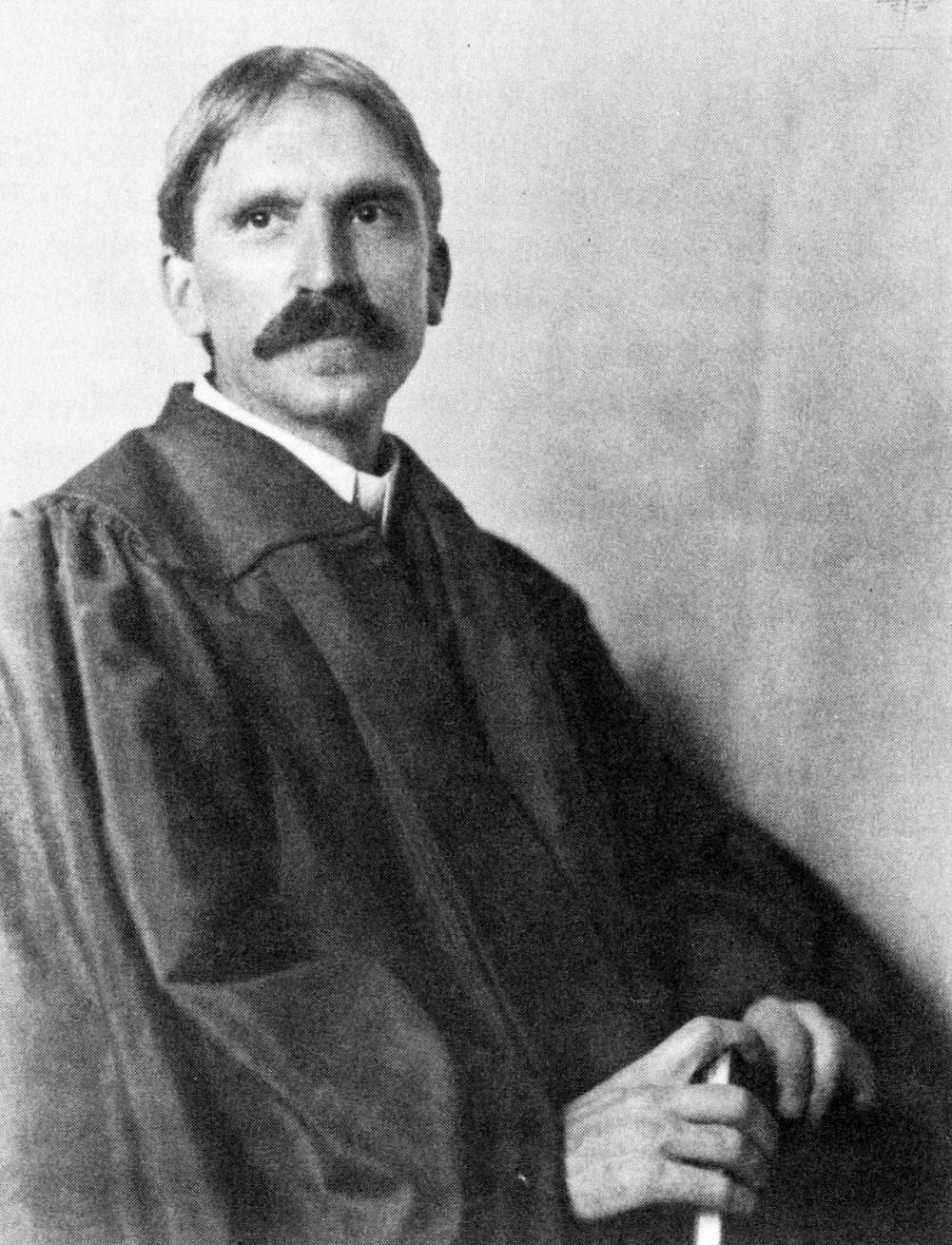
Photo: Eva Watson-Schutze, 1902, public domain · Wikimedia Commons 'John Dewey in 1902.jpg': photograph of John Dewey at the University of Chicago, 1902, by Eva Watson-Schutze (American photographer and painter, 1867-1935, Wikidata Q433566), scanned by the uploader from Louis Menand's The Metaphysical Club (2001), p. 317, original photograph in the John Dewey Photograph Collection, Special Collections Research Center, Morris Library, Southern Illinois University Carbondale; Commons tag PD-old. A lifetime photograph by a photographer who died in 1935, so public domain by age; the book scan is a flat reproduction. Original file 1001 x 1309, used unchanged (no resizing, no upscaling). · Public Domain
philosopher · 20th Century
John Dewey
1859–1952
Known For
Not yet included in personality matching — the documented evidence doesn't yet cover enough of the personality model. Everything else on this page is fully available.
Trait Constellation
Key Achievements
Britannica calls him a cofounder of the philosophy of pragmatism, alongside Peirce and James in Zilversmit's account, and a pioneer of functional psychology; he rejected the idea of changeless being and wrote Experience and Nature (1925).
At the University of Chicago he founded the Laboratory School to test his educational ideas, and set out his philosophy of education in The School and Society (1899) and Democracy and Education (1916).
From Columbia and Teachers College his ideas spread through disciples and became identified with Progressive education; in Experience and Education (1938) he rebuked the movement's excesses, and his reputation later waned after the 1950s.
Moments That Reveal Them
In 1938 Dewey, in Experience and Education, recognised and rebuked the excesses of the Progressive education movement, chastising Progressives for discarding traditional content without offering something worthwhile in its place.
This is consistent with a willingness to criticise a movement he had inspired when he thought it had gone wrong. Conflict Tolerance
At the University of Chicago he founded the Laboratory School as a place to test psychological and educational theories, and used the experience as the material for The School and Society.
This is consistent with testing theory in a working school rather than only arguing it on paper. Experimentation
Turning Points
At the University of Michigan Dewey's interests gradually shifted from Hegel's philosophy toward the new experimental psychology of G. Stanley Hall and William James, which led to child psychology and his philosophy of education.
This is consistent with revising his intellectual starting point in response to a new line of empirical work. Belief Updating
Similar People
People whose overall profiles resemble theirs.


Leonardo da Vinci

Benjamin Franklin

Sequoyah

Ada Lovelace

Fyodor Dostoevsky
Opposite Profile
Not a rival — a different profile shape worth a look.

Katherine Johnson
Sources
- John Dewey (Q131805) -- verified live via the Wikidata API (2026-10-24): English label 'John Dewey', description 'American philosopher, psychologist, and educational reformer (1859-1952)', Korean label '존 듀이', born 1859-10-20, died 1952-06-01, P18 'John Dewey in 1902.jpg'. Orientation only; not used as support for any row.
- Encyclopaedia Britannica, 'John Dewey' (britannica.com; the live site returns 403, so the article was read through an Internet Archive copy, introduction, career and philosophy sections; the AI summary boxes were ignored): American philosopher and educator, cofounder of pragmatism, pioneer of functional psychology, innovative theorist of democracy and leader of the progressive movement in education; shift at Michigan from Hegel toward the new experimental psychology of Hall and James; 1894 move to Chicago where he developed his pedagogy in the Laboratory Schools; 1904 move to Columbia where most of his career and Experience and Nature (1925) fall; later writing on aesthetics, politics and religion; the common theme of a democratic society of informed and engaged inquirers; his critique of the Western tradition of changeless being and his account of nature, experience and 'the construction of good'. CANONICAL SIGNIFICANCE SOURCE. The political-activism material is not used for scoring.
- Stanford Encyclopedia of Philosophy, 'John Dewey' (David L. Hildebrand, plato.stanford.edu), life, chronology, philosophy-of-education and reception passages read; logic, ethics and aesthetics sections skimmed: Hegelian beginnings and the move to experimental psychology; 1894 invitation to lead philosophy, psychology and pedagogy at Chicago and the 'Chicago School' of functionalism with Mead and Angell; the Laboratory School 'to test psychological and educational theories' with Alice Dewey as principal 1896-1904; 1904 resignation after conflicts over the Laboratory School and move to Columbia and Teachers College; Democracy and Education (1916) as the fullest statement of his philosophy; his reconstruction of philosophy as 'the general theory of education'; critics' charges that his account of experience could not yield a metaphysics (Bernstein) and Rorty's later attack on the term 'experience'. Entry passages on marriages, bereavements, religion and political activism were not used.
- Internet Encyclopedia of Philosophy, 'John Dewey' (iep.utm.edu), biography and theory-of-knowledge sections read, remainder skimmed: founded and directed a laboratory school at Chicago that gave material for The School and Society (1899); 'disagreements with the administration over the status of the Laboratory School' led to his 1904 resignation; Studies in Logical Theory (1903) with Chicago colleagues and students; How We Think (1910) and Democracy and Education (1916); the pragmatic theory of truth met strong opposition, notably from Bertrand Russell, and Dewey later preferred 'warranted assertibility'; Logic: The Theory of Inquiry (1938), Art as Experience (1934), Knowing and the Known (1949, with Arthur Bentley). Passages on the Trotsky commission and public life were not used for scoring.
- Richard J. Bernstein, 'Dewey, John', in Encyclopedia of Philosophy (1967 edition, via encyclopedia.com), read in part (the experience, nature, art, inquiry and critique sections): Dewey's project of a new empiricism combining Greek naturalism with experimental method, 'The Reflex Arc Concept in Psychology' (1896), critics who questioned the status of experience within nature and charged anthropomorphism, Dewey's attempt to answer them in Experience and Nature (1925), Art as Experience (1934) as a surprise to readers who thought his philosophy left no place for art, his 'instrumentalism' described as at least an overstatement, and the charge that his analyses of moral judgment were not wholly consistent. A scholarly, sympathetic but critical contemporary-to-1960s assessment by a Dewey specialist.
- Arthur Zilversmit, 'Dewey, John (1859-1952)', in Encyclopedia of Children and Childhood in History and Society (Gale, via encyclopedia.com), read in full: Dewey as a founder and leading philosopher of Progressive education; founding the Chicago Laboratory School 'to test scientifically his ideas'; The School and Society (1899) and the four natural interests of children; his insistence that teachers guide rather than merely free children and that the curriculum be built from both interests and subject matter; his followers, notably Kilpatrick, emphasised the child's interests at the expense of subject matter, which Dewey himself warned against in quoted passages; the postwar reaction against Progressive education, the 1950s blame for academic shortcomings and the waning of his reputation. The author is a historian of progressive education (Changing Schools, 1993), so this is an independent, critical-historical perspective.
- Jonas F. Soltis, 'Dewey, John (1859-1952)', in Encyclopedia of Education (Gale, via encyclopedia.com), read in full: Johns Hopkins doctorate and Michigan; 1894 Chicago chairmanship of philosophy, psychology and pedagogy; the Laboratory School 'where he scientifically tested, modified, and developed' his ideas; The School and Society and The Child and the Curriculum as lectures given to raise money and support for the school; President Harper merging the laboratory school with the university training school without consulting Dewey, so that he resigned in 1904; Columbia and Teachers College for twenty-six years and the dispersion of his ideas by disciples; Experience and Education (1938), in which he 'recognized and rebuked the many excesses' of the Progressive movement; Knowing and the Known (1949). Educational philosopher's entry, sympathetic and detailed on the school episodes.
- Kirkus Reviews, review of Robert B. Westbrook, 'John Dewey and American Democracy' (Cornell University Press, 1991) (kirkusreviews.com), read in full (one paragraph): a comprehensive intellectual biography tracing Dewey's roughly seventy-year career with emphasis on philosophy and politics, mentioning life circumstances only as they influenced his writings. Used only to show that a modern full biography exists and what it emphasises; the biography itself was not opened, so no row relies on it.
- Wikimedia Commons file page 'John Dewey in 1902.jpg' (wikitext and API record) and creator record 'Creator:Eva Watson-Schutze' with Wikidata Q433566 (American photographer and painter, 1867-1935, checked live): photograph by Eva Watson-Schutze, 1902, scanned from Louis Menand, The Metaphysical Club (2001), p. 317, original photograph in the John Dewey Photograph Collection, Special Collections Research Center, Morris Library, Southern Illinois University Carbondale; tagged PD-old; 1001 x 1309. The SIU Center for Dewey Studies page was opened and gives no photograph rights statement. Checked for the portrait's rights; not used for scoring.