Marie Curie
93% Profile Match
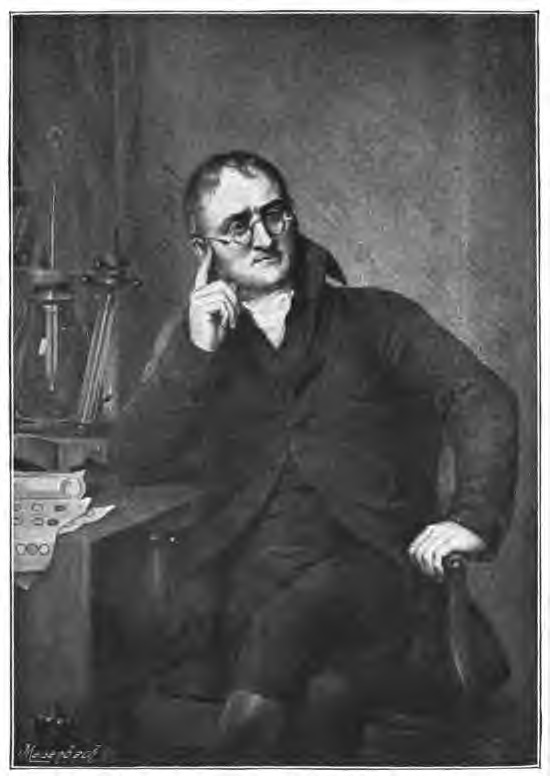
Portrait of John Dalton by Joseph Allen (1814), reproduced as the frontispiece of Roscoe's John Dalton and the Rise of Modern Chemistry, 1895 (reproduction signed Meisenbach) · Frontispiece of Henry E. Roscoe, John Dalton and the Rise of Modern Chemistry (Macmillan, London and New York, 1895), a photogravure after Joseph Allen's 1814 portrait, via Internet Archive · Public domain (book published in 1895; the painting is from 1814)
chemist · 19th Century
1766–1844
Not yet included in personality matching — the documented evidence doesn't yet cover enough of the personality model. Everything else on this page is fully available.
Dalton proposed that each chemical element consists of atoms of a characteristic weight and that compounds form by the union of small whole numbers of atoms. A table of the relative weights of the 'ultimate particles' of gaseous and other bodies, with hydrogen as 1, was appended to a paper he read to the Manchester Literary and Philosophical Society on 21 October 1803 and printed in 1805. He set the theory out in A New System of Chemical Philosophy (part 1, 1808; part 2, 1810). Thomas Thomson described it in the 1807 edition of his System of Chemistry. Henry Roscoe notes that Dalton never claimed to have invented the idea of atoms, only to have used it to explain chemical combination, and that many of his early weights were rough.
In essays read to the Manchester Literary and Philosophical Society in October 1801 and published in 1802, Dalton argued that when two gases are mixed their particles do not repel one another, so the pressure on a vessel is the sum of the pressure each gas would exert alone; this is now called Dalton's law of partial pressures. The same essays showed that the vapour pressure of a liquid is the same in a vacuum as in air and reported that all gases he tested expand by the same amount when heated. Thomson says Gay-Lussac published a paper on the expansion of gases about half a year after Dalton's essays appeared.
Dalton's Meteorological Observations and Essays, drafted at Kendal and printed in the 1790s, covered the barometer, thermometer, hygrometer, rainfall, evaporation and the aurora. In it he argued that water vapour exists as a separate fluid mixed through the air rather than being dissolved in it, and that rain results from cooling below the dew-point; Roscoe sees in this the root of his law of vapours and the first germ of his atomic theory. He also concluded that the aurora is guided by the earth's magnetism. Roscoe notes that he was unaware of some earlier work, such as Hadley's explanation of the trade winds and De Luc's barometer results.
On 31 October 1794 Dalton read to the Manchester Literary and Philosophical Society his 'Extraordinary Facts relating to the Vision of Colours', his first paper to the Society. It described how he and his brother, and four brothers named Harris in Maryport, whom he questioned through a local correspondent, saw pink as blue and some greens as red. He suggested that the vitreous humour of the eye might be coloured; a post-mortem examination after his death found the lenses normal and the explanation was shown to be wrong. The paper drew general attention to the condition, and Prevost of Geneva and Wartmann of Lausanne named it 'Daltonism'.
On 20 September 1812 Dalton wrote to Berzelius that he did not admit the French doctrine of equal measures of gases combining 'in a mathematical sense', while acknowledging 'something wonderful in the frequency of the approximation'. Berzelius answered on 13 October that Gay-Lussac's experiments on combining volumes seemed to him 'the finest proofs of the probability of the atomic theory' and that he would not readily think Gay-Lussac in error. Henry says he never 'heartily and unreservedly accepted' the law; Roscoe and Harden add that, in a strict sense, his conclusion was the more correct one.
Holding to his own measurements against a respected correspondent and the leading French chemist is consistent with a low tendency to revise a view under outside pressure on this point; Henry notes that he did give up his laws of temperature in 1827 after Dulong and Petit's results, so the pattern was not total. Belief Updating
For his dew-point measurements in the Lake District Dalton found a spring on the mountainside, filled a dry tumbler with its water, and noted whether dew formed on the outside; if it did he warmed the water and repeated, and if the water was not cold enough he stirred in powdered nitre and sal ammoniac to chill it, or used snowdrifts. He carried a barometer and a small pocket thermometer to give the height and air temperature. Roscoe says he climbed Helvellyn about forty times and that the Ordnance Survey height of 1,039 yards was close to his figure of 1,035.
Improvising an instrument and a cooling mixture on the spot to get a reading is consistent with resourcefulness; the account is Dalton's own, quoted by his biographers. Resourcefulness
In 1793 Dalton left Kendal, where he and his brother Jonathan had run a school since 1785, to become tutor in mathematics and natural philosophy at the Presbyterian-founded Manchester Academy, with a guaranteed salary of £80 for the session after Gough brought him to the principal's notice. After six years there he gave up the post and lived by private teaching, at two shillings a lesson, so that he could pursue his own research; the Literary and Philosophical Society, which he joined in 1794, made him secretary in 1800. Roscoe adds that, as a teacher, he set pupils to their lessons and then left them largely alone while he got on with his own calculations and experiments.
Leaving a salaried post to live on private pupils and keep his time for research is consistent with a strong need to control how he spent his working days; the account of his motives comes from his admiring biographers. Need for Autonomy
People whose overall profiles resemble theirs.