James Joyce
93% Profile Match
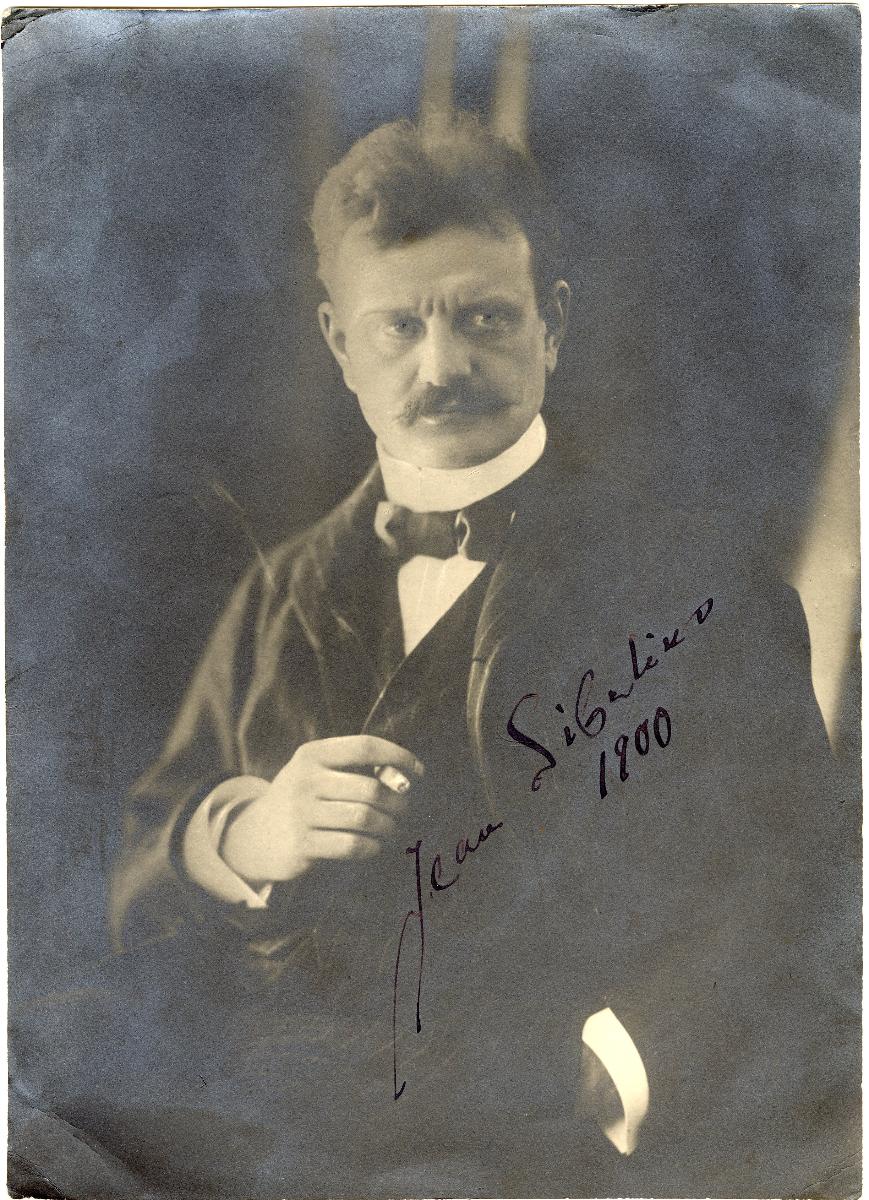
Daniel Nyblin, 1900, Sibelius-museon arkisto (Sibelius Museum archive), via Finna, CC BY 4.0 · Studio portrait photograph of Jean Sibelius, half-length, with a cigarette, signed and dated '1900' by the sitter, by the photographer Daniel Nyblin (1856-1923); Sibelius Museum archive (Sibelius-museon arkisto, Turku), photograph collection item SmF8990, 23.8 x 17.8 cm, Finna record sibelius.35F0F57B0A494426B695B501E1EB562B, digitised and published by the archive under CC BY 4.0 (creator credited as photographer, role 'valokuvaaja'). Rights basis: the live Finna record states CC BY 4.0 and asks for credit to the photographer, the collection and the organisation; independent of that licence, the photographer died in 1923 (Wikidata Q6019293 lists 1856-1923), so a studio photograph made in 1900 is in the public domain in Finland and in the United States by age, and the sitter's autograph and the archive's own title confirm the identity. The archive's conditions add that use of portraits of persons in marketing is not permitted without the sitter's consent (the sitter died in 1957) and ask that a copy of any print publication be sent to the museum. Original file as served by Finna in the 'large' size is 869 x 1200 pixels (the archive holds a higher-resolution original; no upscaling or cropping, file used as served). · CC BY 4.0 (Sibelius Museum archive); photograph also in the public domain by age (photographer died 1923)
composer · 20th Century
1865–1957
Not yet included in personality matching — the documented evidence doesn't yet cover enough of the personality model. Everything else on this page is fully available.
Finland's leading composer and the most noted symphonic composer of Scandinavia, he wrote seven symphonies between 1899 and 1924, and Britannica locates his achievement principally in a remarkable mastery of form and a capacity for organic growth.
The Kalevala-inspired Kullervo Symphony (1892) created a sensation and, with En Saga, the Karelia music and The Swan of Tuonela, established him as Finland's leading composer; the Senate voted him a life pension in 1897 and Finlandia followed in 1899-1900.
His later symphonies and the tone poem Tapiola (1926) are counted among his greatest works, and his ideas of form influenced composers from Vaughan Williams and Barber to later Finnish, French and American composers, even though critics such as Adorno attacked him and his reputation recovered from the late 1980s.
In the 1940s a basket of his manuscripts was fed into the stove at Ainola; his widow could identify the early Karelia Suite among them, and the long-awaited Eighth Symphony is now considered to have been destroyed too, after promises to Koussevitzky through the early 1930s.
This is consistent with an exacting standard for work he was willing to release, though the reason for the burning is not documented. Perfectionism
The Fifth Symphony was first performed on his 50th birthday in December 1915, revised in 1916, and not final until 1919, when its first two movements had been fused into one and the slow movement widened.
This is consistent with continued reworking of a large piece over several years until it met his own standard. Persistence
After leaving law studies and training in Berlin and Vienna, in Vienna in 1890-91 he read the Kalevala and sought a Finnish rhythm for his music, then began Kullervo, which on its 1892 premiere created a sensation and made him Finland's leading composer.
This is consistent with a composer who trained deliberately and then turned that training toward a distinctive material of his own. Mastery Orientation
People whose overall profiles resemble theirs.

Not a rival — a different profile shape worth a look.