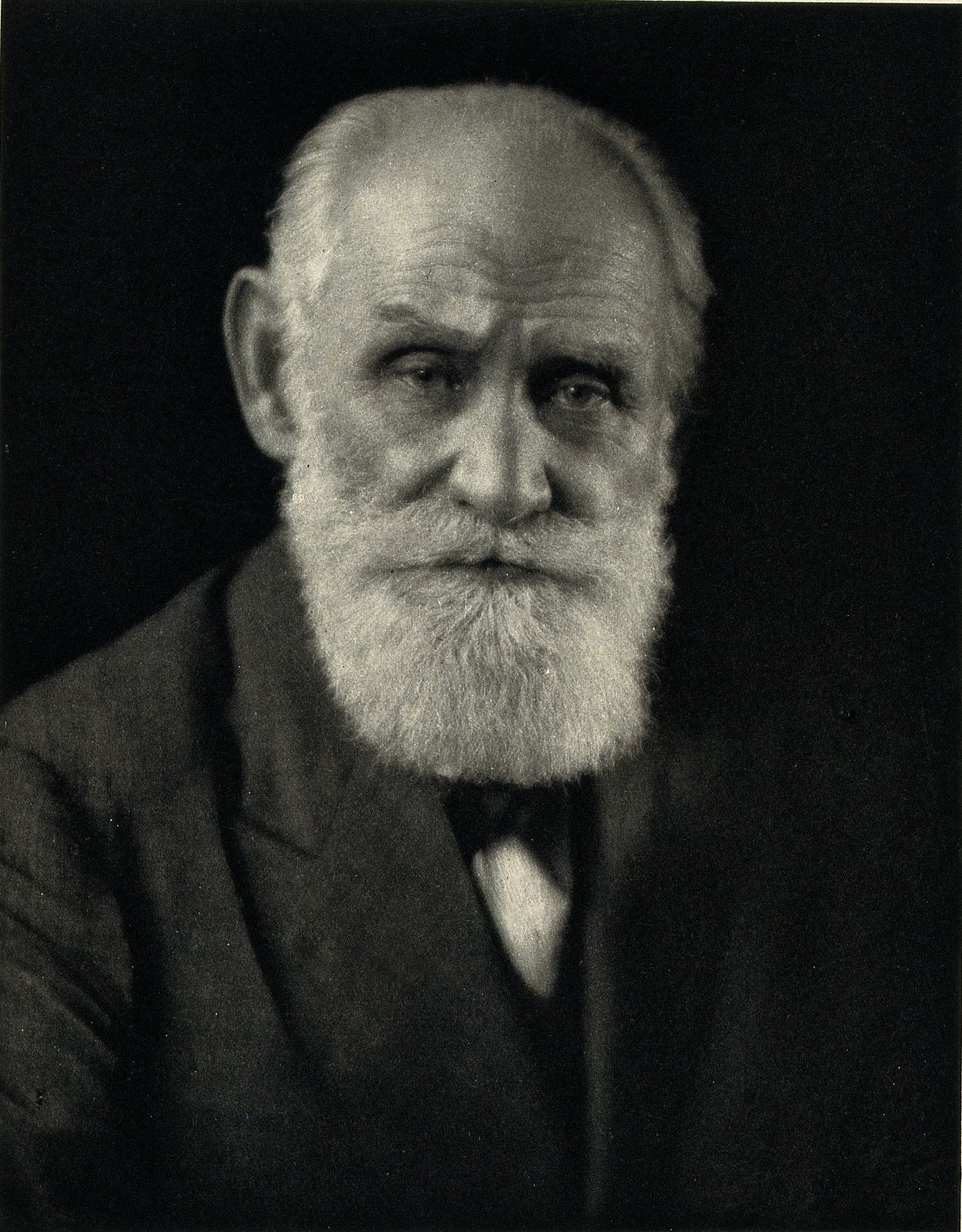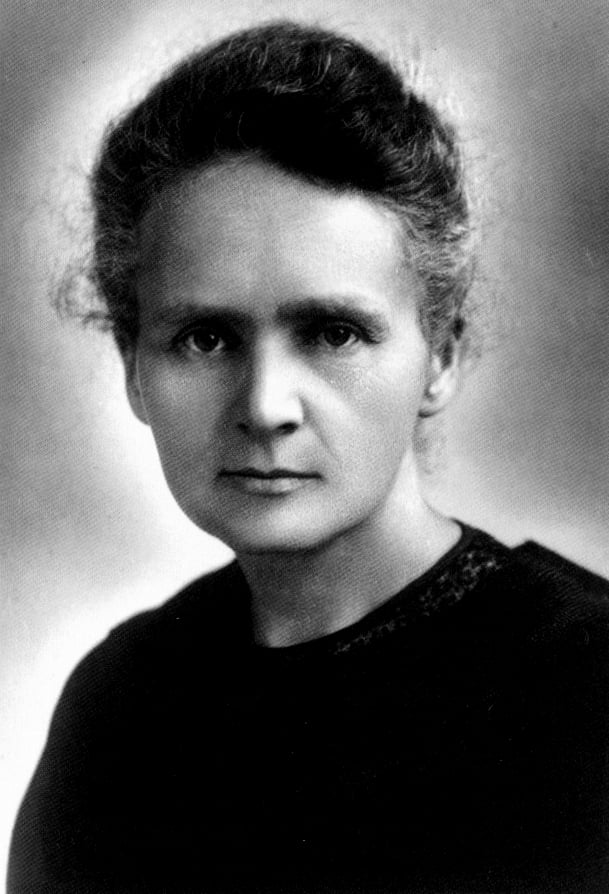

Ivan Petrovich Pavlov, photograph by Lafayette Ltd, photogravure by Emery Walker, Supplement to Nature, 3 Jan. 1925. Wellcome Collection (Public Domain Mark); cropped to the photograph and downscaled · Photogravure by Emery Walker after a photograph by Lafayette Ltd, issued as a Supplement to Nature, 3 January 1925; Wellcome Collection 13393i (ICV No 27467), via Wikimedia Commons · Public domain
Trait Constellation
Key Achievements
Received the 1904 Nobel Prize in Physiology or Medicine for his work on the physiology of digestion. The presentation speech singled out his surgical technique, which let the same animals be studied over long periods.
From 1902 he turned his laboratory to the objective study of so-called psychical secretion in dogs, the work on conditioned reflexes that occupied him until his death in 1936.
Directed physiological laboratories at the Institute of Experimental Medicine and the Military-Medical Academy in St Petersburg for more than three decades. His students record dozens of co-workers at a time passing through them.
Moments That Reveal Them
According to his student Boris Babkin, when Pavlov first tried to make an isolated stomach pouch with its nerves intact, in about 1893-94, the operation failed nineteen times. It succeeded on the twentieth dog, and the student assigned to the problem was able to finish his thesis.
The episode offers one example of the profile's persistence score: repeated failure on a difficult operation did not end the attempt. Persistence
A collaborator, V. V. Savich, recalled that Pavlov asked him to repeat Bayliss and Starling's secretin experiment, which challenged the laboratory's view that pancreatic secretion was controlled by nerves alone. When it was confirmed in front of him, Pavlov left for half an hour and returned saying, 'Of course, they are right.'
This sits alongside the profile's belief-updating score, which is kept moderate because Babkin also records that Pavlov needed a great deal of proof before changing his mind. Belief Updating
Turning Points
In his Nobel lecture of December 1904, Pavlov spent much of his time on a new line of research rather than only on the digestion work being honoured. He described his decision to treat the dogs' 'psychical' salivation from an entirely objective point of view.
The choice is consistent with the profile's independent-thinking score. Gantt records that friends such as Sherrington and Tigerstedt later urged caution about the new programme, and he continued it anyway. Independent Thinking
Similar People
People whose overall profiles resemble theirs.

Rosalind Franklin

Warren Buffett

Yi Sun-sin

Octavia Butler

John D. Rockefeller
Opposite Profile
Not a rival — a different profile shape worth a look.
Theodore Roosevelt
Sources
- Ivan Pavlov (English Wikipedia) -- orientation only; not used as support for any scored row. Korean Wikipedia title '이반 파블로프' confirmed via the Wikidata sitelink.
- Ivan Pavlov (Q42985) -- verified live via wbgetentities (2026-09-26): en label 'Ivan Pavlov', description 'Russian physiologist (1849–1936)', ko label '이반 파블로프', ru 'Иван Петрович Павлов', born 1849-09-14 (Julian; 1849-09-26 Gregorian), died 1936-02-27, citizenship Q34266 (Russian Empire), Q2305208, Q15180 (Soviet Union), P18 'Ivan Pavlov NLM3.jpg', kowiki '이반 파블로프'. Orientation only.
- B. P. Babkin, Pavlov: A Biography (University of Chicago Press, 1949), archive.org OCR full text (in.ernet.dli.2015.156540) -- STUDENT/INSIDER perspective: Babkin worked in Pavlov's laboratory 1902-12 (assistant at the Institute of Experimental Medicine) and knew him for 35 years; much is his own eyewitness, some is transmitted from V. V. Savich's 1924 article, N. J. Chistovich's 1904/1925 recollections, Mrs Pavlov's 1946 'Reminiscences', or Pavlov's own tellings (flagged as such where used). Admiring but openly critical in places (the Bechterev polemic, temper, the secretin 'chance' remark, lack of practical classes). Read: Introduction; ch. 2 (Botkin laboratory 1878-90, the thesis delay to 1883, the control-experiment episode, Chistovich's account); ch. 5 (pharmacology and physiology chairs 1890-95, teaching by demonstration, the Pashoutin ballot protest and reprimand); ch. 6 (Institute of Experimental Medicine, chronic 'physiological surgery', organisation of graduate work); ch. 7 (Babkin's own entry 1902); ch. 8 (indifference to rank, the Academy-conference operation, the Bechterev/Gorshkov/Spirtov controversy c.1906-09, Babkin present); ch. 9 (integrity, secretin, punctuality, Dr V. and Savich's intervention, the Pavlov pouch after nineteen failures c.1893-94, concentration); ch. 10 (testing of reported results, creative imagination, 'six months' rule for theories, training of newcomers, watching Babkin's test tubes 1902); ch. 11 (school, invitation to contradiction, laboratory-council proposal, temperament, Chistovich's forceps story); ch. 12 (attitude to co-workers, operations, the 1902 Thompson demonstration); ch. 13 (daily routine 1901-12 and later per Frolov/Logansky, Nobel 1904, the Nobel lecture topic, 1913 frictions). Ch. 3-4 (marriage and family life), 16-18 (politics, Bolsheviks, illnesses and death) deliberately NOT used.
- W. Horsley Gantt, 'Ivan P. Pavlov: A Biographical Sketch' (pp. 11-31) and translator's preface, in I. P. Pavlov, Lectures on Conditioned Reflexes, vol. 1, trans. W. H. Gantt with G. Volborth (New York: International Publishers, 1928; 1941 printing), archive.org OCR (in.ernet.dli.2015.190960) -- INSIDER/COLLABORATOR perspective: Gantt, an American physician, worked in Pavlov's Leningrad laboratory 1925-29 and writes partly from his own observation (1925-28) and partly from V. V. Savich's 1924 Russian sketch (quoted, and flagged as such where used), plus a 1922 statement by an unnamed assistant and a 1928 note by T. R. Elliott. Admiring. The translator's preface says the sketch was included without Pavlov's knowledge. Read in full: sections I-V (youth per Savich; the 1875 refusal to stay with Tsyon's successor; Pashootin conflict; Institute surgical department 1891; post-Nobel hostility; memory; operating speed; Savich's secretin verification; the 1923 claim and 1925 repudiation of inherited conditioned reflexes in mice; Sherrington's and Tigerstedt's 1912 discouragement of the conditioned-reflex work; punctuality during the Revolution; winter 1919-20 experiments by torchlight; daily routine; temperament). Also read Walter B. Cannon's two-page 'Introduction to the English Translation' (Sept. 1928) -- evaluative only, not used for any row.
- Y. P. Frolov, Pavlov and His School: The Theory of Conditioned Reflexes, trans. C. P. Dutt (London: Kegan Paul, 1937), archive.org OCR (in.ernet.dli.2015.158241) -- STUDENT/COLLABORATOR perspective: Frolov heard Pavlov's lectures from Sept. 1911, worked in his laboratory from c.1913-14 and later as his assistant at the Military-Medical Academy; published in the USSR shortly after Pavlov's death, admiring and with Soviet framing (which is ignored here). Independent of Babkin (an emigre) and Gantt. Read: Author's preface and ch. VIII 'Pavlov's Method of Work: His School' pp. 238-264 (his own recollections of the 1911 lectures, the right of students to interrupt, punctuality to the second; his first conditioned-reflex experiment with home-made Indian-ink screens; the 1919 winter -- operating by the light of wood splinters, cycling to the laboratory, the vegetable plot; the 1921 lecture on the qualities of a scientist; the 'Wednesdays'; assignment of problems; the rule that finished work was set aside for a year or two before printing; the 1917 book not published until 1926). Theory chapters I-VII not used for behavioural rows.
- K. A. H. Morner (Rector of the Karolinska Institute), Presentation Speech for the Nobel Prize in Physiology or Medicine 1904, 10 Dec. 1904, nobelprize.org -- INSTITUTIONAL perspective (the awarding body), read in full 2026-09-26: describes Pavlov's chronic-fistula technique (animals kept in good health and studied over long periods), the systematic series of experiments from his laboratory, and the findings on nervous control of gastric secretion. Used only as independent corroboration of the method, not for personality claims.
- I. P. Pavlov, Nobel Lecture 'Physiology of Digestion', 12 Dec. 1904 (English text), nobelprize.org -- SELF, one perspective, never sole support for a row. Read in full 2026-09-26: his own description of the surgical/chronic method (asepsis, post-operative care, 'modus vivendi' for the animals), acknowledgement of his laboratory co-workers, and the second half devoted to 'psychical' salivary secretion treated from an 'entirely objective point of view' (the first public statement of the conditioned-reflex programme).