Jane Goodall
89% Profile Match
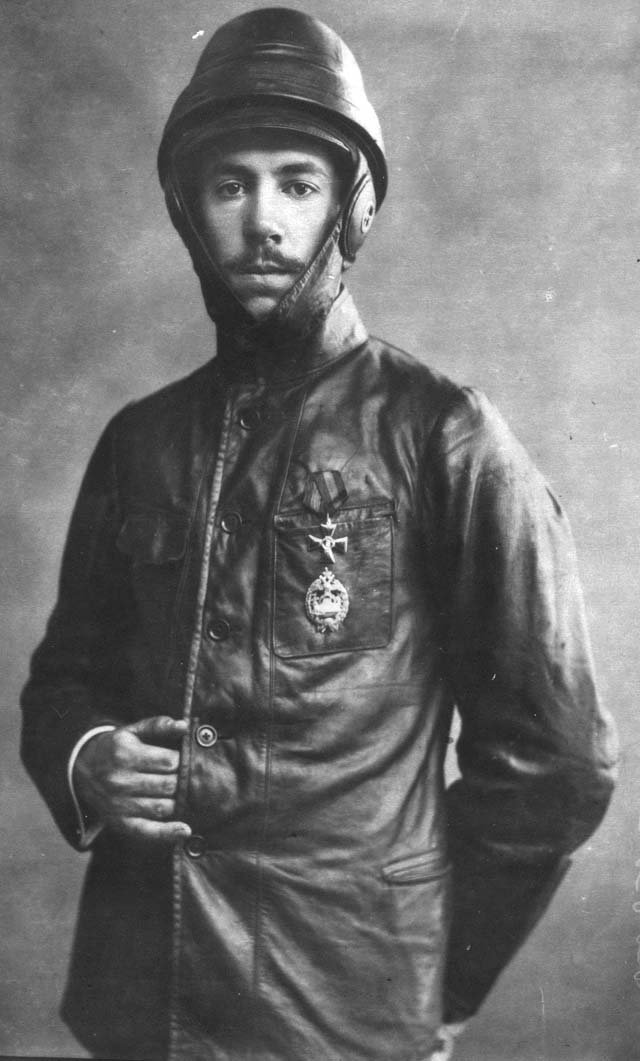
Karl Bulla, portrait of Igor Sikorsky in flying dress with the Order of St Vladimir, 1914 (St Petersburg) · Wikimedia Commons 'Sikorsky I.I. 1914. Karl Bulla.jpg' (scan from the book 'S-Peterburg. Stolitsa Rossiiskoi imperii. Liki Rossii', St Petersburg 1993, of a 1914 studio portrait by Karl Bulla) · Public domain (author Karl Bulla died 1929; photograph taken 1914; Commons tag PD-old)
Sikorsky designed and test-flew the VS-300, which first lifted off, tethered, on 14 September 1939 at Stratford, Connecticut. Over the next two years it was rebuilt into a single main rotor with full cyclic control and one tail rotor to cancel torque, the layout that most of the world's helicopters still use. The American Society of Mechanical Engineers designated it a landmark as America's first practical helicopter.
From the VS-300 Sikorsky built the XR-4, which first flew on 14 January 1942 and, with cyclic control carried over from the VS-300, became the prototype of the first production single-rotor helicopter. By the end of the Second World War his plant had turned out more than 400 R-4, R-5 and R-6 helicopters. On 3 January 1944 a Coast Guard R-4 flew blood plasma to the survivors of a sunken destroyer in a snowstorm.
In Russia Sikorsky built the Russky Vityaz (Le Grand), which he flew in May 1913 as the first four-engine aeroplane, and then the Ilya Muromets, a passenger aircraft with an enclosed saloon. In 1914 he flew a Muromets about 700 miles from St Petersburg to Kiev. When the First World War began the type was developed into a long-range bomber, and more than seventy were built for the Russian military.
In the United States Sikorsky's S-38 amphibian (1928) became Pan American Airways' workhorse, with 38 of the 111 built going to the airline. For Pan Am he then built the 40-passenger S-40, which Juan Trippe named the American Clipper (1931), and the longer-range S-42 (1934), designed with Pan Am's adviser Charles Lindbergh. The S-42 was used to survey Pan Am's ocean routes.
After Captain Frank Gregory flew the VS-300 in July 1940 and recommended the Army fund development, the Army insisted that all control sit in the main rotor and that the cockpit be enclosed. Sikorsky, who had been steering the VS-300 with horizontal tail rotors, returned it to a single main rotor with full cyclic control and carried that design into the XR-4. Gregory later described the VS-300 as 'a bucking bronco'.
Returning to the original layout after months of testing a different one, and accepting the customer's control requirement, is consistent with belief updating; the company's own historian dates the final decision to June-December 1941. Belief Updating
On 21 September 1926 the S-35 built for René Fonck's transatlantic attempt crashed on take-off at Roosevelt Field, killing two of the crew. Sikorsky later wrote that all the company's capital was spent and its debts far exceeded its assets, and the aircraft was uninsured. He and most employees went to the funeral Mass for the radio operator; within two years the company had the S-36 and S-38 amphibians on the market.
Rebuilding the business after a fatal, uninsured loss, rather than closing it, is consistent with persistence; the same sources say the promoters' schedule overrode his wish to test further, so the setback was partly outside his control. Persistence
By 1938 long-range land planes were replacing flying boats, United Aircraft's Sikorsky division had no orders, and the parent company threatened to close it. Sikorsky proposed building an experimental helicopter, on condition that his engineering team be kept together, and United Aircraft approved the project in late December 1938. The VS-300 flew nine months later.
Pivoting the whole operation to a long-held idea when its main market vanished is consistent with adaptability; the article's writer also calls the earlier flying-boat bet a strategic blunder, so the pivot followed a misjudgment. Adaptability
People whose overall profiles resemble theirs.