Mahatma Gandhi
93% Profile Match
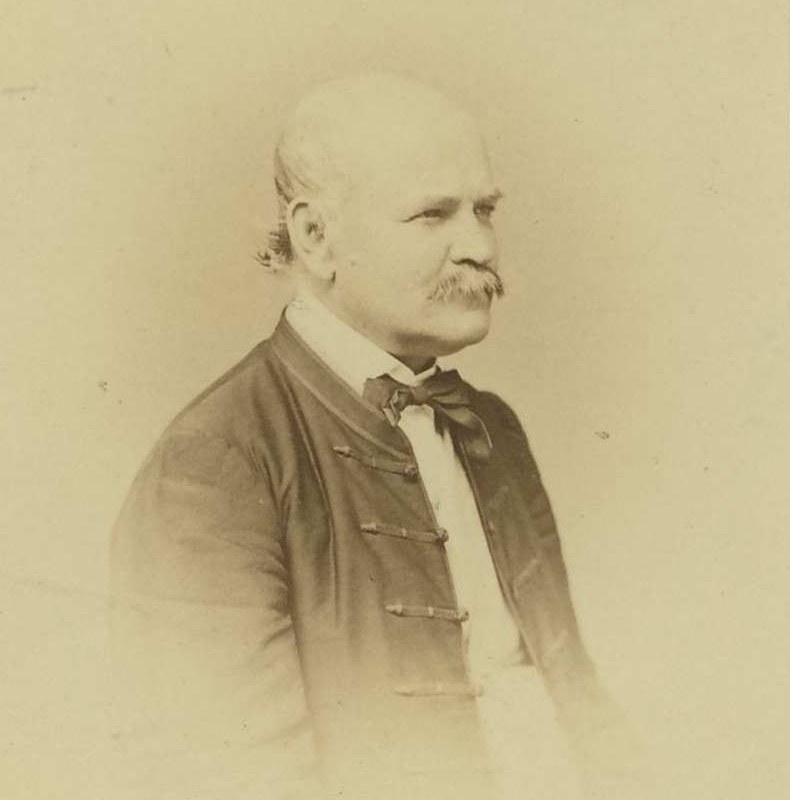
József Borsos and Albert Doctor (Borsos és Doctor studio), 'Semmelweiss Ignácz', carte-de-visite photograph, 1860; National Széchényi Library, Manuscript Collection; Wikimedia Commons file 'Borsos & Doctor Semmelweis Ignác.jpg' (authors died 1883 and 1888) · Borsos és Doctor studio carte-de-visite, 1860, National Széchényi Library (OSZK) Manuscript Collection, via Wikimedia Commons (hand crop of the 1000 x 1580 scan, no upscaling) · Public domain
In 1847, as assistant in the First Obstetric Clinic of the Vienna General Hospital, Semmelweis tied the clinic's heavy toll from childbed fever to doctors and students who came to the labour ward from the dissecting room. From late May 1847 he required everyone to wash their hands in a chlorinated-lime solution before examining women; monthly mortality, over 18 per cent in April, fell to 2.38 per cent in June and 1.20 per cent in July.
Semmelweis compared the First Clinic, where medical students were trained, with the Second, where midwives were trained: over 1841-46 the First recorded 9.92 per cent mortality against 3.38 per cent in the Second. He used that contrast, and the fall after 1847, to argue against the prevailing 'epidemic influences' explanation, and in 1861 he published his case as Die Aetiologie, der Begriff und die Prophylaxis des Kindbettfiebers, a 543-page book with statistical tables and replies to critics that named decomposing matter from cadavers and from living patients as the cause.
In 1861 Semmelweis answered his critics with open letters to the obstetricians Spaeth, Scanzoni and Siebold. He wrote that thousands of mothers and infants had died since 1847 who need not have died had he not stayed silent, told Siebold, a friend since 1847, that not sharing his view was equivalent to being a murderer, and offered to teach assembled German physicians until all were convinced. Siebold's posthumous letters of 1862 say he forgave his friend Semmelweis, and Kugelmann, an admirer, had asked in July 1861 for gentler treatment of Siebold.
This is consistent with the high conflict tolerance in this profile: after years of silence he chose open confrontation with senior opponents, and the replies from Siebold and Kugelmann suggest the tone cost him goodwill even among people who respected his results. Conflict Tolerance
In October 1847 a woman with a discharging cancer of the cervix was examined first on the ward round; Semmelweis and the students washed with soap and water as before and examined the other women, and eleven of the twelve women examined after her developed childbed fever. He concluded that matter from living patients, not only from cadavers, could cause the fever and required chlorinated-lime washing after any contaminated examination; a similar cluster in November led him to add air in the ward as a possible carrier.
This episode helps explain why this profile's belief updating sits only near the middle: he revised the mechanism when the results contradicted it, but his writings of 1861 presented the doctrine as settled. Belief Updating
In March 1849 Professor Klein blocked the extension of Semmelweis's assistantship in the First Clinic, and the Ministry rejected his appeal in November 1850. Appointed a lecturer on 10 October 1850, Semmelweis left Vienna for Pest within days; there he became honorary head of the St Rochus maternity division in May 1851 and professor of obstetrics in July 1855. Until 1857 his discovery was presented in print by others, notably Hebra and Skoda.
This episode sits alongside the profile's persistence score: he kept seeking posts from which to apply the method, yet the move coincided with years in which others, not he, explained his work in print. Persistence
People whose overall profiles resemble theirs.

Not a rival — a different profile shape worth a look.