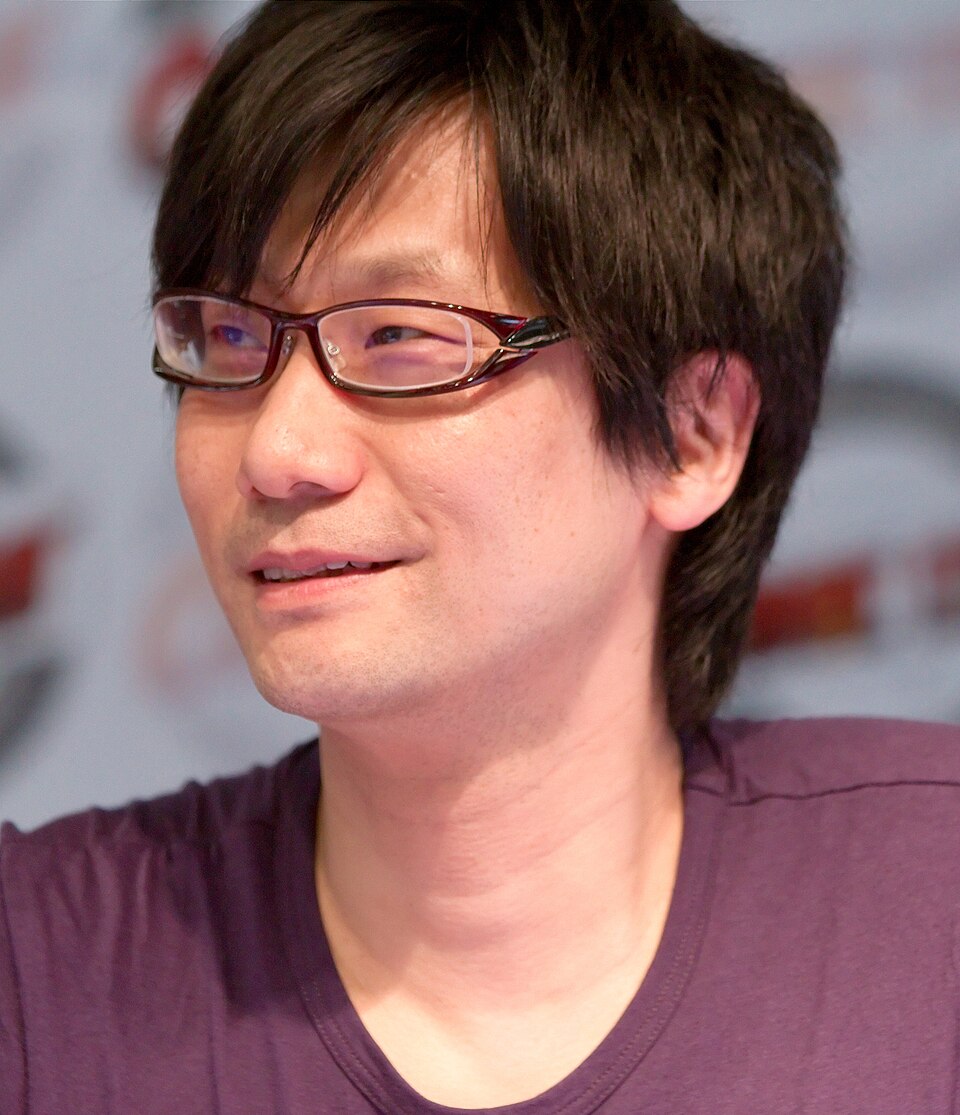

Photo: Georges Seguin (Okki), 2 July 2010, CC BY-SA 3.0, resized from the original · Wikimedia Commons, 'Hideo Kojima 20100702 Japan Expo 1 (cropped).jpg' -- own work by Georges Seguin (Okki), 2 July 2010, autograph session at Japan Expo 2010 in Paris, supported by Wikimedia France; downscaled from the original 2851 x 3312 pixels to 960 x 1115 (Commons thumbnail, no cropping beyond the file's own crop) · CC BY-SA 3.0
product designer · Contemporary
Hideo Kojima
b. 1963
Known For
Not yet included in personality matching — the documented evidence doesn't yet cover enough of the personality model. Everything else on this page is fully available.
Trait Constellation
Key Achievements
He created and designed Metal Gear in 1987, a war game built around avoiding combat that is credited with helping establish the stealth action genre.
Metal Gear Solid (1998) on PlayStation was his global breakthrough, with cinematic cutscenes and film-inspired storytelling, and he received the Game Developers Choice Lifetime Achievement Award in 2009.
In December 2015 he re-formed Kojima Productions as an independent studio and, with Sony as publishing partner, released Death Stranding in 2019, a game critics found by turns bold and divisive.
Moments That Reveal Them
When his company asked for an arcade Rambo-style war game, Kojima says he was against it and conceived a war game that avoids combat, which became Metal Gear.
This is consistent with an inclination to push back on a brief and work from his own idea. Independent Thinking
Death Stranding's open world built on delivery and asynchronous connection split critics, with scores from 6 to 10 and reviewers calling it both unusual and tedious.
This is consistent with a willingness to experiment with unconventional game design despite a polarising reception. Experimentation
Turning Points
After Konami cancelled the Silent Hills project in 2015, Kojima left to re-form Kojima Productions as an independent studio, starting from four people in December 2015.
This is consistent with a shift from salaried studio work toward leading his own independent studio. Need for Autonomy
Similar People
People whose overall profiles resemble theirs.

Yayoi Kusama

Pablo Picasso

James Joyce

Frida Kahlo

Leonardo da Vinci
Sources
- Hideo Kojima (Q315577) -- verified live via the Wikidata API (2026-10-24): English label 'Hideo Kojima', description 'Japanese video game designer (born 1963)', born 24 August 1963, no date of death, Korean label present, P18 images include 'Hideo Kojima 20100702 Japan Expo 1 (cropped).jpg'. Orientation only; not used as support for any row.
- Game Developers Conference, '2009 Game Developers Choice Awards Honor Kojima For Lifetime Achievement' (announcement by GDC and Gamasutra), read in full. CANONICAL SIGNIFICANCE SOURCE: says the Lifetime Achievement Award recognises developers with an 'indelible impact on the craft'; credits Kojima with the stealth genre via 1987's Metal Gear (born of MSX hardware limits), the 1998 breakthrough of Metal Gear Solid on PlayStation, the Snatcher, Policenauts and Zone of the Enders work, Boktai's sunlight sensor cartridge as 'disruption of traditional gaming mechanics', and breaking the fourth wall with players; names earlier recipients including Miyamoto and Sid Meier. An award-body announcement: admiring and promotional in tone.
- British Film Institute, 'Metal Gear Solid 3: Snake Eater 20th anniversary: Kojima's masterful tribute to spy cinema' (BFI feature), read in full: places Kojima's 1987 Metal Gear as a war game that avoids combat, quoting his 2020 BAFTA interview after receiving the BAFTA Fellowship about being against his company's instruction to make an arcade war game; describes the cinematic cutscenes, film references, the survival and camouflage mechanics of Snake Eater and the series' notorious cutscene length; notes a Konami remake in development without Kojima. A film-institute critical appreciation; admiring, with some criticism of cutscene length.
- GamesBeat, 'A Brief History of Stealth Games', read in full: traces stealth game lineage from Castle Wolfenstein (1981) to Metal Gear (1987) and Metal Gear Solid (1998), says Kojima created and designed Metal Gear, incorporated core elements of Castle Wolfenstein and added more refined presentation, that its release 'didn't send shockwaves', and that Metal Gear Solid became a seminal work whose success its antecedents did not match, while crediting Tenchu and Thief for the same-year response to stealth action. Independent genre history that qualifies 'first' claims.
- Kotaku, Metal Gear Solid retrospective article, read: argues that Metal Gear Solid is one of the most fondly remembered games, helped codify stealth action, and uses its structure to undercut the player's success; credits Kojima with emulating film language, such as integrating the credits into play. Independent critical retrospective that is partly critical of the series' message.
- Video Games Chronicle, 'Death Stranding review round-up: critics divided on Kojima's epic' (November 2019), read in full: scores from 6 to 10 with quotes from named outlets; one reviewer finds an 'unusual and fascinating' game clogged by its creator's self-importance, another calls it Kojima's boldest and most tedious, another describes an open-world design with asynchronous cooperative multiplayer alongside a long, confusing film, another the most unique big-budget game they have played. COUNTER-VOICE source on the independence period's first game.
- Game Informer, 'An Interview With Hideo Kojima' (15 June 2016), read in full: Kojima on life as an independent developer (freedom, fewer meetings, the danger of meeting fewer people, reading and film to keep his vision wide), staffing Kojima Productions from four people in December 2015, searching for an engine and facilities with Sony, the Kobo Abe stick-and-rope idea behind Death Stranding, and reconnecting with Norman Reedus and Guillermo del Toro. An interview: self-account, admiring interviewer.
- NME, 'Death Stranding developer will stay independent as long as I'm alive says Hideo Kojima' (NME news report on his Brain Structure podcast), read in full: Kojima says the studio was funded 100 per cent out of his pocket, that he receives acquisition offers some at 'ridiculously high prices' and will not accept them, and that he won't revisit earlier franchises. Entertainment-news report quoting his own statements.
- SiliconANGLE, report on the Nikkei article about Konami's working conditions and the Silent Hills cancellation (3 August 2015), read in full for context only: confirms Konami cancelled the Kojima-del Toro Silent Hills project and quotes del Toro calling the cancellation 'scorched earth'; the working-condition allegations concern Konami and were not used to score Kojima. Secondhand report of a Nikkei story.
- Wikimedia Commons file page 'Hideo Kojima 20100702 Japan Expo 1 (cropped).jpg' by Georges Seguin (Okki), own work, 2 July 2010, licence GFDL and Creative Commons Attribution-ShareAlike 3.0/2.5/2.0/1.0 (self-published multi-licence), checked for the portrait only.