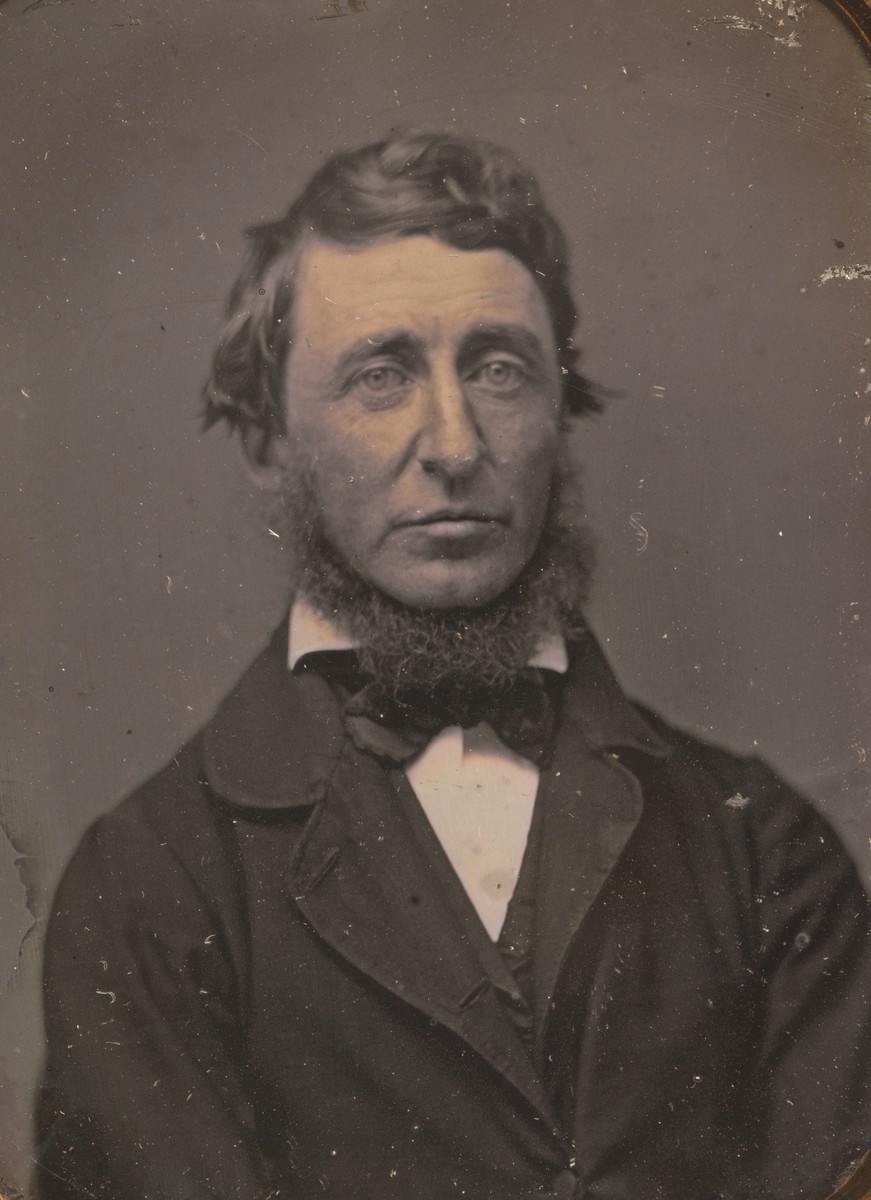

Benjamin D. Maxham, Henry David Thoreau, 1856, ninth-plate daguerreotype, National Portrait Gallery, Smithsonian Institution; gift of anonymous donor (NPG.72.119), CC0 · Ninth-plate daguerreotype of Henry David Thoreau by Benjamin D. Maxham (1821-1899), made at his studio in Worcester, Massachusetts, in June 1856, National Portrait Gallery, Smithsonian Institution, Washington (object NPG.72.119, gift of an anonymous donor). A documented sitting during the sitter's lifetime. The file is a plain crop of the plate from the museum's own 3345 x 4000 pixel scan of the cased object (the case and mat are cut away), downscaled to 871 x 1200 with no upscaling and no retouching. · CC0 (Smithsonian Open Access); photographer died 1899, so also public domain by age
writer · 19th Century
Henry David Thoreau
1817–1862
Known For
Not yet included in personality matching — the documented evidence doesn't yet cover enough of the personality model. Everything else on this page is fully available.
Trait Constellation
Key Achievements
He wrote Walden (1854), an account of living for two years at Walden Pond that combines narrative, close observation of nature and philosophical reflection.
After a night in jail for refusing to pay a poll tax he wrote the essay 'Resistance to Civil Government', later called 'Civil Disobedience', which the Stanford Encyclopedia links to later figures such as Gandhi and King.
He kept a multivolume journal of nature observation from 1837 until his death, and scientists later used his 1850s plant records to study how flowering times in Concord have changed.
Moments That Reveal Them
Hired at the Concord public school after graduating from Harvard, he resigned after two weeks because he disagreed with the superintendent about how to discipline students.
This is consistent with a strong preference for working on his own terms. Need for Autonomy
Researchers from Harvard and Boston University compared his 1851-1858 notes on plant flowering at Concord with modern surveys and found that plants now flower about a week earlier on average.
This is consistent with careful, repeated observation that remained usable 150 years later. Detail Orientation
Turning Points
On 4 July 1845 he moved into a small house at Walden Pond, aiming to write his first book and to test whether he could meet his needs by working one day a week; the stay lasted until September 1847 and gave rise to Walden.
This is consistent with a decision to organise his life around writing and observation. Experimentation
Similar People
People whose overall profiles resemble theirs.

Marie Curie

Yayoi Kusama

Leonardo da Vinci

Gertrude Bell

Sigmund Freud
Sources
- Henry David Thoreau (Q131149), verified live via the Wikidata API (2026-10-31): label 'Henry David Thoreau', description 'American essayist, poet, and philosopher (1817-1862)', born 12 July 1817, died 6 May 1862, citizenship United States, Korean label 헨리 데이비드 소로, images including the Maxham daguerreotype. Orientation only; not used as support for any row.
- Stanford Encyclopedia of Philosophy, 'Henry David Thoreau', read in the biography, Walden, journal, natural-history and critics sections. CANONICAL SIGNIFICANCE SOURCE: born and died in Concord, Massachusetts, Harvard graduate of 1837, friendship with Emerson, supported himself mainly as a land surveyor with brief spells as a schoolteacher and pencil maker; lived at Walden Pond for two years and two months from 1845 as an 'experiment'; published two books in his lifetime, A Week on the Concord and Merrimack Rivers and Walden (1854), the latter combining narrative, close observation and philosophical speculation; kept a multivolume journal from 1837 until his death; discussed field findings with leading naturalists and read Humboldt and Darwin; his natural-science writings were not published until the late twentieth century; critics include Stanley Cavell's remark that his work may embarrass academic philosophy, doubts that 'transcendentalist' fits him, his ambivalence about science and his possible overestimate of how far a person can detach from institutions. Scholarly reference; the political material in the entry is NOT scored.
- Thoreau Society / Thoreau Alliance, 'Meet Henry David Thoreau (1817-1862)', adapted from Richard J. Schneider, 'Thoreau's Life' (PDF read in full): graduated Harvard in 1837 in the top half of his class during a depression, resigned a Concord school post after two weeks over a dispute with the superintendent about discipline, worked in his father's pencil business where the family's pencils were considered the best in America 'largely because of Henry's research into German pencil-making techniques', opened a private school with his brother in 1838, built the Walden house in 1845 with two goals (to write A Week and to test whether he could meet his needs working one day a week), revised Walden extensively after A Week sold poorly, supported himself by pencil-making, surveying, lecturing and essays, kept careful journals of nature observations and left dozens of volumes of journals and unfinished studies of local nature. Admiring institutional biography; its political and family sections are NOT used.
- Ralph Waldo Emerson, 'Thoreau' (funeral address of May 1862, printed in the Atlantic Monthly, August 1862), as reprinted by Cabinet magazine, read via a fetched summary: contemporary account by his mentor and friend. After a pencil experiment praised by Boston experts Thoreau declined to continue it, preferring walking and study; he taught briefly with his brother and then took up land surveying, which suited his accuracy and gave access to remote land for his nature studies; he earned only enough for modest needs, keeping his time free; he knew Concord's rivers, ponds, animals and plants closely and observed patiently and precisely. Emerson also criticises him: little ambition ('the captain of a huckleberry party'), contrariness, a quickness to refuse and severe standards that made him a hard companion ('that terrible Thoreau'), paradoxical prose and rough verse. Friendly but candid primary account; the full text was not read line by line.
- Harvard Gazette, 'Effects of climate change vary greatly across plant families' (October 2008), read in full, with the bibliographic record and abstract of A. J. Miller-Rushing and R. B. Primack, 'Global warming and flowering times in Thoreau's Concord: a community perspective', Ecology 89 (2008), via AGRIS: independent scientists (Charles Davis, Charles Willis and Brad Ruhfel at Harvard; Primack and Miller-Rushing at Boston University) used Thoreau's 1851-1858 notes on plant occurrence and flowering times at Walden and Concord as the earliest part of a roughly 150-year community-level dataset, finding that plants now flower about a week earlier on average, that species respond very unevenly, and that about 27 percent of the species he recorded are locally extinct. The papers also state the limits of his records: different observers, methods and sampling intensities, and a subset of 43 species. Independent scientific use of his behaviour; it confirms the records were usable, not that he worked as a scientist.
- Rebecca Beatrice Brooks, 'James Russell Lowell's Feud with Henry David Thoreau', History of Massachusetts Blog (2013, updated 2025), read in full: popular secondary account of Lowell's hostile judgements of Thoreau (a mocking verse in 1848 and a North American Review essay in 1865 that charged him with narrow provincialism, egotism, and a lack of imagination, originality, logic and humour, and said he preached the forest cure while seeking doctors) and of the 1858 quarrel in which Thoreau angrily refused to write further for Lowell's Atlantic Monthly after a line of his essay was cut. The primary Lowell essays were not opened. Counter-voice source; the charges are one hostile critic's opinions and are not scored as facts.