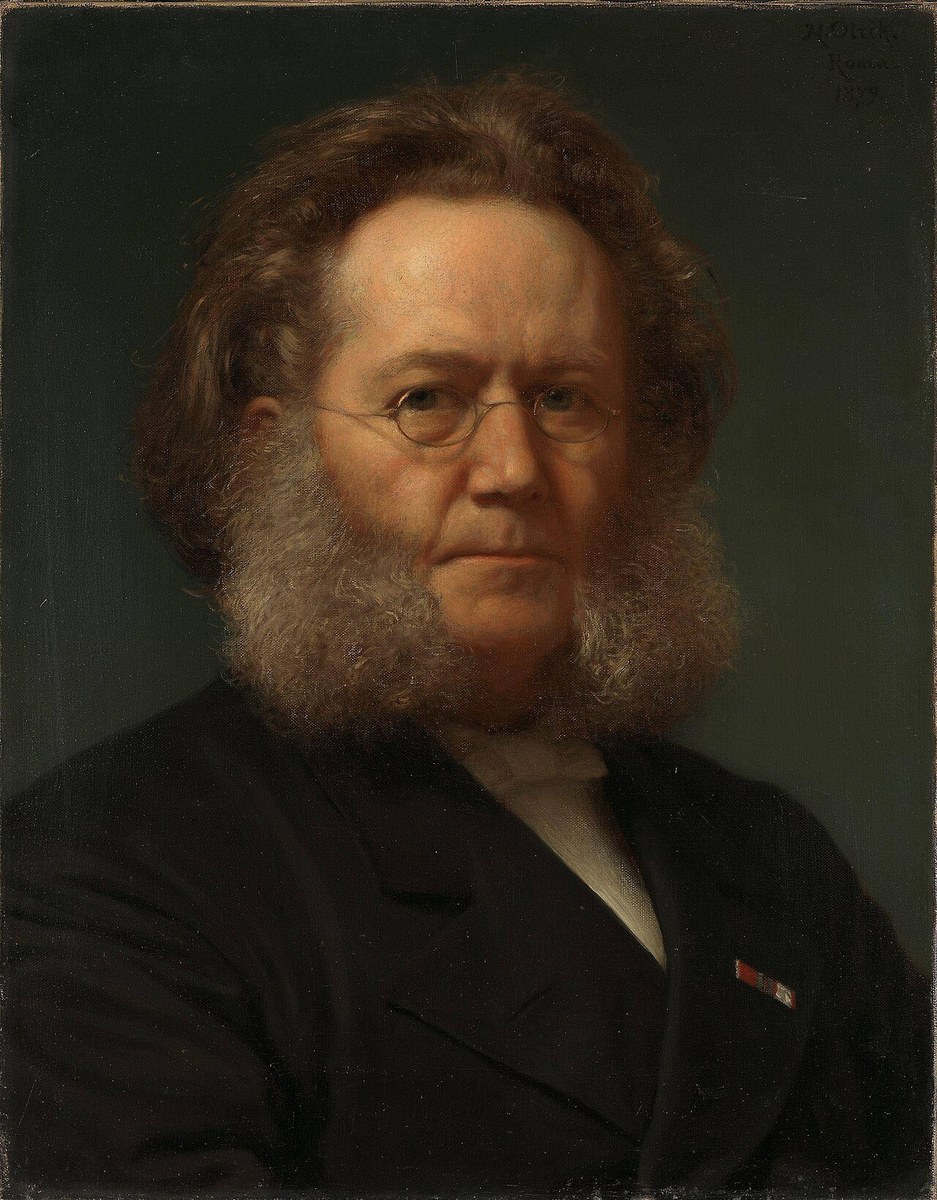

Henrik Olrik, portrait of Henrik Ibsen, 1879, Nasjonalmuseet, Oslo (public domain) · Portrait of Henrik Ibsen by Henrik Olrik, oil on canvas, 55 x 43.5 cm, dated 1879 (the canvas is signed 'H. Olrik, Roma 1879'), Nasjonalmuseet, Oslo, inventory NG.M.00355, acquired 1890, via Wikimedia Commons file 'Ibsen by Olrik.jpg' (original 2342 x 3000). The painter died in 1890, so the work is in the public domain worldwide and in the United States by its pre-1931 date; the Commons page states a faithful reproduction of a two-dimensional public-domain work adds no new copyright. The museum's collection record gives no conflicting copyright notice. The stored file was downscaled only, from a 1280 x 1640 Commons rendition to 937 x 1200 pixels, never enlarged. No source I read states that Ibsen sat for this painting, so it is presented as a painted portrait, not as a photograph; the lead may upgrade the classification if a documented sitting is found. · Public domain (painter Henrik Olrik died 1890)
writer · 19th Century
Henrik Ibsen
1828–1906
Known For
Not yet included in personality matching — the documented evidence doesn't yet cover enough of the personality model. Everything else on this page is fully available.
Trait Constellation
Key Achievements
He was a major Norwegian playwright who introduced to the European stage realistic contemporary plays that set a new kind of moral analysis against a middle-class background.
A Doll's House (1879) brought him his international breakthrough, and Ghosts (1881) and An Enemy of the People (1882) followed in the same vein.
He wrote 26 dramatic works and about 300 poems, including the verse dramas Brand (1866) and Peer Gynt (1867).
Moments That Reveal Them
He structured his days around a fixed routine of writing, meals, a walk to the cafe and the papers, and produced a new play about every two years.
This is consistent with a highly regular working discipline. Discipline
After A Doll's House and Ghosts, critics denounced him, and he answered with An Enemy of the People, whose hero is declared an enemy of the people for speaking an unwelcome truth.
This is consistent with continuing to write contested work rather than retreating from criticism. Conflict Tolerance
Turning Points
After the Christiania theatre went bankrupt in 1862, he left Norway in 1864 for Italy and spent 27 years abroad, writing Brand and Peer Gynt in Rome and most of his best work.
This is consistent with persistence and a need to work on his own terms after a professional setback. Need for Autonomy
Similar People
People whose overall profiles resemble theirs.

Frida Kahlo

Sigmund Freud

Leo Tolstoy
Coco Chanel

Martha Graham
Opposite Profile
Not a rival — a different profile shape worth a look.
Theodore Roosevelt
Sources
- Henrik Ibsen (Q36661), verified live via the Wikidata API (2026-10-25): label 'Henrik Ibsen', description 'Norwegian playwright and theatre director (1828-1906)', Korean label in Hangul, born 1828-03-20, died 1906-05-23, several P18 images including 'Ibsen by Olrik.jpg'. Orientation only; not used as support for any row.
- Encyclopaedia Britannica, 'Henrik Ibsen', read in full. CANONICAL SIGNIFICANCE SOURCE: major Norwegian playwright of the late nineteenth century who brought realistic contemporary social drama to the European stage; early theatre work in Bergen and Christiania and the unsuccessful early plays and bankrupt theatre; 27 years abroad from 1864; the verse dramas Brand and Peer Gynt; the prose plays from Pillars of Society to A Doll's House (1879), Ghosts (1881), An Enemy of the People, The Wild Duck and Rosmersholm; the scandalised reaction and the critics who denounced him. Reference entry with interpretive commentary: factual, admiring, and its character readings of the plays are not used as evidence of his own character.
- University of Oslo, Ibsen Centre, 'Short biography' and 'Chronological survey of Ibsen's life and works' (Ibsen archive and Virtual Ibsen Centre), both read in full: Grimstad apprenticeship, first poem 1849, debut play Catiline 1850 under a pseudonym, six years in Bergen writing and staging six plays and learning the theatre as a director, the bankruptcy of the Christiania theatre in 1862, departure in 1864, publication in Copenhagen from Brand onward, Emperor and Galilean (1873), the contemporary plays from 1877, A Doll's House as the international breakthrough, 26 dramatic works and about 300 poems, and the year-by-year list of writing and first stagings. University research-centre biography: factual and admiring.
- Kirsten Shepherd-Barr, review of Ivo de Figueiredo's 'Henrik Ibsen: The Man and the Mask' (Yale, 2019), Scandinavica vol. 59 no. 1 (2020), read in full. Independent scholarly review of a biography: Ibsen's rigidly methodical daily routine and a new play about every two years, his careful management of his reputation and publication and his distance from movements that sought to claim him, the finding that his early plays were more successful with Nordic and German audiences than the usual story says, and the reviewer's criticisms of the biography's thesis and character-reading. Its closing speculation about his mind and private conduct was read and deliberately excluded from scoring.
- Steve Donoghue, review of Ivo de Figueiredo's 'Henrik Ibsen: The Man and the Mask', Open Letters Monthly, read in full: calls it the most lauded life of Ibsen since Michael Meyer's, notes the biography's view that he was a poet before he became a dramatist and took longer to master dramatic form. Short, admiring trade-press review of the biography; no behavioural claim relies on it alone.
- Washington Free Beacon, 'To Shock and Offend', review essay on de Figueiredo's biography, read in full. COUNTER-VOICE: argues that Ibsen has faded as a classic, that his stock of social-problem characters now seems hackneyed, that he wanted his plays to shock and offend and that he constantly solicited medals and decorations from European governments. An opinionated essay: its account of his family and private conduct was read and excluded; the claims about honours and shock are used only as a critical reading, with the honours remark carrying low weight as the reviewer's summary of the biography.
- Nasjonalmuseet (National Museum of Art, Architecture and Design, Oslo) collection record NG.M.00355, 'Henrik Olrik, Henrik Ibsen' (oil on canvas, 1879, acquired 1890), and its Wikimedia Commons file page 'Ibsen by Olrik.jpg', checked for the portrait only.