Ada Lovelace
93% Profile Match
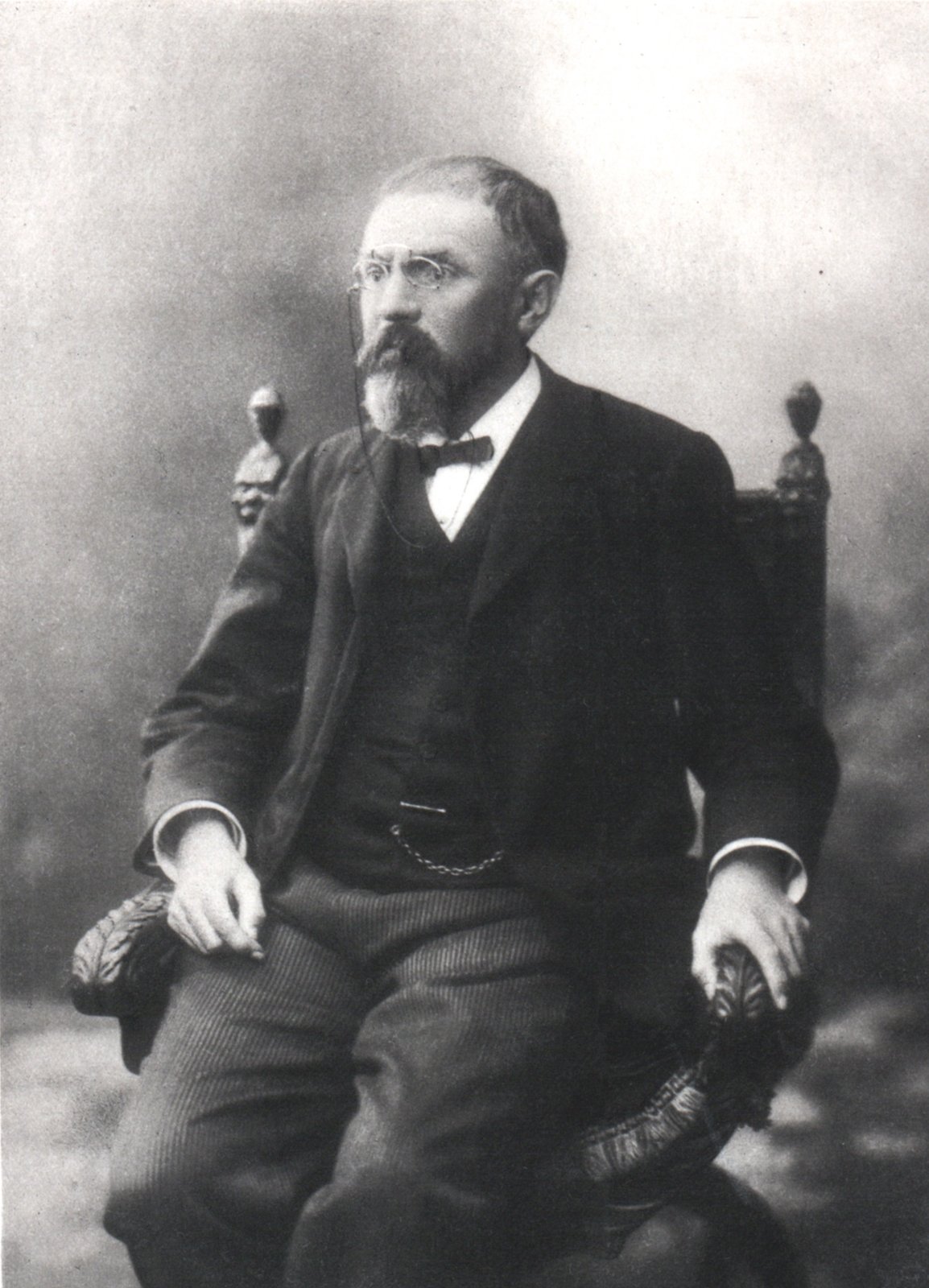
Photograph credited 'Cliche Henri Manuel' on the print (Smithsonian catalogue lists the photographer as unidentified); Smithsonian Institution Libraries, Dibner Library, SIL14-P005-03; no known copyright restrictions (Flickr Commons). · Smithsonian Institution Libraries, Dibner Library of the History of Science and Technology, 'Scientific Identity: Portraits' collection, accession SIL14-P005-03 ('Portrait of Henri Poincare (1854-1912), Mathematician'), printed photograph 14.8 x 10.6 cm; credit line 'Cliche Henri Manuel' printed on the print; via Wikimedia Commons file 'Henri Poincare sitting.jpg' (2.0 MP original, cropped to the photograph and downsized) · Public domain (photograph dated before 1912; Smithsonian Libraries: no known copyright restrictions; photographer Henri Manuel d. 1947, so French term life+70 has expired)
mathematician · 19th Century
1854–1912
Not yet included in personality matching — the documented evidence doesn't yet cover enough of the personality model. Everything else on this page is fully available.
In 1888 Poincaré entered the King Oscar II prize competition, organised through Mittag-Leffler's journal Acta Mathematica, with a memoir on the three-body problem and the equations of dynamics. A committee of Hermite, Mittag-Leffler and Weierstrass awarded him the prize in January 1889, and a corrected, much longer version appeared in 1890. It studied the orbits geometrically and described the transverse homoclinic intersections whose complex geometry later work linked to chaotic dynamics. Yoccoz calls him the founder of the theory of dynamical systems; Poincaré developed the ideas in the three volumes of Les Méthodes nouvelles de la mécanique céleste (1892-1899).
In the early 1880s Poincaré introduced the automorphic functions, which he named Fuchsian, tied them to non-Euclidean geometry and used them to integrate linear differential equations with algebraic coefficients. In Analysis situs (1895) and the papers from 1894 he laid the foundations of algebraic topology and introduced the fundamental group. MacTutor says that for about forty years essentially all the ideas and techniques of the subject rested on his work. The Poincaré conjecture, which grew out of it, was settled by Grigori Perelman in 2002.
On 5 June 1905 Poincaré presented a note 'Sur la dynamique de l'électron' to the Académie des sciences, and on 23 July sent a long memoir on the same subject to the Rendiconti del Circolo Matematico di Palermo. Walter says he was arguably the first to state the principle of relativity as the form-invariance of physical laws under a group of transformations, and historians agree that he found and named the modern form of the Lorentz transformation. They disagree about how he interpreted it: he kept an ether-based picture and, according to Damour, apparently never cited Einstein's contribution.
Poincaré set out his philosophy of science in Science and Hypothesis (1901), The Value of Science (1905) and Science and Method (1908), including the view that the choice between Euclidean and non-Euclidean geometry for physical space is a convention. The Royal Astronomical Society's obituary said the books found a multitude of readers and shaped the philosophical ideas of many younger physicists and mathematicians. In 1908 he also gave a lecture on mathematical invention that described how some of his own discoveries had come to him.
On 1 September 1879, five months into his post as a mining inspector at Vesoul, Poincaré went down the Magny pit while the rescue was still under way after an explosion that killed sixteen of the twenty-two men on the shift. His report listed the possible causes with the evidence for and against each, used the direction of the burns to narrow the blast to two sites, and traced the numbered lamps; a damaged lamp found beside the wrong body led him to conclude that one miner had picked up another's lamp. Roy and Dugas note that the report does not mention his own part in the rescue.
Narrowing the possible causes by testing each against physical evidence is consistent with analytical rigor. The account comes through MacTutor's summary of the report and the study by Roy and Dugas, not from the report itself. Analytical Rigour
In 1881 Poincaré named a class of functions after Fuchs, and Klein objected, writing that he would use neither 'Fuchsian' nor 'Kleinian'. On 4 April 1882 Poincaré replied that he would recognise a prior claim only if shown earlier work of the same kind and that he had not named Kleinian functions after Klein 'by way of compensation'. He wrote that he would not prolong the dispute and would 'do as I please', quoting Goethe, 'Name ist Schall und Rauch', and he hoped the quarrel over a name would not harm their good relations.
Holding his position against an established German mathematician, while keeping the tone courteous, is consistent with independent thinking. The episode is known here only from two letters, one from each side. Independent Thinking
In July 1889 Mittag-Leffler passed on a request from his editor Phragmén for clarification of the prize memoir. Poincaré saw that Phragmén's objections were well founded and found a more serious error elsewhere, and in early December 1889 he told Mittag-Leffler that the correction required substantial changes. Mittag-Leffler recalled the copies already sent out, Poincaré paid the 3,500-crown printing cost of the first version, 1,000 more than the prize, and the revised 270-page memoir appeared in November 1890. Yoccoz says that correcting the error led him to the transverse homoclinic intersections.
Accepting the objection, reporting that the whole argument needed rewriting and paying to withdraw the first version is consistent with belief updating. The circumstances are known through Yoccoz and Brent, who rely on Barrow-Green's study. Belief Updating
People whose overall profiles resemble theirs.


Not a rival — a different profile shape worth a look.