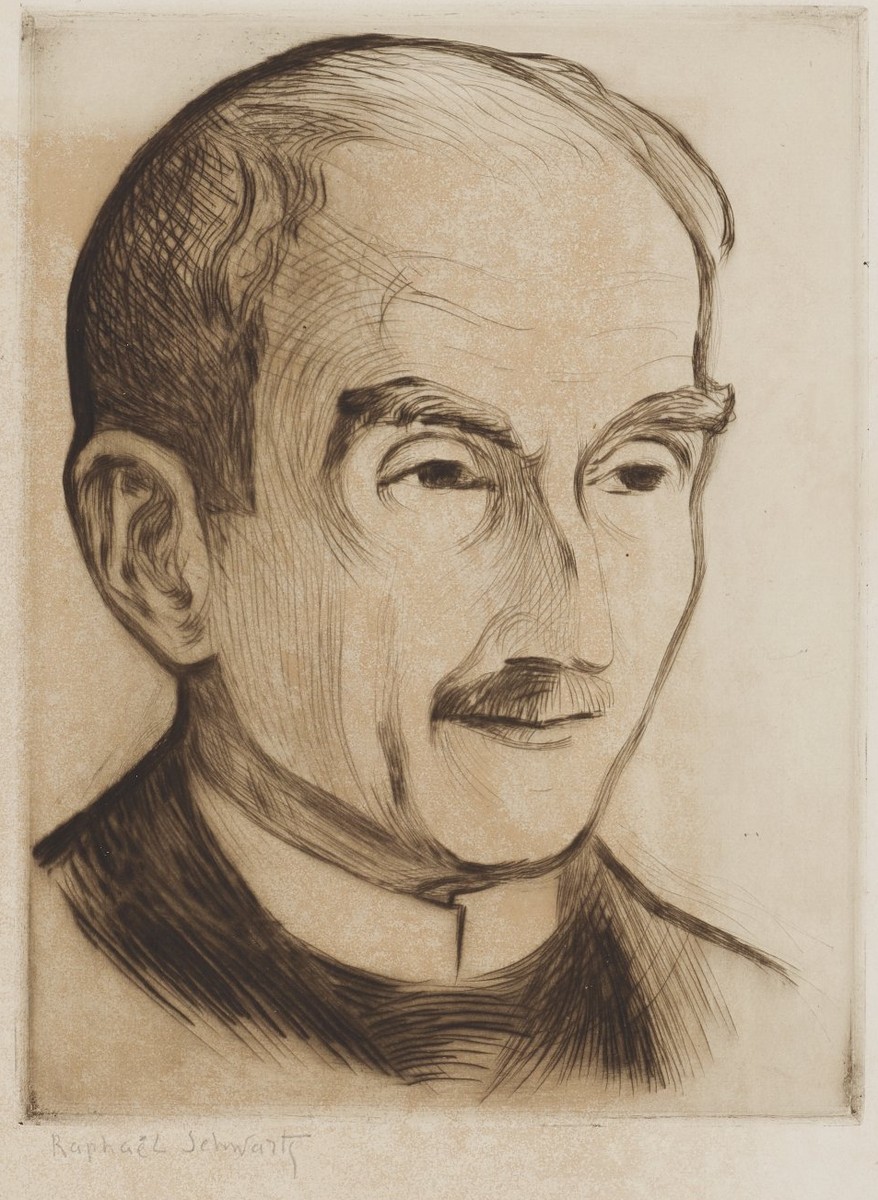
Raphael Schwartz, Portrait du philosophe Henri Bergson, drypoint, before 1912, Paris Musees / Petit Palais, musee des Beaux-Arts de la Ville de Paris (PPG1690), CC0 · Drypoint portrait of Henri Bergson by the printmaker Raphael Schwartz, made before 1912 in Bergson's lifetime and given by the artist to the Petit Palais in January 1912 (inscribed in pencil with the artist's signature and the title 'Philosophe Henri Bergson'); Petit Palais, musee des Beaux-Arts de la Ville de Paris, inventory PPG1690, plate 29.7 x 22.5 cm. The Paris Musees Collections page for the work carries a CC0 mark. The museum's own image is 1,444 x 2,160 pixels, cropped to the plate and signature line and downscaled once to 878 x 1,200 pixels; nothing was upscaled. Shown as an artist's portrait print, not as a documented sitting. Caveat: the museum gives the artist's death as 1942, so the work is old enough that no age-based protection remains, and the museum's CC0 label is the stated basis. · CC0 1.0 (Paris Musees, Petit Palais; the artist died in 1942)
philosopher · 20th Century
Henri Bergson
1859–1941
Known For
Not yet included in personality matching — the documented evidence doesn't yet cover enough of the personality model. Everything else on this page is fully available.
Trait Constellation
Key Achievements
He developed a philosophy of duration, the lived, flowing time that clocks cannot measure, and of intuition as a method, in Time and Free Will (1889), Matter and Memory (1896) and Creative Evolution (1907), setting it against mechanist and positivist views.
From 1900 he held a chair at the Collège de France, where his free public lectures drew overflow crowds, and in 1914 he was elected to the Académie française; his 1913 lectures at Columbia University were said to have caused a traffic jam on Broadway.
He was awarded the Nobel Prize in Literature for 1927, presented in 1928, and his ideas influenced American pragmatism, Cubism and modern literature; his other books include Laughter (1900), a theory of comedy, and The Two Sources of Morality and Religion (1932).
Moments That Reveal Them
In January 1913 his lectures at Columbia University in New York drew crowds so large that, according to the accounts, they caused the first traffic jam on Broadway.
The episode is consistent with a lecturer able to draw a very large public, though the sources do not show how far it converted sceptics. Persuasiveness
On 6 April 1922 he came to a Paris meeting to listen to Einstein, was pressed to speak, and asked how the time of relativity relates to lived time; Einstein dismissed the question, and later commentators judge that Bergson had misunderstood a technical point of relativity.
The exchange is consistent with an independent thinker who pressed his own view of time in front of the leading physicist, with a cost in credibility on one technical point. Independent Thinking
Turning Points
After Matter and Memory (1896) and two failed attempts to win a Sorbonne post, he was given a chair at the Collège de France in 1900, which Stanford marks as the beginning of his growing fame.
The move from lycée teacher to the Collège de France is consistent with original ideas finding an audience once he had a public platform. Creative Originality
Similar People
People whose overall profiles resemble theirs.

Hildegard of Bingen

Leonardo da Vinci

Ada Lovelace

Maya Angelou

Carl Jung
Sources
- Henri Bergson (Q42156), verified live via the Wikidata API (2026-11-04): label 'Henri Bergson', description 'French philosopher (1859-1941)', born 18 October 1859, died 4 January 1941, citizenship France, Korean label 앙리 베르그송. Orientation only; not used as support for any row.
- Stanford Encyclopedia of Philosophy, 'Henri Bergson' (Life and works section read in full, about 2,300 words). CANONICAL SIGNIFICANCE SOURCE: traces his path from a mathematics prize and the Ecole Normale to Time and Free Will (1889), Matter and Memory (1896), Laughter (1900), the Collège de France and the 'Bergson legend' around Creative Evolution (1907), his influence on pragmatism, Cubism and literature, the 1922 exchange with Einstein and Duration and Simultaneity, The Two Sources of Morality and Religion (1932) and the Nobel Prize; also records Russell's objection that intuition would turn us into bees and a dispute over whether Bergson later wished the relativity book not to be reprinted.
- Internet Encyclopedia of Philosophy, 'Henri Bergson' (life and works sections a to d read in full, about 3,500 words). Gives his education, the move from Spencer-style mechanism to the problem of duration (partly in his own later account to a disciple, treated here as self-report), the 1886 hypnosis paper and his later discreet psychical research, the Collège de France years and 'Bergsonmania' with the criticism of it as vague or frivolous, the placing of his books on the Index, and the 1922 debate with Einstein. CRITICAL / COUNTER-VOICES: Darlu's rebuke of the hypnosis paper, critics of the lecture audiences, Action francaise attacks, and the decline of his reputation after the war. His wartime diplomacy is read but not scored.
- NobelPrize.org, Nobel Prize in Literature 1927, Henri Bergson: the Nobel Foundation's biographical note written at the time of the award and the presentation speech by Per Hallstrom for the Swedish Academy, 10 December 1928 (both read in full, about 1,900 words together). Lists his books and positions (Collège de France chair 1900-1921, Académie francaise 1914), and presents duration, intuition and his break with rationalist biology in an admiring contemporary account; the speaker says he lacks a philosopher's training and does not assess the arguments. Admiring award-body source, so not independent evidence for any trait.
- Evan Thompson, 'Who really won when Bergson and Einstein debated time?', Aeon (2024 essay by a University of British Columbia philosopher; read in full, about 4,200 words). Reconstructs the 6 April 1922 meeting of the Société française de philosophie (Bergson came to listen and was pressed to speak), states that Bergson misunderstood a technical aspect of special relativity (time dilation) while arguing he was not out of touch with mathematics, and cites Hanna (1962) and Prigogine and Stengers for harsher judgments. SYMPATHETIC TO BERGSON BUT HONEST ABOUT HIS ERROR; independent of the encyclopedia accounts.
- Paris Musées Collections, Petit Palais, 'Portrait du philosophe Henri Bergson', drypoint by Raphael Schwartz (Kiev 1884 - Pau 1942), before 1912, inventory PPG1690, gift of the artist in January 1912 (item page and IIIF manifest read; the page carries a CC0 mark for the image). Used for the portrait only, not for any trait row.