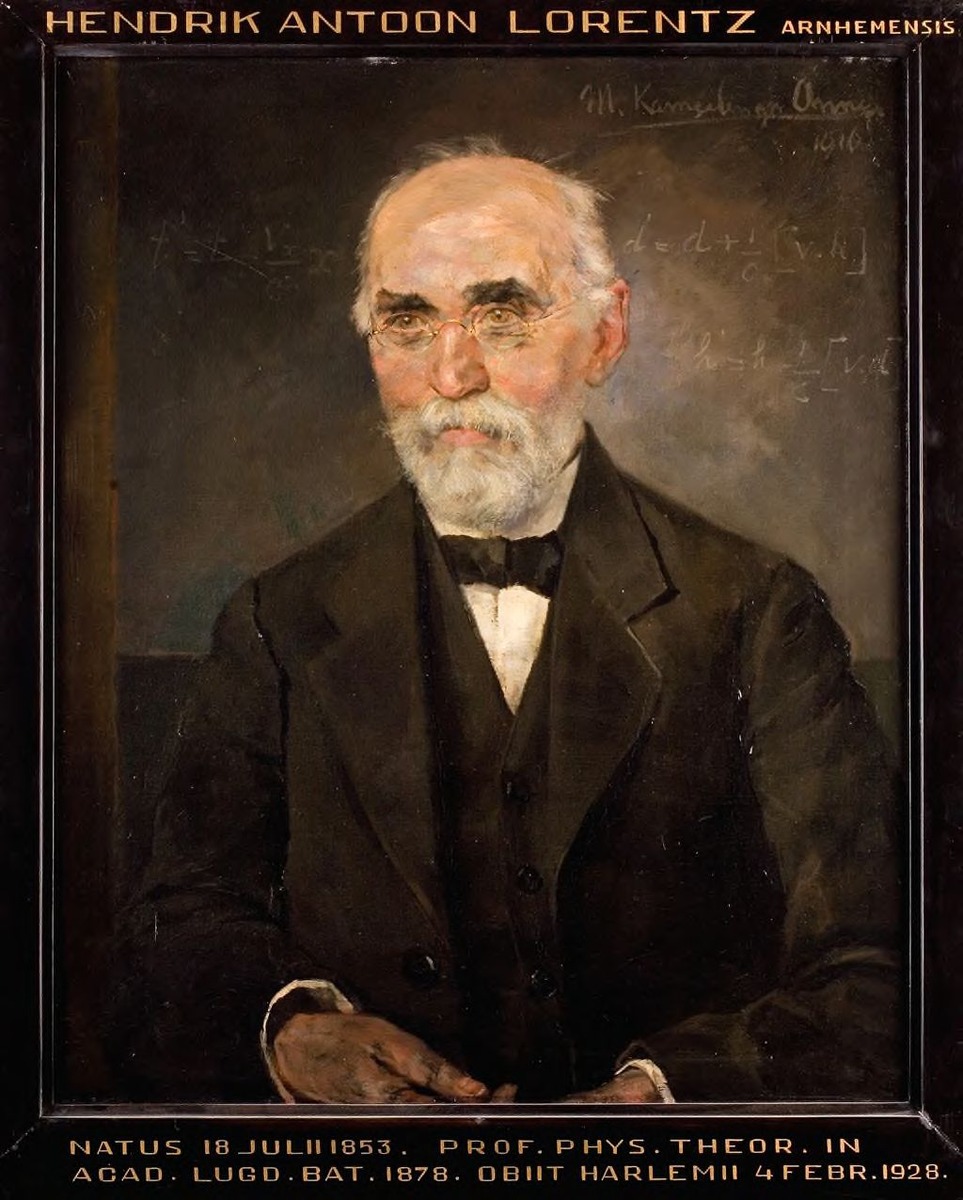
Menso Kamerlingh Onnes, Portrait of Hendrik Antoon Lorentz, 1916, oil on canvas, Icones Leidenses, Leiden University Libraries (Icones 310), public domain · Portrait painting (oil on canvas, signed and dated 1916) of Hendrik Lorentz by Menso Kamerlingh Onnes (1860-1925), Icones Leidenses, Leiden University Libraries (Icones 310), given by the sitter's family in 1931. The Leiden University Libraries item record and its IIIF manifest state 'The rights status of this resource is public domain' (Public Domain Mark), and the painter died in 1925. Downloaded from the library's IIIF image service at its full available size (1024 x 1276 pixels) and downscaled only, to 963 x 1200; no upscaling. The picture includes its frame with the Latin inscription naming Lorentz. · Public domain (Leiden University Libraries Public Domain Mark); painter died 1925
physicist · 20th Century
Hendrik Lorentz
1853–1928
Known For
Not yet included in personality matching — the documented evidence doesn't yet cover enough of the personality model. Everything else on this page is fully available.
Trait Constellation
Key Achievements
Developed the electron theory that completed Maxwell's electromagnetism, treating matter and charge as particulate; its explanation of Pieter Zeeman's observation won them the 1902 Nobel Prize in Physics.
In 1904 formulated the Lorentz transformation, which accounted for the null result of the Michelson-Morley experiments and, in the Nobel Foundation's words, paved the way for Einstein's special theory of relativity; he kept the ether to the end.
Chaired the first five Solvay Conferences (1911-1927) and the Dutch Zuiderzee Commission, whose tidal calculations for the closing dyke used a scientifically based method for setting dyke heights.
Moments That Reveal Them
At the 1911 Solvay conference he chaired, a colleague wrote that he led the discussion with exceptional clarity and friendliness, creating an amicable yet serious tone whenever opinions differed.
This is consistent with a collaborator who made group discussion work, though the account comes from a close colleague. Collaboration
He lectured on Heisenberg's matrix mechanics in 1925-26 and on Schrödinger's theory in 1927, within a year of each appearing, when he was over seventy.
This is consistent with a physicist who kept pace with new theories he did not fully accept himself. Curiosity
Turning Points
In 1912 he took the Haarlem curatorship at Teyler's and the secretaryship of the Dutch Society of Sciences, leaving his Leiden chair to keep only the Monday-morning lectures, so that research and lecturing on new physics replaced routine academic duties.
This is consistent with a deliberate trade of administrative load for time to follow the new physics. Curiosity
Similar People
People whose overall profiles resemble theirs.


Ada Lovelace

Ibn Khaldun

Otto von Bismarck

Niels Bohr

Maimonides
Sources
- Hendrik Lorentz (Q41688), verified live via the Wikidata API (2026-11-02): label 'Hendrik Lorentz', description 'Dutch physicist (1853-1928)', born 18 July 1853, died 4 February 1928, citizenship Netherlands, Korean label present. Orientation only; not used as support for any row.
- 'Hendrik A. Lorentz - Biographical', NobelPrize.org (Nobel Foundation biography, 1902 Physics), read in full. CANONICAL SIGNIFICANCE SOURCE: states that from the start he made it his task to extend Maxwell's theory of electricity and light, that the conception of the electron stems from him, that the 1904 Lorentz transformation explained the null result of the Michelson-Morley experiments and 'paved the way for Einstein's special theory of relativity', that he chaired the Zuiderzee committee on tidal movements, chaired every Solvay Congress until his death and helped start the Dutch applied-research organisation TNO, and calls him 'a man of immense personal charm'. Award-body biography: admiring, institutional, with no critical voice.
- 'Hendrik Antoon Lorentz', Encyclopaedia Britannica, read in full: joint Nobel Prize for Physics 1902 with Pieter Zeeman; doctoral thesis 1875 refining Maxwell's theory; professor at Leiden from 1878; his central aim 'to construct a single theory to explain the relationship of electricity, magnetism, and light'; the electron theory and its confirmation by Zeeman in 1896; the local time idea of 1895 and the 1904 transformations; director of research at Teyler's institute in Haarlem from 1912 while lecturing weekly at Leiden. Encyclopedia overview; notes that the electron theory could not explain the Michelson-Morley result by itself.
- 'Hendrik Antoon Lorentz', MacTutor History of Mathematics Archive, University of St Andrews, read in full: biography with dated list of works (1892 and 1895 treatises on moving bodies, The Theory of Electrons 1909, Lessons on Theoretical Physics from 1919), the 1911 Solvay opening address welcoming Planck's quantum hypothesis as 'a wonderful ray of light', the statement that he 'never fully accepted quantum theory and always hoped' to bring it back into the classical approach, an obituary appreciation of his 'mental vivacity' in guiding discussion, and an account of his funeral. University history-of-mathematics archive; admiring, with the quantum reservation recorded.
- Frits Berends, 'Hendrik Antoon Lorentz: his role in physics and society', Journal of Physics: Condensed Matter 21 (2009) 164223, read in full: a history of Lorentz by a Leiden emeritus professor of theoretical physics, with dated episodes (appointment in 1878 to one of the first chairs of theoretical physics; his support for Kamerlingh Onnes's appointment and his taking over the latter's medical-student teaching for about twenty years; the 1896 Zeeman effect and his explanation of it; the 1904 transformation; chairing five Solvay conferences, with a 1911 letter from Kamerlingh Onnes praising his clarity and friendliness; the move to Haarlem in 1912 to keep one Monday lecture course; lectures on general relativity within about two years, matrix mechanics and Schroedinger's theory within a year of their appearance; the 1919 telegram to Einstein about the eclipse result; the Zuiderzee method for dyke heights; the 1925 jubilee and the funeral). Scholarly history by an institutional successor: well documented but admiring.
- Michael Eckert, 'A forgotten trailblazer', review of A. J. Kox and H. F. Schatz, 'A Living Work of Art: The Life and Science of Hendrik Antoon Lorentz' (Oxford, 2021), Physics Today, March 2022, read in full: a historian at the Deutsches Museum says the biography portrays Lorentz as a central figure of the Dutch and international physics communities, whose 'gift with languages, calm demeanor, and administrative skills' made him a 'linchpin', records that he chaired the first five Solvay Conferences and the Zuiderzee Commission from 1918 to 1926, and notes that the book contains no formulas and treats his scientific achievements in a single chapter. Independent review of a biography.
- 'Between humans and atoms: H. A. Lorentz, spiritual father of Einstein', The Low Countries (2020), read in full: a review of two Dutch biographies (by Kox, and by Van Delft and Berends) that says Lorentz made no spectacular discoveries but is considered a pioneer of relativity, notes that he was 'never willing or able' to give up the ether as Einstein did and kept an ambivalent attitude to quantum mechanics, says he chaired the Solvay Councils because he was respected, multilingual and from a neutral country, credits him with insisting on including women in the Solvay institute and with being Leiden's first professor to supervise female doctoral students, and criticises both biographies because his personality 'does not come to life anywhere', calling him 'a bit boring' and 'aloof'. Independent critical review of the biographies; the most sceptical voice read.
- 'Portret van Hendrik Antoon Lorentz, hoogleraar Theoretische natuurkunde te Leiden' (Icones 310), Icones Leidenses, Leiden University Libraries, item record and IIIF manifest read for the portrait review only: oil on canvas by Menso Kamerlingh Onnes (1860-1925), 1916, given by the sitter's family in 1931, with the rights statement 'The rights status of this resource is public domain'. Not used for any row.